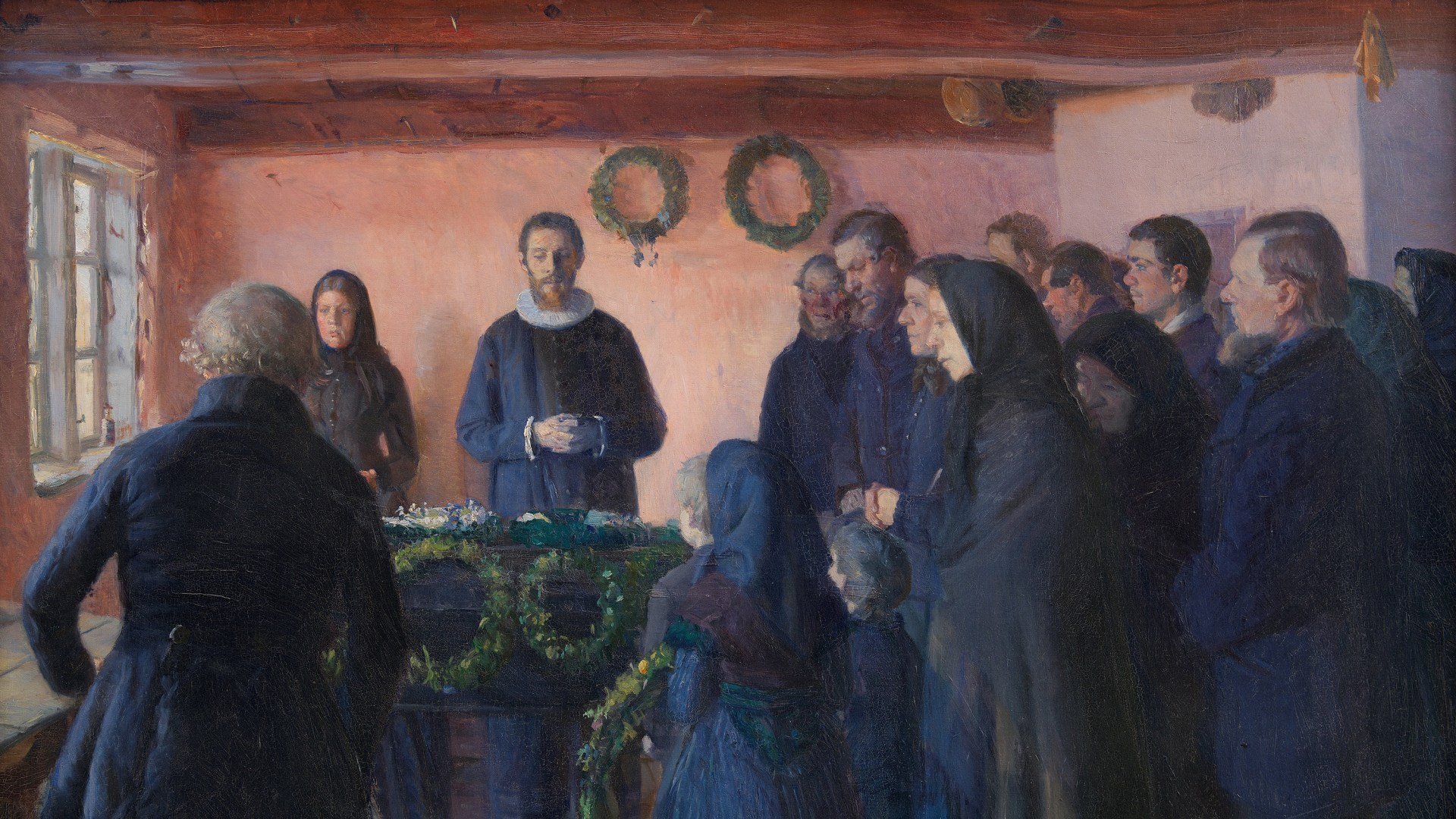
I’m troubled by a trend I’ve seen with funerals.
For the last decade, I’ve been the preaching minister at a rural congregation in the Bible Belt South. My outpost is nowhere near Nineveh. In fact, if anywhere enjoys protection by the ghosts of Christendom past, it’s here. A lot of conservatism lives in my backyard—conservatism of every kind, but especially theological conservatism. The impulse is strong to protect the deposit of faith from our forebears and guard against worldly powers that would undermine our beliefs. If the Christian funeral is going right anywhere, it ought to be going right here.
But I’m not confident it is. For instance, a few months ago I preached at the funeral of a great Christian man from our church, one who had lived a long and prosperous life as Psalm 91:16 envisions: “With long life I will satisfy him and show him my salvation.”
The problem when someone lives so long, however, is that the funeral is not usually well-attended. He had outlived most of his congregational contemporaries, so it was a small gathering primarily comprising extended family members I did not know. Still, these were Christian folks. After the service began and it was my turn to speak, I started, as I like to do, with some remarks of sympathy for the family and a few anecdotes about the deceased, qualities I’d admired, that sort of thing.
Then, somewhere in the middle of the eulogy, I made the turn to the gospel, the only hope we Christians have and the sole hope of this man now slumbering in the Lord. But a strange feeling came over me, and as I spoke I was alarmed by the body language of my listeners (always distressing for public speakers). It seemed I had mostly lost them.

Some were fidgeting again with their programs. (Now what was the next item on the agenda? Oh, right, the closing prayer.) Some were checking the time. Their lack of interest after ten minutes seemed to interrogate me: What are you talking about? And are you almost finished? We just wanted a nice service, not a sermon.
What I felt in that moment I intuit elsewhere and in other ways. More folks are opting for whichever form of funeral can call the least amount of attention to death. Even the word itself—funeral—is out of style, and I hear ever more of memorials, celebrations of life, private gatherings. We would not like a preacher, people say. Someone from the family will say a few words instead.
When I am asked to speak, I sometimes hear similar messages in the tone and subtext of the family’s desires for the service: Don’t go too long. Accentuate the positive. Our loved one wouldn’t want us to be morose.
It leaves me wondering if that’s really what the deceased wanted. How can Christians come to the end of their lives and, on death’s doorstep, abandon the gospel? A funeral strikes me as exactly the wrong time to drop this theme.
Of course, I understand it when nonbelievers want to avoid talk of death. These choices make sense from unchurched families. But I’m talking about the funerals of women and men who, from every indication of their lives, were on the right side of this story. These were churchgoing, Bible-reading, Christian-radio-listening folks, people who heard 70 or 80 Easter sermons about Christ as the resurrection and the life, the victor over death itself (1 Cor. 15:20–32).


How can such Christians come to the end of their lives—lives of taking up crosses, following the Crucified One, dying daily, knowing that Christ alone conquered death—only to ask for a low-key funeral with no clear presentation of the gospel? And how can Christian families be content with a service more likely to share hobbies than the truth itself? What does this say about the faith of those in our pews or the direction things are heading for American Christianity?
I’ve come to think that parishioners’ desires for basically secular funeral services with a Christian veneer reveal that our theology is not sufficiently robust. Their attitude calls into question whether I am proclaiming the gospel often enough, clearly enough, or winsomely enough. Parishioners’ desires for tepid preaching at Christian funerals portends the failing of our hope.
To be sure, funerals accomplish many things. They are mostly for the family, for the living, I hear often. I wonder if this is true. Either way, celebrating or remembering life is a good work. Still, Christians are supposed to be all in on the Resurrection.
Few moments in life warrant as clear and confident an articulation of the gospel than a funeral. That doesn’t mean overdone, opportunistic sermons that capitalize on a captive and grieving audience to win souls. In my experience, funerals that seek to convert the living most often only irritate them. What I am prescribing is a eulogy that simply and clearly articulates, clings to, and celebrates the Christian hope.
Congregants may have little appetite for a witness that takes death seriously while proclaiming escape in Christ’s empty tomb. Such loss of appetite for the gospel (especially in the wake of death) is troubling, but it is also a firm reminder of the important work ministers do. We are not the first to say the words “Now I would remind you, brothers, of the gospel” (1 Cor 15:1, ESV). In every age, this will be our fundamental task, for our people (saved and sanctified though they are) are prone to forget it.
Matthew D. Love teaches preaching and ministry at Harding School of Theology.