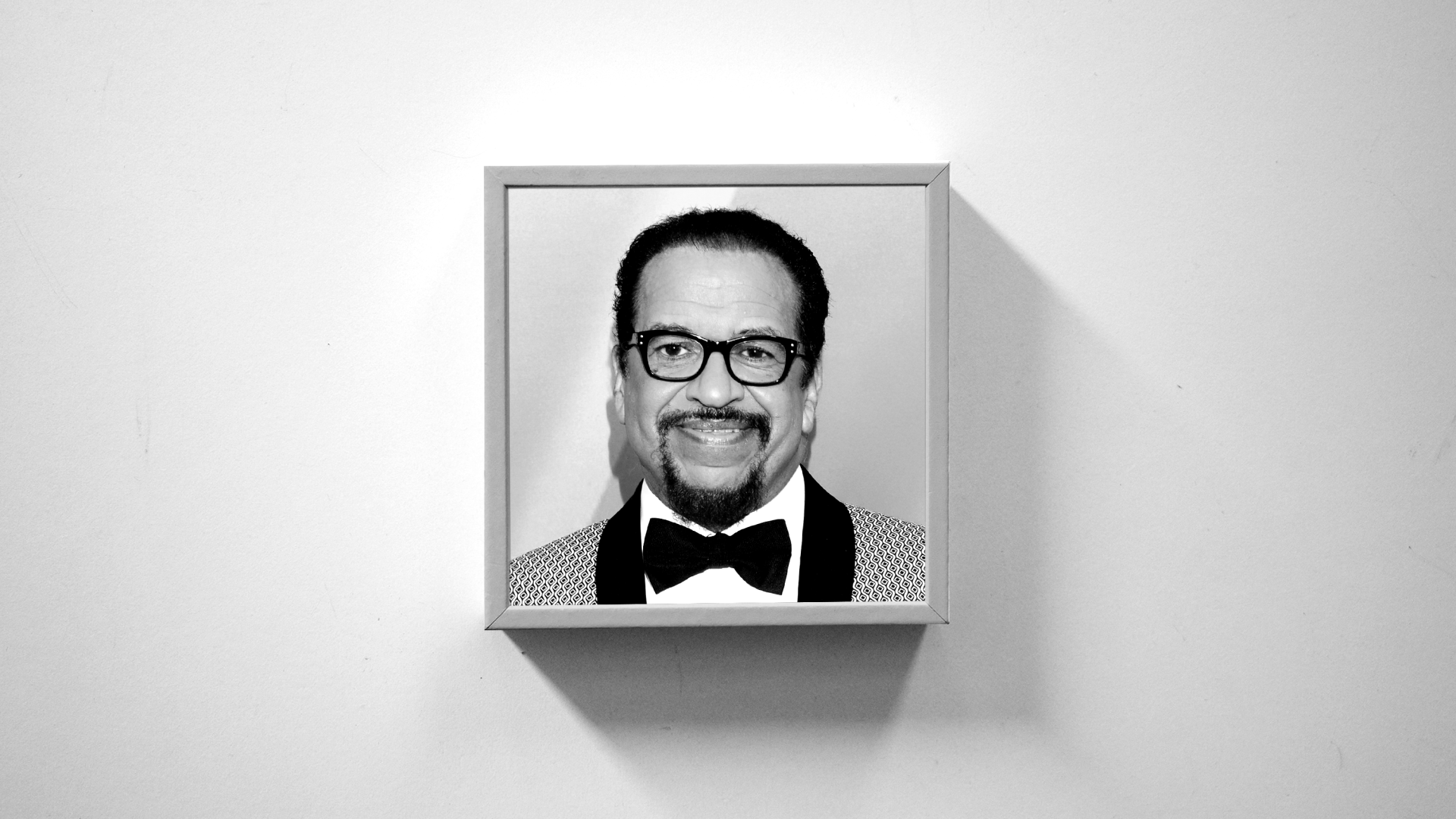
In April 1996, Richard Smallwood and his choir, Vision, released Adoration: Live in Atlanta. The groundbreaking gospel album featured the anthem “Total Praise,” which Smallwood would later refer to as “the song that changed everything.” Later that year, Whitney Houston performed Smallwood’s “I Love the Lord” in the blockbuster film The Preacher’s Wife.
By that time, though, Smallwood had already established himself as one of the most influential composers and performers in gospel music. He had been a major figure in the niche for decades, and he was committed to reaching new generations with his music and his message by embracing change.
“My desire is to stay current. I never want to become dated,” Smallwood said in a 2001 interview. “Music of today still inspires me.”
Over the course of his career, Smallwood earned eight Grammy nominations, three Dove Awards, and seven Stellar Awards. He was a member of The Celestials, the first gospel group at Howard University and the first to perform at the Montreux Jazz Festival in Switzerland. In 1989, the Richard Smallwood Singers became the first black gospel group to tour the Soviet Union. In 2023, President Joe Biden awarded Smallwood the President’s Lifetime Achievement Award.
Smallwood’s compositional style is marked by rich four-part harmony, intricate orchestration, and irresistible melodies. He helped bring Black gospel music into the halls of Eurocentric university music departments during the 1960s and ’70s, and his works remain widely sung in both congregational and concert settings.
Smallwood died at the age of 77 from complications of kidney failure on Tuesday, December 30, 2025.
As a student at Howard University—a historically black university in Washington, DC—Smallwood participated in student protests and sit-ins that led to the inclusion of gospel music in the university’s course offerings. In 1968, Smallwood accompanied student protesters on the piano, playing “from sun up to sun down,” he wrote in his autobiography.
Smallwood remained a tireless advocate for the gospel music tradition throughout his life, seeking to honor its history and its innovators and keeping it grounded in what he saw as its most important component: the message.
“The message is the most important thing,” Smallwood said. “I don’t have a problem with the trappings or musical package as long as the message isn’t diluted.”
Braxton Shelley, the George Washington Williams Professor of Divinity and Music at Yale University, said that one of the through lines in Smallwood’s vast catalog is the commitment to the singing of Scripture.
“There’s an anthemic character to Smallwood’s catalog because of how focused he is on setting Scripture in song,” Shelley told CT.
In his book Healing for the Soul: Richard Smallwood, the Vamp, and the Gospel Imagination, Shelley describes Smallwood’s “omnivorous sonic palate,” shaped by classical music, Broadway tunes, and jazz. He says Smallwood spoke often of his affinity for Bach and his early introduction to Rachmaninoff’s Piano Concerto No. 1.
“Smallwood’s signature synthesis of the Black gospel tradition and a host of musical influences, especially classical traditions, made his pen one of the most distinct in musical history,” Shelley told CT.
Richard Smallwood was born in 1948 in Atlanta. In his 2019 autobiography, he described his early introductions to an eclectic array of music as well as his difficult home life. He recalled being beaten by his stepfather, an itinerant pastor who eventually settled in Washington, DC, and founded the Union Temple Baptist Church.
Music was an outlet and a fascination. Smallwood formed his first gospel group as an 11-year-old, gathering neighborhood kids to sing together. One of his early mentors was his eighth-grade music teacher, Grammy Award–winning musician Roberta Flack.
Smallwood graduated cum laude from Howard in 1971 with degrees in piano and vocal performance. He then served as musical director of Union Temple’s young adult choir, with which he recorded two studio albums.
In 1977, he formed the Richard Smallwood Singers. Their 1982 debut album, The Richard Smallwood Singers, had an 87-week run on the Billboard gospel chart. The group’s next two albums, Psalms and Textures,were both nominated for Grammy Awards. Smallwood won his first Grammy for his arrangement and production of the song “Rejoice Greatly, O Daughter of Zion” on the 1992 album Handel’s Messiah: A Soulful Celebration.
In 1985, Smallwood served as musical director and composer for the Broadway musical Sing, Mahalia, Sing!,based on the life and music of Mahalia Jackson. The musical featured Jennifer Holliday, who had previously won a Tony Award for her performance as Effie in Dreamgirls. Smallwood wrote all of the vocal arrangements and several original pieces for the musical.
Smallwood’s ability to arrange for both the church choir and the concert hall gave him a singular voice in gospel. Sarah Benibo, a worship leader and former member of the Stellar Award–nominated gospel trio God’s Chosen, told CT that while many remember Smallwood for his elevated orchestrations and colorful harmonies and textures, he had a way of nurturing singers and honoring the human voice.
“Richard Smallwood both challenged and comforted singers,” Benibo said. “Somehow, he was able to call us higher. He writes so that the voices themselves testify.”
Benibo credits Smallwood with making contemporary gospel music more accessible for male voices, noting that her gospel ensembles almost exclusively sang three-part harmony before Smallwood’s music began to circulate. Smallwood’s arrangements often divide the lowest vocal line into a high tenor part and a lower baritone.
“Suddenly, there was a split in the tenor part. That was a game-changer,” Benibo said. “Most gospel music was out of range for most men. It was all written for high-singing tenors. But most men are baritones.”
Shelley also added that, despite the oft-noted intricacy of Smallwood’s compositions, he was committed to accessibility and singability.
“The key to Richard’s accessibility is his recognition of the power of melody,” Shelley said. “Yes, there’s a ton of complexity in terms of harmony and counterpoint and accompaniment, but when you look at the melodies he writes, they’re extremely singable.”
Shelley compared Smallwood’s gift for adapting memorable melodies to that of J. S. Bach, who set simple chorale tunes in fugues and elaborate counterpoint. Smallwood’s melodies, Shelley said, could “wreck a church” even if sung completely in unison. “Richard writes in a way that is reflective of some of the best hymn writing across the centuries. He grounds his song in portable, accessible, memorable melodies. Not cheap melodies.”
Grammy-winning gospel artist Yolanda Adams wrote in a recent post on social media, “[Smallwood’s] music was faith incarnate—a divine gift that brought heaven to earth and transformed worship around the world.” Smallwood collaborated with Adams on the song “That Name” in 1999.
In a video tribute, multi-award-winning gospel artist Fred Hammond recalled Smallwood’s kindness and generosity early in his career, before Hammond gained widespread recognition in the industry. “There’s nobody like Richard,” Hammond said. “He was truly the maestro. … I don’t do everybody’s songs, but I do a lot of Richard’s.”
Smallwood was as committed to ministry as he was to his recording and performance career. In 2004, he was ordained as a minister at Metropolitan Baptist Church in Washington, DC. He was also open about the ways hardship and personal struggles shaped his creative output. He wrote “Total Praise,” one of his best-known songs, as he was caring for his mother, who had dementia and was experiencing declining health. Later in his career, he spoke openly about his own struggles with depression and suicidal ideation.
Shelley described “Total Praise” as “a window into what Smallwood does,” taking the singer or listener on a journey that encompasses both dissonance and resolution. The song uses the text of Psalm 121, beginning, “Lord, I will lift my eyes to the hills knowing my help is coming from you.”
“People latch onto that song because we all need help,” Shelley said. “We all need to know where our help is coming from. We all have storms. We all need to find peace in them.”
Smallwood remained dedicated to sharing that message throughout his career. His songs reached millions and were covered by artists like Destiny’s Child and Boyz II Men, but he insisted that everything but the Good News was secondary.
“This is not about making money,” he said in 2015. “It’s about winning souls and encouraging people through Christ. He takes care of it all.”