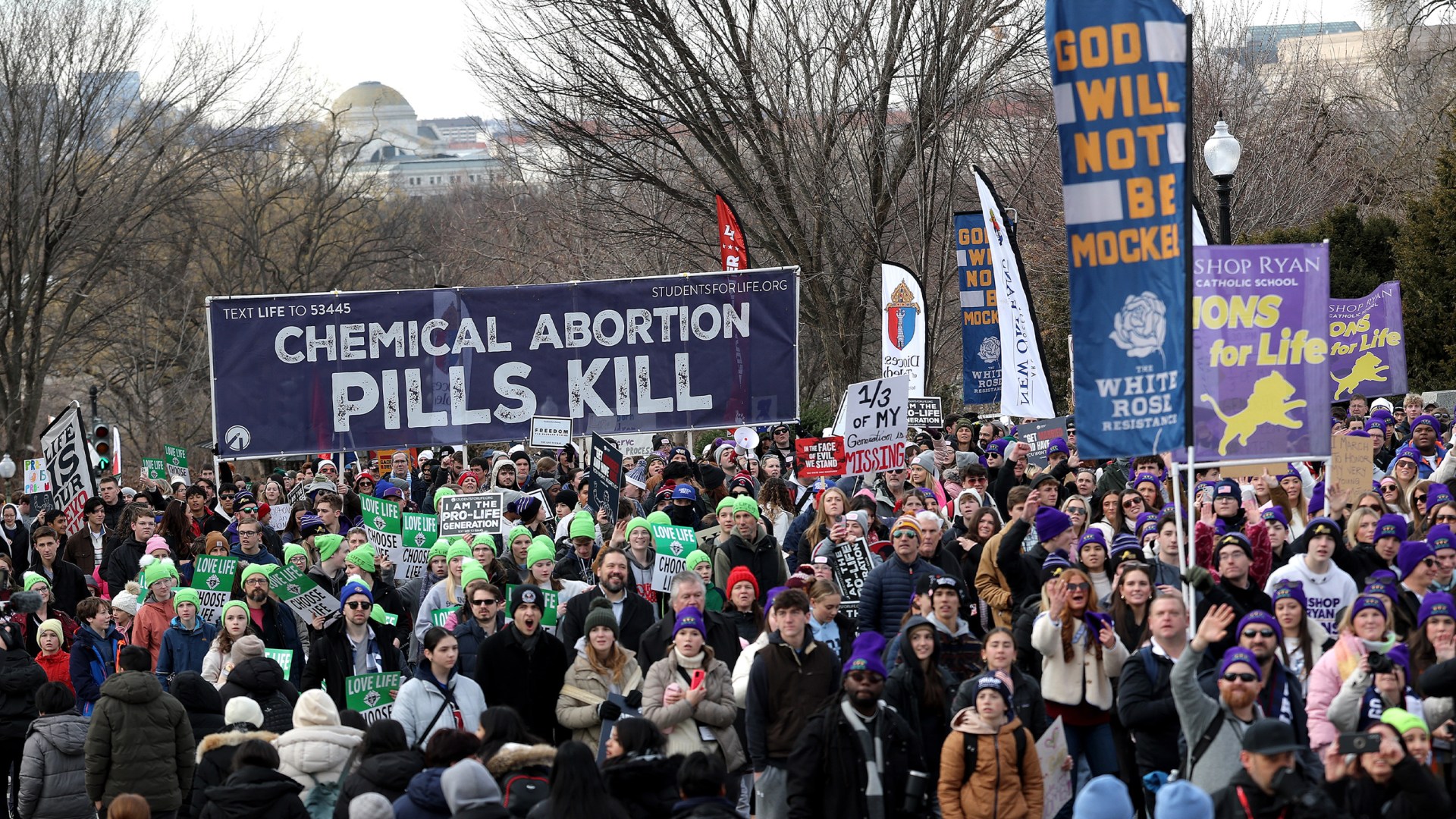
At the March for Life event Friday in Washington, DC, the largest annual gathering of pro-lifers, it may have seemed that all was well in the pro-life movement.
Despite the brisk January weather and the threat of a polar storm barreling toward the region, tens of thousands gathered from all over the country in the crowded streets of Washington for a march that dates back over half a century.
Families pushed strollers, clergy mingled with students who were wearing matching school colors, and young adults touting homemade and printed signs offered extras to passers-by.
But despite visibly high energy in the crowd, some pro-life leaders and marchers expressed consternation over what they deemed as tepid actions toward their cause from the Trump administration over the last year.
Gavin Oxley, spokesperson for Americans United for Life, said pro-lifers came to the march “discouraged by the lack of a strong pro-life commitment by the Trump administration, specifically on Hyde Amendment provisions in the health care package … and then also the issue of the abortion pill.”
When Vice President JD Vance took the stage for a speech, a cry from an unsatisfied protester brought those tensions into the open: “Ban the abortion drug!”

That’s a reference to what has been a sore spot between the pro-life movement and the Trump administration’s second lap in office: The administration has continued a Biden-era relaxation of restrictions to the abortion pill. (Currently, federal law allows abortion pills to be administered at home, outside of medical supervision.) The Trump administration also approved a generic version of the abortion drug. Officials stated that the Food and Drug Administration (FDA) is required by law to approve the generic version.
Vance initially ignored the shouted comment, seeking instead to assuage pro-lifers of the administration’s commitment to their cause during his headline speech at the march. He pointed to efforts to curb taxpayer-funded abortions overseas through an expansion of the Mexico City policy, to create investment accounts to provide $1,000 for newborns to American families, and to expand the Child Tax Credit.
Eventually, though, the vice president seemed to heed the cries and said he would address “the elephant in the room.”
There’s a “fear” that “our politics have failed to answer the clarion call to life,” he began.
“I want you to know that I hear you,” Vance said. “There will inevitably be debates within this movement … about how best to use our political system to advance life, how prudential we must be in the cause of advancing human life. I think these are good, honest and natural debates, and frankly … they help keep people like me honest, and that’s an important thing.”
“But I think all of us also have to remember that we are commanded to ‘let not our hearts be troubled,’” he added in a paraphrase of Jesus’ words in John 14:1, before telling the crowd that the overturn of Roe had taken 50 years and continued progress might also take time.
Ahead of the march, Vance told the Washington Examiner that pro-lifers need to be “realistic” about what could be achieved federally.
“Most of what’s going to happen over the next generation of the pro-life movement is we’re going to have to win victories at the state level,” Vance said. “I think we can do that. I think we should organize and mobilize for that. But I think we have to be realistic with ourselves that, right now, the American people are not endorsing a lot of pro-life policy.”
Some pro-life voices expressed disappointment with his stance.
“Chemical abortion is not a matter for “prudential” discussion among pro-lifers,” Alexandra DeSanctis Marr, a contributing writer at National Review, posted on X in response to Vance’s speech.
“The vice president doesn’t have to oppose chemical abortion—in fact, he’s been quite clear that he supports it, as does his administration. But pro-lifers should not allow him to position himself as pro-life while taking his current stance,” she added. DeSanctis Marr authored an article ahead of the march criticizing the decision to platform Vance there.

“The Trump administration has the ability to end this today,” Kelsey Pritchard with Susan B. Anthony Pro-Life America (SBA) said, referring to the availability of abortion pills.
Marjorie Dannenfelser, president of SBA, said that abortions have increased by 30 percent since 2016.
“We have the opportunity to save lives and serve women. But it is because of the inaction of the Trump-Vance administration on abortion drugs that this opportunity isn’t being realized—and abortions are going up, not down.”
In 2024, the Guttmacher Institute, a pro-choice organization that tracks reproductive rights, estimated in 2023 that around 642,700 abortions, or over 63 percent of all abortions in the United States, were medication abortions. Since the overturn in 2022 of Roe v. Wade, which granted a national right to abortion, and though some states have tightened restrictions around the procedure, the number of abortions has risen.
Pro-life leaders point to the wide availability of abortion pills that can be prescribed online or through telehealth consultations. The abortion pill also has ways of crossing state lines, even to states that ban abortion. Some 14 states ban abortion pills, but other states have passed “shield laws” to protect prescribers from legal action, even if their patients are from states with restrictions. Reporters have found underground networks where women can obtain the abortion pill.
Some pro-lifers believe that the percentage of chemical abortions is even higher now: “Closer to 70 percent,” estimated David Bereit, executive director of the Life Leadership Conference and founder of 40 Days for Life.
Leaders in the movement interpret these numbers as lack of action on the part of the Trump administration, failing to address what they see as the new primary crisis on the issue of life.
“In this post-Roe landscape, the pro-life movement has actually been losing more than winning for the last few years on many fronts,” Bereit said.
While pro-lifers are thankful for the actions that occurred during the first Trump administration, Bereit said that, “in admin two, it has felt more like, ‘Hey, we just want to brush this issue off.’”
“I feel that President Trump and the administration are focused in other areas and feel that, ‘Hey, we gave the pro-life movement what we thought they wanted, so now we’re going to move on to other things.’”
Bereit views this as a mistake: “There’s still leadership needed on this … our fight is not over, it’s simply changed.”
On Thursday, White House officials briefed several pro-life leaders on new pro-life policies. They announced that the National Institutes of Health would no longer federally fund research that relies on fetal tissue from abortions; the Small Business Administration would review whether Planned Parenthood illegally received millions in COVID-19 pandemic–era loans; and that they would expand the Mexico City policy, which requires foreign nongovernmental organizations that receive US federal funding to refrain from performing or promoting abortion.
Conspicuously absent was any reference to the primary topic animating pro-life leaders, leaving some attendees unsatisfied. And vocally so.
“The Trump-Vance Administration has not reversed Joe Biden’s Covid policy allowing for the mail-order of the drugs,” Dannenfelser said in a statement Thursday. “This is making state pro-life laws completely unenforceable—undermining Trump’s ‘back to the states’ position.”

Bloomberg reported last month that the FDA has delayed reviewing data around the safety of mifepristone, which is used alongside another drug called misoprostol to induce a chemical abortion, after commissioner Marty Makary requested waiting until after the midterm elections.
Makary and Health and Human Services secretary Robert F. Kennedy Jr. have said they are actively working on a review of the abortion drug. A spokesperson denied to Bloomberg the idea that the FDA is “slow walking this review for political purposes.”
Lawmakers’ requests for more information have not so far resulted in concrete updates.
“From a pro-life Democrat perspective, it’s really, really, tremendously frustrating,” Kristen Day, president of Democrats for Life, told CT. “The pro-life movement has put all their apples in the cart with the Republican Party life … and now we see the leader of the Republican Party wavering.”
Day expressed particular concern over a comment Trump made earlier this month during comments on healthcare negotiations: “You have to be a little flexible on Hyde,” Trump said. The Hyde Amendment prevents taxpayer dollars from directly funding abortion.
Press secretary Karoline Leavitt later walked back the president’s remarks, saying he hadn’t changed his position on Hyde.
House speaker Mike Johnson told reporters in the aftermath that “we are not going to change the standard that we’re not going to use taxpayer funding for abortion. … I’m just not going to allow that to happen.”

Johnson also spoke to the march Friday, flanked by a crowd of lawmakers, including one Florida representative cradling her baby (and occasionally allowing a colleague to hold her). Johnson highlighted recent bills passed by the House to greenlight federal assistance going to pregnancy resource centers and require colleges and universities to counsel students of their rights to accommodations if they become pregnant.
Some pro-life leaders preached patience when working with Washington.
“This is the best administration I’ve ever worked with on the issue of life,” Penny Nance, president of Concerned Women for America, said. “[Trump] doesn’t always get it right, but he tries very hard.”
“There’s times I don’t love things that he says, but I just know the reality of working directly with him,” she said.
“I am so thankful that we have a president and we have a vice president who stood for life in their actions,” Cissie Graham Lynch, who works with Samaritan’s Purse and the Billy Graham Evangelistic Association and gave the closing prayer at the march, told CT. “Always look at the actions … that’s where we need to hold them accountable.”
“We have a long road ahead,” Lynch added. “It took us 50 years to overturn Roe v. Wade; it could take us another 50 years to change the heart of a nation to think of [abortion] as unimaginable.”
Lauren McAfee, president of Stand for Life, said the current challenges are an opportunity for Christians to get involved in pro-life advocacy, regardless of what happens politically. (McAfee is a member of CT’s Board of Directors.)
“There’s always challenges in the landscape around the life issue that have only gotten more complex,” McAfee said. “Pro-life leaders have a lot to navigate.”
Her group supports pro-life organizations. It also works with churches to help pastors, lay leaders, and congregants better understand and get involved in pro-life work.
“From my over a decade of experience walking alongside pro-life leaders in the movement, I have seen [their] resilience,” she said. “They’re always going to continue caring, continue showing up, and continue advocating.”
When March for Life Education and Defense Fund president Jennie Bradley Lichter took the stage Friday, she celebrated the administration’s Thursday announcements. Left unsaid were any of the concerns animating other pro-life leaders.
Near the close of the rally, she asked everyone in the crowd to pull out their phones and tell elected officials to support the Hyde Amendment. The moment was a reminder that, even with assumed allies controlling Washington, long-held wins could not be taken for granted.
“Together, we will send a powerful message to your senators,” Lichter said, “that we want them to stand firm and be courageous for life.”