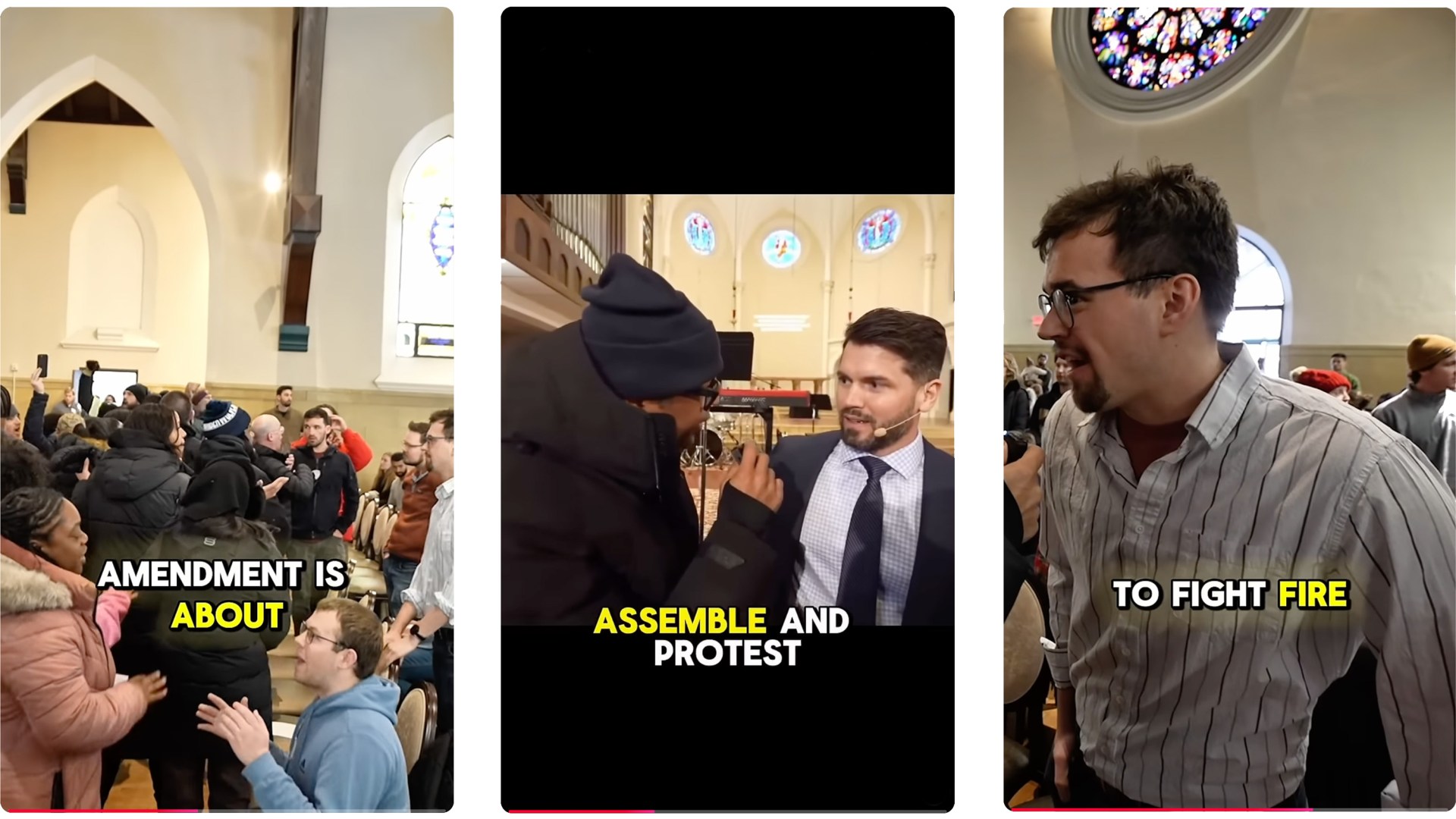
This past Sunday in Minnesota, a group of protesters barged into a Southern Baptist church in Saint Paul during the worship service. Chanting “justice for Renee Good” and “hands up, don’t shoot,” they spread out in the aisles and refused to leave.
Alerted ahead of time by the organizers, former CNN host Don Lemon showed up too. Though he said on camera that he wasn’t there as an activist, Lemon described the disruption in a transparently approving tone, endorsed a “traumatic” experience for kids at church as “what protesting is about,” and later accused the targeted congregation of an “entitlement [that] comes from a supremacy, a white supremacy.”
Amid the demonstration, Lemon inanely insisted to the preaching pastor at Cities Church, Jonathan Parnell, that the whole thing was merely an exercise in free speech that the congregation should tolerate—or even welcome—in their sanctuary during their worship.
This is bunk. Protesters should not disrupt worship services, and anyone with the scantest constitutional knowledge knows that what these demonstrators did is not the free speech our First Amendment protects from suppression by the state.
Demonstrators should stay out of church services for many reasons. One is a matter of federal law, which explicitly prohibits attempts to “interfere with any person lawfully exercising or seeking to exercise the First Amendment right of religious freedom at a place of religious worship.” They should also stay out because of property rights. For though a church is generally open to all comers, it is still private property with all the privileges that entails, including the right to exclude unwanted speech and assembly.
But most of all, protestors should stay out because disrupting worship is wrong, regardless of the demonstrators’ cause or the worshipers’ religion. It is wrong because it is a disordered assertion that your politics matter more than their devotion to God.
It is wrong because it is an announcement that no inch of space, no moment of time, no seriousness of purpose may be exempt from our volatile national discord—that there is no such thing as sanctuary.
It is wrong because it is not what you would want done to you.

Now, I don’t say this because I’m opposed to these protestors’ cause. I’m not confident in my interpretation of the videos of Good’s death, but I lean toward believing the shooting is unjustified. I hope she does get whatever insufficient, temporal justice we can muster on this side of eternity.
More broadly, I’m long since on-the-record as favoring pretty open immigration laws. This isn’t a view I hold lightly or ignorantly. I understand why so many are reflexively bothered or angered by scenes of chaos at the border. I don’t want chaos either, and I easily agree with the 8 in 10 Americans who want to deport people who are here illegally and have been convicted of violent crimes. I also understand how rapid, high-volume immigration strains red-state border communities flooded by migrants on account of their location—and deep blue cities flooded by migrants on account of their foolishly expansive welfare guarantees.
Even so, my preference is something far more akin to the relative simplicity of the Ellis Island system than anything we’ve seen in my lifetime, with particular welcome for people oppressed by Communist and other totalitarian regimes. Much of what ICE (Immigration and Customs Enforcement) is doing in Minnesota strikes me as inefficient, theatrical, harsh, and deliberately disruptive.
Moreover, the Twin Cities were my home for eight years, the bulk of my adult life, and I’m sad to see them in turmoil once again. I just watched a video on Reddit that appears to show door-to-door raids in my old neighborhood. I’ve run past those very doors time and again. I’ve walked our dogs and strolled our babies there. It’s not right.
This is an immigrant-heavy neighborhood, but the immigrants, many of whom arrived as refugees after helping the US in the Vietnam War, are not a problem. On the contrary, their arrival helped transform that neighborhood from a notorious stretch of porn theaters and prostitution to one of the best concentrations of Southeast Asian restaurants in America. It’s certainly not perfect—we lived near a crime-ridden nuisance bar, and one time I watched a man flee the cops through my next-door neighbor’s yard, handgun still in hand. But immigrant families weren’t the people patronizing that bar, and that man was an American.
The immigrants on my block were quiet. A multigenerational Hmong family grew vegetables in their flower beds and had family cookouts with a 20-gallon soup pot in their garage. They were good neighbors. Is someone pounding on their door without a warrant, shouting for their papers? And if they’re churchgoing—as they may well be, for there are many Hmong congregations in Saint Paul—will ICE barge into their services, as the Trump administration has expressly allowed? It is a deeply American instinct that drives me to say: Leave them alone.

After each fresh outrage, many well-meaning people develop a common tick. X is wrong, of course, they say, and I’d never endorse it. But when you consider how bad Y is, well …
I want to be very clear that I do not suffer from that tick. The conjunction I am using here is not but. It’s and: Demonstrators should not disrupt worship services. And immigration enforcement should be competent, cool-headed, and constrained by the Constitution.
One of Lemon’s interviewees, a congregant at Cities Church, got it exactly right.
“I don’t necessarily agree with everything that’s going on in the Twin Cities right now,” he said. “But I don’t think it’s good to fight fire with fire. I think it’s good to speak up. I think it’s good to protest, but I think it’s better to do it in a peaceful way. [This] is trespassing. … This is a house of God.” Next week, may he and his church worship in peace.
Bonnie Kristian is deputy editor at Christianity Today.