In February 2009, 22-year-old Kenneth Echiche and a friend were picking cashew fruit from a tree near their small village of Ukwortung in Cross River State, Nigeria. As his friend used a stick to shake the yellow fruit from the tree, one slipped through Echiche’s outstretched hands. He’s still not sure how it happened, but he remembers the caustic juice squirted into his eye, causing a burning sensation.
“I did nothing about it because I felt it was something minor,” Echiche said.Three months later, his vision blurred. Unable to afford a hospital visit, his parents tried herbal remedies such as ointment from goat weed leaves and bitter kola: “They were squeezing all manner of herbs in my eyes.”
Doctors later told him the herbal cures had contributed to his blindness. Echiche blamed “ignorance and poverty” for his lost eyesight. Many Nigerians won’t seek help for vision loss until it has advanced too far for repair.
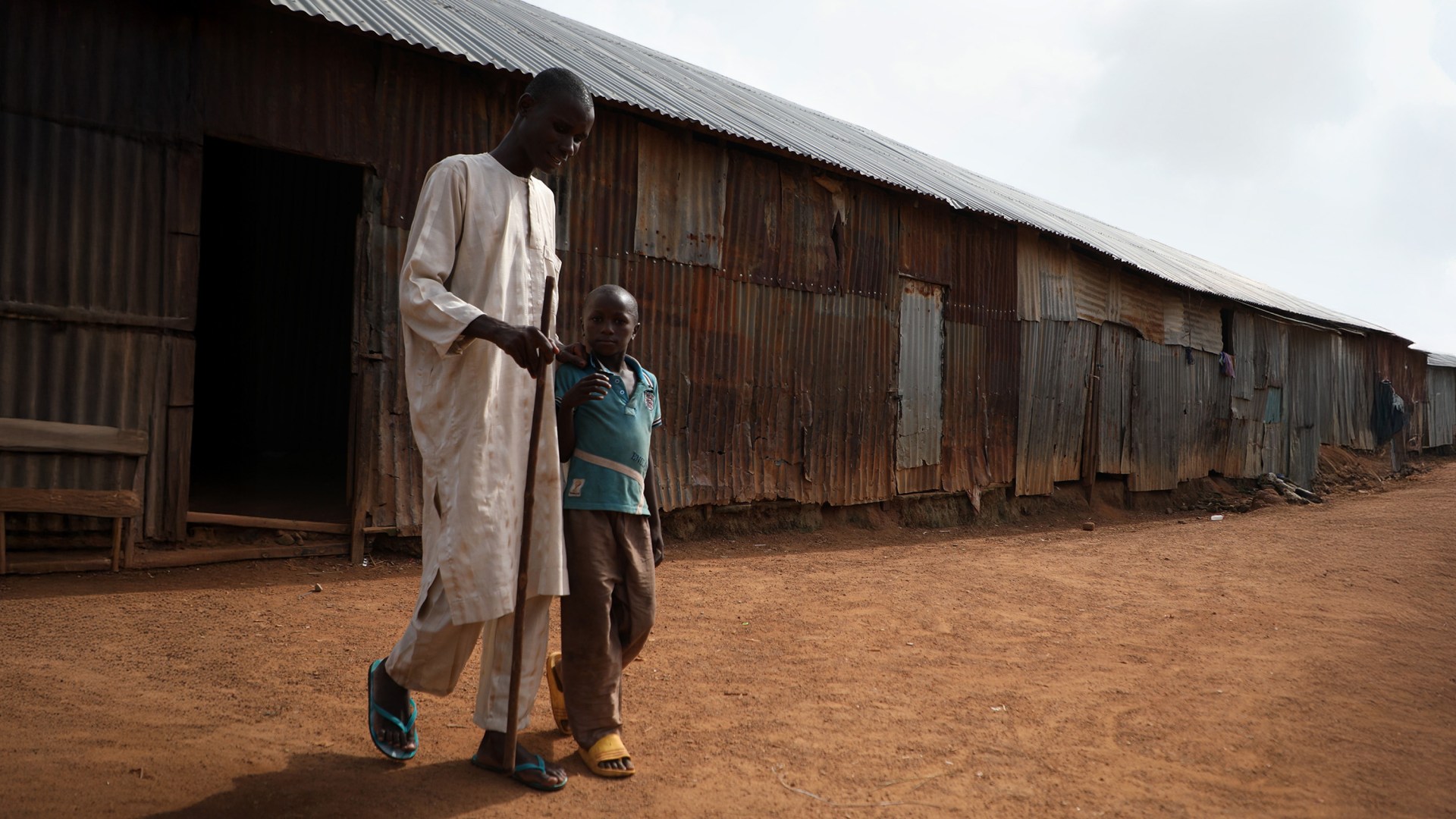
After Echiche’s vision disappeared, his education did too. His public high school didn’t have Braille materials or teachers trained to help visually impaired students. Echiche was already trying to finish his last year of high school, which had been delayed four years due to switching schools and repeating classes several times after his parents’ divorce. Now his blindness made graduation seem impossible. He couldn’t even walk around by himself, let alone complete his homework.
“My world literally went dark,” Echiche said, adding he felt God had abandoned him.
Though Nigeria’s 2019 Discrimination Against Persons with Disabilities (Prohibition) Act entitles every person with a disability to free education through high school—including special education support in public schools—the World Health Organization reports that poor enforcement leaves many students without resources and unable to obtain high school diplomas.
Nigeria has just under 1,200 special needs schools, both public and private, to serve a reported 5 million children, according to the Joint National Association of Persons with Disabilities. Though people with disabilities make up at least 12 percent of Nigeria’s population, they made up less than 1 percent of most universities’ students in 2019. The United Nations estimates 15 percent of each country’s population may have special needs, and 25 percent of any community is affected by them.
Church-run schools and ministries are seeking to bridge the gap and dispel cultural superstitions associated with disabilities. Groups like Evangel Ability Motivation Institute (EVAMI) and Uplifting Our Children Through Support are helping children with disabilities to know their innate worth in God and to find purpose in their lives.
EVAMI’s director, Georgian Ugah, said these schools provide a “ministry of care where the students are given orientation that will help shape their life and strengthen their belief in God.”
Amaka Ude, the mother of an autistic child spent 40,000–60,000 naira (about $28–42 USD) per month on private teachers when she couldn’t find a school with a strong special education program. Because her husband is the director of a federal agency, they could afford it. Yet those living on minimum wage (about $49 USD per month) or an average wage (about $56–84 USD per month) can’t.
Cultural stigmas also hinder education. Some families hide children with disabilities from their communities, fearing neighbors will see them as a symbol of shame. Other children face bullying in school, discouraging them from learning. Echiche said people treated him badly after he lost his sight. When he sat in public places, even in church, people would change seats to move away from him.
“People did not want to share seats with the physically challenged,” he said. Some Nigerians fear blindness could be contagious.
EVAMI is a special education center owned by Assemblies of God Nigeria in Enugu State. Director Georgian Ugah told CT she works to counter common beliefs that God rejects people with disabilities or that disability is punishment from village gods. Ugah starts by teaching children that God doesn’t hate them.
EVAMI helps children work within their abilities by providing tuition-free early childhood education, middle school classes, and job training, she said. Students only pay for books and uniforms. Children who cannot thrive in an academic setting after an initial evaluation focus on training in vocational skills such as tailoring, hairdressing, and shoemaking.
One of EVAMI’s graduates, Paul Godspower, said if EVAMI hadn’t offered him an education, his parents couldn’t have sent him to school: “I thought all hope was lost when I lost my sight, because I had to drop out of school for a while.”
Godspower said in the program he learned basic skills such as moving around safely, washing and ironing his own clothes, and developing self-confidence. He now studies law at the University of Nigeria Enugu Campus.
Still, students face setbacks. Parents might not know how to help their children keep up their learning at home during breaks. Impoverished families can’t afford to pay for private Braille lessons, so children lose some language skills during breaks. Ugah said it’s like starting over every time these students return to EVAMI.
Rosyln Yilpet, administrator of the Christian ministry Uplifting Our Children Through Support in Jos, Plateau State, said the greatest need for people with disabilities is acceptance in their communities. Job skills are one way to make that happen. Yilpet’s ministry trains youth with disabilities for the workforce and persuades local employers to take a chance on hiring them. So far, she has trained 14 students. Eleven have taken advanced apprenticeships with employers in their communities and received job offers.
Yilpet said when churches provide disability education, they show that these children are still “a gift from God, created in God’s image” and born with a purpose.
For Echiche, finding purpose took time. Three months after Echiche lost his vision, a Catholic priest named Ferdi Oma from All Saints Catholic Church recommended him as a student to the St. Joseph’s Centre for the Visually Handicapped in Obudu, a five-hour drive from Echiche’s home. Oma drove him to the school to visit in July.
When Echiche first arrived at St. Joseph’s, he said he felt distressed when he met many of the school’s youngest students, ages three to eight, and learned they were also blind. They didn’t understand why he felt upset for them.
“The children were laughing at me for crying and refusing to eat,” Echiche recalled. He struggled to adjust during the visit—he hadn’t left home since losing his sight. Still, Echiche wanted to finish high school, so he joined the school for the fall term.
Echiche learned to walk with a cane to help him avoid obstacles, cook for himself, wash his own clothes, and read and copy notes in Braille. He said learning to “see again” through his hands by reading Braille gave him access to the Bible. During moments of discouragement, he turns to Scripture for comfort.
He earned his high school diploma and eventually a university degree in mass communication. Echiche, now 39, works as a senior cultural officer with the Federal Ministry of Arts, Culture, Tourism and Creative Economy.
Echiche said before he completed his education, people assumed he was a beggar, especially if he visited an office building. Now he shows confidence, and people treat him with more dignity: “I no longer see those crude levels of discrimination because my level of education has lifted me up.”
He said that as his faith has grown, other people’s reactions to his inability to see began to affect him less. Still, he can’t get a hymnal in Braille, and he hopes the government will make disability laws more enforceable and specific to individual disabilities like vision loss: “Accessibility is still a big problem.”