“If I wish to name-drop, I have only to list my ex-friends.”
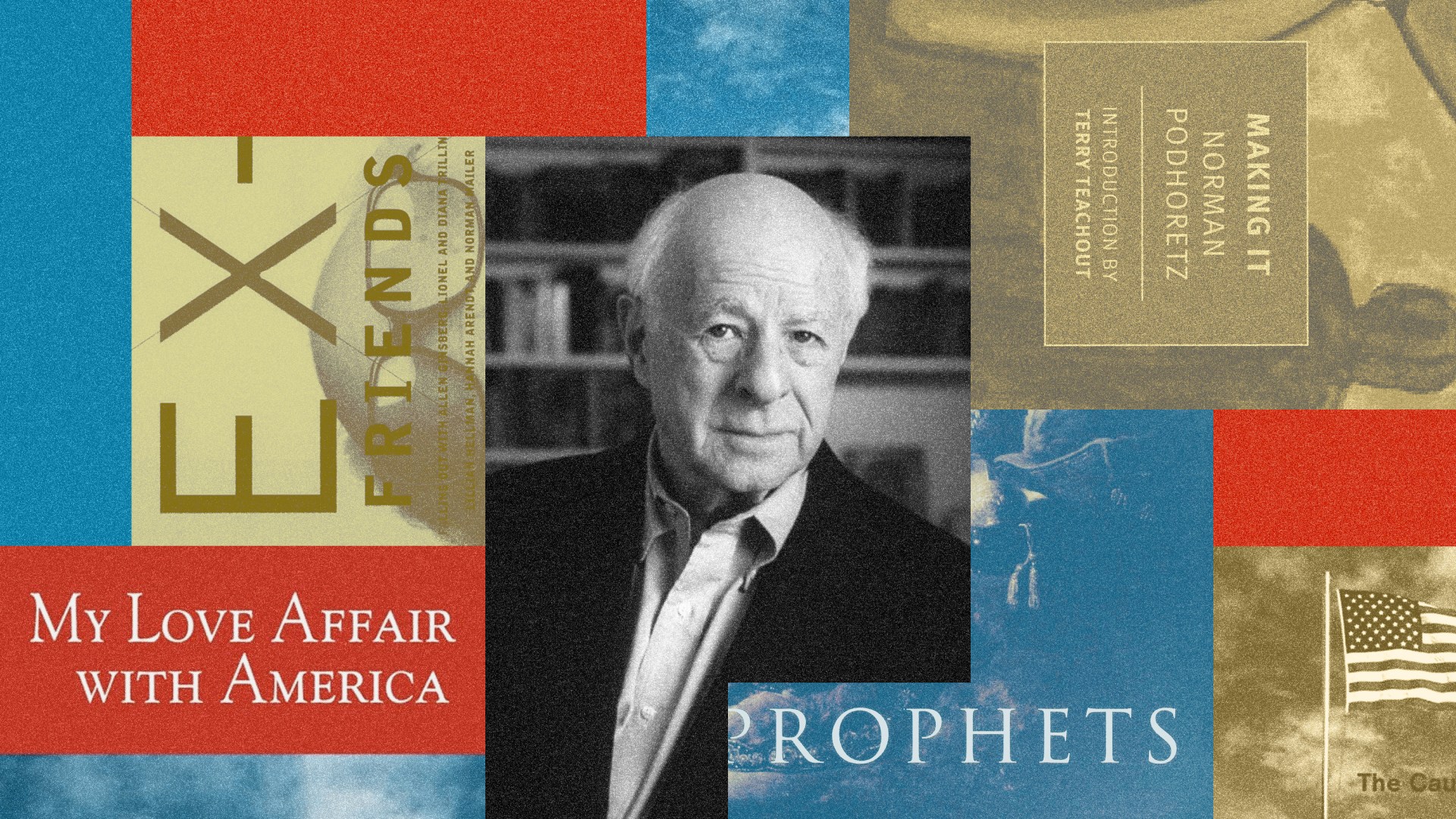
So wrote editor and essayist Norman Podhoretz in the early pages of a 1999 book titled (unsurprisingly) Ex-Friends. Podhoretz, who died last month at age 95, was until his mid-30s part of New York’s left-of-center intellectual community. He broke with it once the “New Left” became more extreme and friendly to Marxism and communism.
Born in Brooklyn in 1930, Podhoretz was the son of Jewish immigrants who came to America from a region that has changed hands between Poland and Ukraine in the century since. In 1956, he married the writer Midge Decter, and they stayed married for 66 years until her death in 2022. Podhoretz helped to raise four children, 13 grandchildren, and 16 great-grandchildren.
In the 1970s, Podhoretz, Irving Kristol, and others became known as neoconservatives, liberals (as Kristol put it) “mugged by reality.” They’d grown up in one intellectual ethos and found its principles lacking as the Cold War and Russia’s totalitarian influence continued.
As the child of immigrants, Podhoretz grew up understanding the reality of pogroms, gulags, and Communist atrocities, so for friends and colleagues to express any kind of sympathy for Marxism was a moral atrocity.
Podhoretz was willing to lose status in those intellectual and social circles to maintain his principles. As editor in chief of Commentary magazine from 1960 to 1995, he made the magazine a leading neoconservative voice.
“Neocons” were not social conservatives but believed America possessed a moral excellence because of its commitment to democracy and human rights and had a duty to extend its influence where it reasonably could. They also resolved to resist the spread of totalitarian influence around the globe.
Podhoretz and Kristol edited and published work from Daniel Patrick Moynihan, Jeane Kirkpatrick, James Q. Wilson, Michael Novak, Charles Krauthammer, and many others. Podhoretz authored many books, including his autobiographical Breaking Ranks and (my personal favorite) My Love Affair with America. Each showed conviction, love of country, literary sensibility, and often caustic wit.
Podhoretz’s death comes as the notion of even having political principles has become tenuous. On the left and right, many politicians and pundits refuse to criticize their own side. The principled and courageous perspective that marked Podhoretz’s life and writing, with a willingness to leave former allies, is rare. The few politicians who do it—like Liz Cheney and Adam Kinzinger, who broke with their party over January 6—often pay a price for being courageous, and lose their seats.
Today, publications like The Dispatch and The Free Press exist because their founders and many of their writers were unwilling to embrace progressive shibboleths or MAGA elements and thus had to leave institutions where they’d once belonged. Last month, Ben Shapiro, founder of The Daily Wire, demonstrated moral courage at a TPUSA event and may pay a price for it.
As a Christian who believes that human beings are made in the image of God, I resonated with Podhoretz’s perspective. We should we care about democracy and human rights around the world because humans are made in God’s image. Why should we battle Marxist and Islamist dictatorships and hope to see human flourishing expand through free markets, entrepreneurism, and innovation? Because people are made in the image of God. For Podhoretz, religion was not central, but his point of view had deep roots in the Judeo-Christian tradition.
Podhoretz also understood the importance of stewardship regarding the Western canon of literature, philosophy, and stories. He was grateful for the gifts our forebearers bequeathed to us, and we should remember how his ideas shaped the understanding of Ronald Reagan, Kirkpatrick, and others who led the global movement to defeat the Soviet Union.
Podhoretz’s body of work reminds us that we don’t need to “make America great again,” because its principles, legal structure, history, and symbols are already great. It’s a treasury to be stewarded, as the Constitution says, to made more perfect rather than deconstructed.
Podhoretz’s legacy of principled stands based on deep moral conviction deserves remembering. As our Jewish friends often say at a moment of loss, may his memory be a blessing to us—a nation in search of its soul—at this fraught moment.
Related