Pastor Justin Anderson drove up the winding road to his new congregation’s church campus, nestled between two steep green hills and moments from the Pacific Ocean. The previous Sunday, he’d preached his first sermon to his new flock. Now it was Tuesday; the church’s school was in session, and its offices were alight with staff members ready to greet the week.
Anderson didn’t know that this first Sunday would be his only Sunday at Calvary Palisades. He didn’t know that on this particular Tuesday, January 7, 2025, the Los Angeles–area Palisades fire would begin to burn.
In that morning’s staff meeting, church employees gathered near a window, looking at smoke in the hills. Fifteen minutes later, they got an evacuation notice. Teachers, administrators, and church staff marched 460 students to a parking lot for parents to pick them up. Eventually, traffic got so bad that the last 150 students walked with staff members along the Pacific Coast Highway (PCH), searching the lines of stopped cars for their families.
Anderson and the head of the church school tried to walk back up the hill to the campus to see what they could do. “We were completely surrounded by fire when we left. We’re coming back thinking, This thing’s gone. We got to Sunset [Boulevard] and PCH, and [officials] turned us away, wouldn’t let us back up the hill.”
Around a dozen places of worship were destroyed by the fires that hit Los Angeles this same time last year. Combined, the fires burned over 37,000 acres, destroyed over 16,200 structures, and claimed 30 lives.
related

As with any natural disaster, volunteers stepped up to help, and churches sprang into action. Firefighters from Mexico, Canada, and other states flew in to douse the blazes. Within days, community members were hosting supply drives in parking lots. (I heard a story about a woman who drove two hours from San Diego to bring her homemade tamales.) My own church made a database to connect people across the city who could open their homes for the displaced.
For a time, a city fragmented by highways and hills became a tight-knit community, offering a glimpse of what the kingdom of God must look like. According to GoFundMe’s 2025 report, Los Angeles was last year’s most generous city. Calvary Palisades alone said it received over $500,000 of support from around the world. Immediate needs like temporary housing, food, and clothing were shared about and met.
But as with any natural disaster, the news cycle moved on. Eventually, volunteers went home and supplies were exhausted. The Palisades and Eaton fires were declared 100 percent contained on January 31.
One year after the fires, church buildings still lay burned, damaged, or leveled, gated off and covered in sawdust. The work of recovery for the communities of Christians impacted by the Palisades and Eaton blazes is far from over. They’ve had to reimagine what worshiping together will look like in the months and years ahead while grieving their lost sacred spaces.
Rev. Dr. Grace Park described pacing the empty parking lot where Pacific Palisades Presbyterian Church (PPPC) used to be as akin to hearing that someone you love has died but not being able to see the body. She didn’t get closure.
related
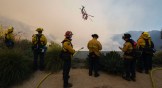

The morning the fire began, the Santa Ana winds were abnormally strong, with gusts reaching up to 100 miles per hour. Park, one of PPPC’s pastors, stayed home on account of the weather. By 10 a.m., her phone was lighting up; church members and staff were evacuating their homes. Park and the church’s senior pastor, Matthew Hardin, traded texts and phone calls as the church school cleared out.
Later that evening, Park saw PPPC on television.
There was an NBC news reporter in our parking lot. (Our parking lot was quite large, and fire trucks were coming in there to park.) It was a live news feed, and the news reporter was saying, “I’m here in the parking lot of the Presbyterian church. I’m here with fire trucks. … There’s an ember. It just alighted on the church’s roof.” We’re watching it live, and I cannot believe it. I thought, She’s there. Fire trucks are there. They’re on it. They’re going to be on it. They’ve got to put this out. And then as the sun set, we just continued to get more photos of the church. It was on fire. We literally were just watching [the reporter] at the church as it burned down.
The first Sunday following the fires’ outbreak posed a challenge for preachers across the city. What message wouldn’t sound cliched or flippant? How do you speak to some church members who lost homes or even loved ones and others who emerged unscathed with a vague sense of survivor’s guilt? And practically speaking: Where do you meet when your regular meeting place is gone?
Palisades Presbyterian immediately received messages from synagogues and other houses of worship offering the church the use of their spaces. Ultimately, they spent that first Sunday at a church in Westwood. After a while, they moved to a church in Culver City. Now, they are meeting in the afternoons at a church in Brentwood.
“It was just like 9/11. … People were pouring in because they needed something to hold onto,” Park said of high attendance in the disaster’s aftermath. “We knew that people were going to come in, and then, after a while … they might leave.” Before the fire, the congregation had 100 people. Now, attendance is closer to 50.
Expressions Church, a young church in Altadena, led a prayer walk for its first post-fire service. Pastor Christopher Spolar had planted the congregation three months before, in October 2024, and the small community had been meeting in a rented space.
“It’s the Lord, I guess, that just kind of gave me this sense of peace or calm,” Spolar remembers. “Not panic, but as soon as I heard [about the Eaton fire], I just felt like … The building is gonna be gone.”
Sure enough, like Park, Spolar turned on the television to a newscaster standing in front of flames engulfing his church campus. “The Lord was saying to me, if the walls of the church had been burned down, be the church beyond the walls,” he said.
That first Sunday, Spolar read through parts of Acts, reminding his congregation of the early church’s humble beginnings. About 20 people showed up to worship with an acoustic guitar at Victory Park, its grounds streaked with burn marks. Then they prayer walked the neighborhood, visiting various checkpoints marking off areas where people were not allowed to pass as the fire continued to rage.
Expressions is now housed in the building of another church that closed in December. The theme of its one-year anniversary was “faithfulness.”
“Our vision is to help people live with Jesus and love like Jesus … . Our two big pieces are gospel witness and holistic renewal,” Spolar said. “And we got to be a part of that holistic renewal in a way that we never would have imagined.”
Members of Expressions Church, including those who couldn’t return to their own homes, helped distribute food, water, toiletries, and toys for kids. One year later, they’ve given out more than $100,000 in gift cards and hotel stays, meeting the spiritual and material needs of their community, even while grieving their own loss.
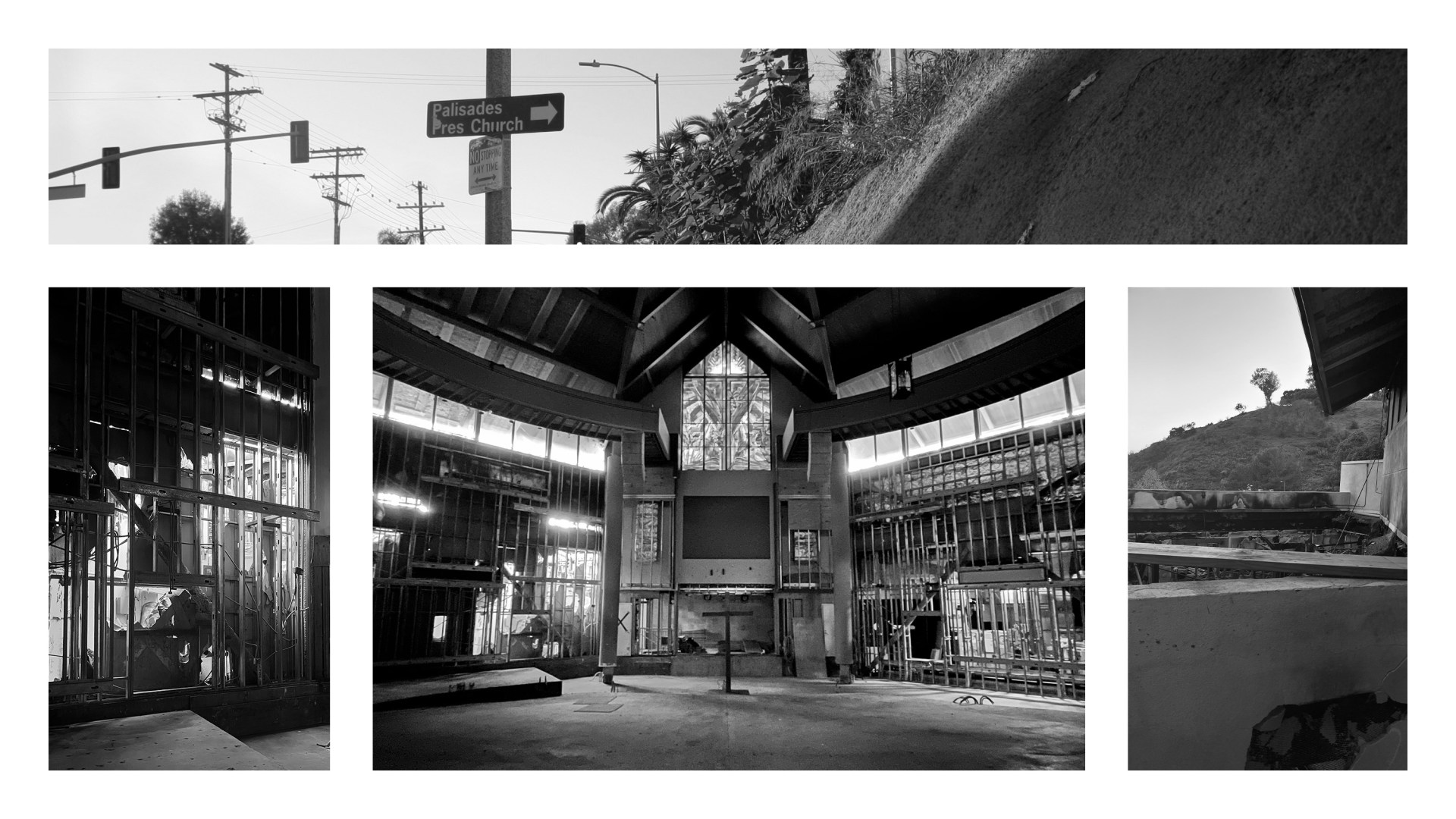
For its first post-fire Sunday, Calvary Palisades hosted an online service. Then they moved into a Seventh-day Adventist church in Santa Monica, which allowed them to host services for the next couple months. Then they moved into an empty chapel in Bel Air. On September 7, before the first day of the 2025–2026 school year, the congregation returned to their damaged sanctuary to hold baptisms among the burn scars and studs.
Rebuilding churches is a battle on multiple fronts. If they decide to rebuild old sanctuaries, congregations must file insurance claims and organize permitting and construction logistics. In the meantime, they rent temporary spaces, order replacements for incinerated hymnals and Bibles, navigate parking in new neighborhoods, and communicate new (and constantly shifting) meeting times to worshipers as they move from location to location—all in the midst of caring spiritually and emotionally for congregants, pastors, and their city at large.
“For the first month after the fire … I was curled up in fetal position in my bed and not eating. I was constantly on. The phone was ringing up to 2 o’clock in the morning … and it would start ringing at 5 o’clock in the morning, and you can’t not answer it because you know that people are just in trauma,” Park said.
At Calvary Palisades, you can still smell the smoke in the sanctuary. The bones of the building miraculously survived, but it will be a few years before its interior is fully restored. As has been the case for many homeowners and businesses, the church’s insurance coverage was not enough to cover the extent of the damage it endured.


“Where does that money come from when your congregation is in the place that it’s in, and the difficulty of asking people to participate in a building campaign when they’re trying to build their homes?” Anderson said.
Planning for the future is both hopeful and painful. “They lost the future that they had thought that they had,” said Park of her church. “They lost the future that they believed was there for them.”
She added, “We are very intentional in making sure that the church continues. … But we are committed to making sure that our church is there for our people.”
Expressions Church has seen its attendance shrink. At Christmas 2024, the community peaked at around 100 people; now, they’re about two-thirds that size. Attendees left California permanently, departed the state temporarily to stay with relatives, or moved into different neighborhoods in Los Angeles with more available housing stock.
Even if a congregant’s house won the “dark lottery,” as Spolar put it, and survived, the surrounding community will have changed. Neighbors have left; a convenient grocery store might be gone; or a favorite coffee shop is under construction.
Amid the soot, relics survive. Calvary’s stained-glass window and cross are intact, surrounded by the studs of the sanctuary. Expressions Church recovered its lectern, from which Spolar preaches in a new space down the street.
Park hadn’t expected to find anything when she visited the burn site. But there it was, standing amid the rubble: the Presbyterian church’s large steel cross. The next day, they retrieved it with a truck.
related


“It was very ironic,” Park said, “and made me realize what a weird sense of humor God has, to give us that as a gift to say, ‘It’s okay. There’s hope here. And there’s life in the ashes, and there’s life that can be had, and there’s hope that can rise from all this.’”
As I drove through the Palisades in November of last year, I was struck by new greenery shining on the blackened hills. Regrowth and rejuvenation is possible, I remembered. God’s mercy continues after the world burns. That’s one lesson churches in Los Angeles learned this year.
“The building burned down,” Park pointed out, but “we didn’t lose our church. We lost the building. … Church is not brick and mortar. … The church is her people.”