More than a decade ago, writer Ta-Nehisi Coates successfully pushed reparations into the contemporary conversation with his seminal essay on why, after 250 years of slavery, 90 years of Jim Crow, and decades of discriminatory housing policies, the United States owed a debt to African Americans that it simply could not wish or wave away.

Calls for reparations have been around since the end of the Civil War, when Union general William T. Sherman and the federal government promised to allot some 400,000 acres of confiscated land in the American South to newly freed Black families—an order that became known as “40 acres and a mule” and was ultimately foiled by President Andrew Johnson.
Roughly a century and a half later, the Black Lives Matter movement, Coates’s work, and the nation’s renewed focus on racial injustices paved the way for reparations to gain momentum in some corners of the political left. In 2019, Democratic politicians, who rely heavily on the Black vote, were pressed to answer questions about where they stood on the topic. State and municipal reparation efforts also grew. The city of Evanston, Illinois, dispensed payments to Black residents (or their descendants) who were affected by discriminatory zoning policies from 1919 to 1969. Various institutions, including prominent and often elite universities, launched their own efforts while liberal states like California and Maryland waded into the waters.
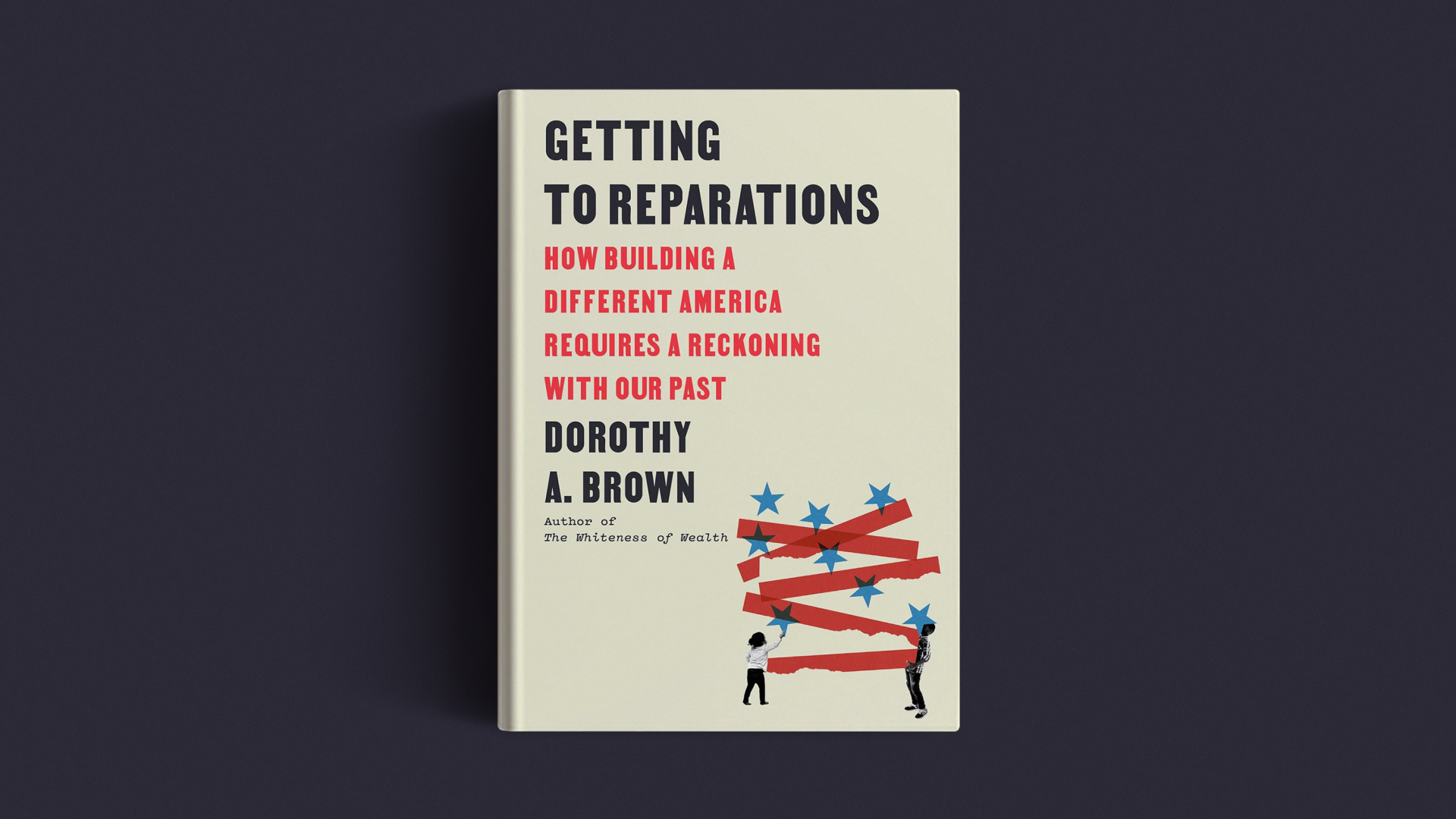
As political winds shifted, however, many efforts have slowed. Federal legislation focused on reparations to Black Americans has never really been on the table, and it seems highly unlikely that it will be on offer anytime soon. But in her new book Getting to Reparations: How Building a Different America Requires a Reckoning with Our Past, Georgetown University law professor Dorothy Brown argues reparations are critical not only for reckoning with slavery but also for building our future. Reparations, she believes, are vital for America to bind up its racial wounds.
I approached Brown’s secular book on the topic with an already-favorable view of reparations, though not only for the conventional reason of supporting Black flourishing. I have come to believe that reparations can be done in a way that resonates with God’s justice, as distinct from secularized “justice.” Reparations as an exercise in white ethnic shame or self-laceration would be wrong, a step away from reconciliation. But reparations carefully and fairly designed for the country to correct past injustices, make right on its broken promises, and help us move forward as a single integrated people is, in my view, a good—and biblically defensible—project.


As Christians, we take this posture in our individual lives of faith: Whenever we do not meet the requirements of God’s law, we repent by not only acknowledging our sins of omission and commission but also making a change in our actions, literally an about-face. Applying this concept to our national sins, Christians should wrestle with how restitution completes a process of national repentance.
While reparation does not require assuming white Americans have inherited the guilt or sin of their ancestors (a reasonable concern from skeptics, in accordance with Ezekiel 18:20), it does involve US institutions like the national government and other living entities, which have overseen and participated in injustices, paying the debt they have accumulated over centuries.
And though this issue is often debated along partisan lines, the basic principle of reparations is not the purview of any one political party. In fact, it’s deeply biblical. Reparations is simply a politically charged term for a well-attested biblical principle of restitution.
In Exodus, for example, we see God instituting laws of restitution for various forms of theft and damage (22:1–15). The principle persists in the New Testament when Zaccheus promises to “pay back four times” anyone he has defrauded and is applauded for it by Jesus (Luke 19:1–10). America isn’t ancient Israel, and Zaccheus was talking about his own personal sins. But as we think about what justice looks like now, it’s worth, in my view, taking these principles seriously both individually and corporately.
Reparations are not a quick fix for what ails America’s racial disparities. Nor are they, as Brown acknowledges in her book, a panacea for Black poverty. We will need many other reforms and changes to solve American racial disparities. But this could be an indispensable step in repairing our torn social fabric.


Brown’s book offers more than an argument for reparations. It offers brief practical considerations for how the country could implement them. In under 220 pages, Brown makes a scrupulous and compelling argument: Black Americans were not only brutalized by chattel slavery but also excluded from government-backed mortgage programs, business loans, land, and other opportunities. This argument even converted some opponents to supporters in focus groups she conducted. Still, while Brown’s book is backed by robust historical research, I found some of her arguments to be lacking, particularly her stance that all Black people in America—not just American descendants of slaves—should be eligible for payments.
Brown writes for a skeptical audience, which is a good approach for this topic. Reparations remains a fraught topic for politicians and an unpopular idea among most Americans, who largely view restitution as both impractical and unnecessary (the only exception here being Black Americans, who mostly support the idea). Brown, a Black tax lawyer, says she herself was a skeptic until “very recently.” She changed her mind after realizing the US paid reparations for the deaths of Italians, specifically Sicilians, who were lynched by white mobs in the South between 1890 and 1910.


The book details how over time the US government has also paid reparations to other groups: President Ronald Reagan signed a law in 1988 giving $20,000 to surviving Japanese Americans who had been put into World War II internment camps. The US has given Native American tribal nations cash payments (up to $1.3 billion in total) for lands the government seized during the 18th and 19th centuries. Even some white slave owners were compensated during the Civil War to soften the blow of losing slaves emancipated by President Abraham Lincoln.
If the country awarded reparations to those groups, then why not, she asks, to Black Americans who suffered during chattel slavery and in its aftermath? Brown writes,
The failed effort to provide land to newly freed families was followed by 150-plus years of exploiting black labor and building white wealth, via different means. You could work for your former enslavers under onerous “sharecropping” agreements that made them rich and kept you poor. If you refused, your unemployment would make you guilty of the crime of “vagrancy” and allow you to be locked up and “leased” to individuals, small businesses, and large companies like U.S. Steel to work for no pay. Blackness was criminalized.
At times, those mechanisms did not prevent blacks from achieving self-sufficiency, and through some miracle, black people still managed to own things and benefit from their own labor. … States employed racially discriminatory legal actions like eminent domain to do the same, while sundown towns—places where black Americans could work but had to be gone by sundown or put their very lives at risk—made sure black people were forbidden from living there, much less building wealth there.
Brown further explains the downstream modern effects: Racially restrictive housing covenants and decades of redlining prevented prospective Black homeowners from buying homes, which hampered wealth creation.
While the US government has aided the creation of wealth for some Americans, Brown notes how Black veterans returning from World War II could not benefit as much as white veterans could from the GI Bill, an instrumental government move that grew America’s modern middle class. In more recent decades, sentencing disparities for offenses tied to crack and powder cocaine, though not explicitly discriminatory, have led to the disproportionate incarceration of Black people.
While Brown’s research is strong, her clarity on what realistic change could look like unfortunately is not. Citing various studies, she notes that the total cost of labor worked during slavery, loss of free time (which she notes is difficult to measure), and other losses from institutional harm can easily rack up to eye-popping dollar amounts.
But after she provided all the critical historical lessons, it was disappointing she didn’t write more on what could be feasible and realistic regarding compensation for those harms. From my own vantage point, one idea I’ve found to be persuasive is for the national government to compensate every African-American family in the amount of the nation’s racial wealth gap, though of course other structural reforms are important to reduce racial disparities. Brown however punted the answer to a theoretical presidential commission she hopes would be created to study the topic.
Ultimately, Brown provides a strong argument for the need for reparations. But as she acknowledges, the devil is in detailed policy prescriptions, and her own book fails to deliver on the details.
Where she does describe details—Brown’s idea of reparations includes both direct cash payments and legislative reforms in various areas like education, taxation, and criminal justice—she doesn’t adequately wrestle with how bundling them together will likely mean the former will be forestalled while politicians continuously debate the latter.
Brown also largely ignores the topic of fatherhood and the two-parent household. Many have long blamed family breakdown as the sole reason for Black poverty. While that’s untrue, it is true the nuclear family is good (Gen. 2:18) and its goodness has been recognized socially through positive economic impacts. But Brown fails to acknowledge this component in a meaningful way. She touches on it only briefly, dismissively mentioning it in an aside about some high-poverty states using block grants given by the federal government.
While it is a strong book with some weak spots, the most pressing problem I see is her assertion that reparations should go to all Black people in America, not merely the descendants of slaves. While I understand where she is coming from—Black immigrants can face discrimination akin to that facing African Americans—it doesn’t seem to have reached a level to warrant reparations. Rather, reparations should primarily be for those who suffered under the institution of slavery and bore subsequent injustices, predominately affecting African Americans.
More than half of Black immigrants in the US arrived after the year 2000, including my own family, who immigrated from Ethiopia. Black immigrants who came to America during periods of legal segregation and disenfranchisement should be eligible for some form of reparations, while others who encountered injustices more recently can seek standard redress in courts. It doesn’t strike me as just to give historical reparations to newer immigrants who weren’t part of the original chain of harm, especially considering that some, such as Nigerian Americans, have a median household income above the average American and white American household incomes.
Brown’s work helpfully addresses reparations skeptics and provides some useful starting points for readers to understand the US history of injustice toward African Americans. The facts she assembles are valuable. But Christians cannot merely adopt her secular framework. We must interpret the facts in light of the Bible’s view of justice and, from the sturdy ground of God’s Word, move forward into acts of repair.
Haleluya Hadero is the Black church editor at Christianity Today.