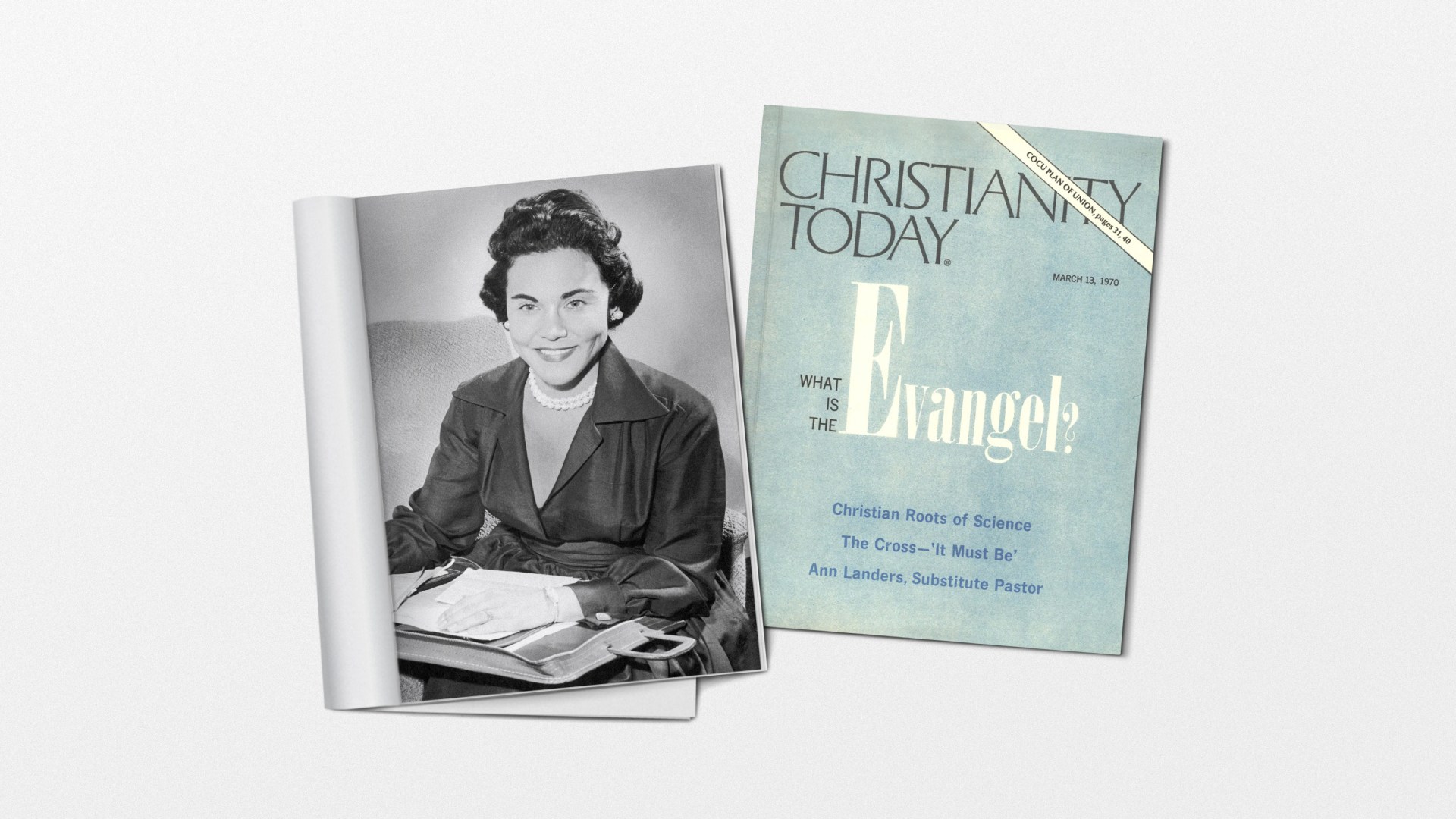
In 1970, CT caught up with Ann Landers, the widely read newspaper columnist who answered personal, ethical questions. CT asked, “Why do you think people come to you for advice rather than seek the counsel of a clergyman?”
My readers actually answer this question in the opening sentence of their letters. For example: “Please don’t tell me to see my clergyman about this problem. I’m ashamed to let anyone know we are having this kind of trouble in our family.” “It is easier for me to write to you because you do not know us.” …
I receive approximately 1,000 letters a day. Every letter that has a name and address receives a personal reply in the mail. …
Both clergymen and psychiatrists have written to me for help. Far more numerous are letters from wives of psychiatrists and clergymen. The wives of clergymen resent the criticism of women from the congregation. If they dress in style the word is, “She has no right to look like a fashion model.” If the clergyman’s wife underdresses, she is harpooned for “looking dowdy.”
Ministers appeared marginal in other popular media as well. CT noted a lack of “evangelical visibility in TV programming.” Part of the problem, according to the magazine, was that church leaders showed little interest in innovation.
The churches are still trying to reach people within the confines of formal worship, and not on the level where they live. … The Church has to realize that just as evangelism must assume many different postures (as shown at the recent U. S. Congress on Evangelism), so spiritual television programming must find expression in a variety of situation contexts.
Here is the meat of what the Church can portray: examples of believers on the firing line of contemporary events and needs; enactments of Christian heritage, perhaps in a spiritually oriented “Saga of Western Man” series; modern-parable presentations of the Christian message in ways able to speak to all age groups; and exposure of the great music, art, and literature of the Church with an emphasis on the Church’s ability to continue to inspire the arts today.
Many evangelicals were pessimistic about the future of America in 1970. The country seemed on the verge of collapse.
More and more the question is asked: Will we soon need a new Gibbon to write The Decline and Fall of the United States of America? Signs of decay are not hard to find. The showy facade of affluence, technological advance, great knowledge, military might, and a high standard of living cannot hide the internal rot. …
The frightening thing is the combination of ailments coupled with the patient’s disregard for his symptoms, and his unwillingness to seek a true cure. Is this not a way of committing suicide?
We are engaged in a war that has terribly divided our people, brought near anarchy to some college campuses, and elicited a flood of obscenities, half-truths, name-calling, and irresponsible rhetoric. Emotion and fear and weakness, rather than reason and courage and strength, now seem to characterize our people. The social fabric is wearing thin and the holes are visible to all.
Founding editor L. Nelson Bell was especially concerned about the anti-war movement and the possibility of a revolution.
We must recognize the forces with which we have to deal. We are not confronted merely by a group of idealists who wish to effect change by an over-activistic approach. True, many young enthusiasts have been captivated by the professed idealism of some leaders. But the fact is that we are faced with a hard core of student activists and others who are determined to tear down the present structures of society at any cost, and within their number are those whose basic philosophy is closely allied with that of either Moscow or Peking.
That spring, national guardsmen shot and killed four unarmed students at an anti-war protest at Kent State University in Ohio. CT invited an evangelical campus minister to write about the experience.
I have never been in war, but that day as I stood with hundreds of students on the campus commons I knew how ugly war could be. … The whirlwind has begun. The unalterable laws of the spiritual dimension are proving their reliability. God is not mocked. What a man plants in his life and in the lives of others will yield back manyfold. And we have sown the wind.
We have sown the wind of permissiveness in the home. … We have sown the wind of egotistic humanism. … My plea to the Church is to begin sowing the wind—the Spirit. Begin at the most crucial location in the nation: the college campus. Sow genuine love and spiritual power in the lives of students who may someday determine the direction of men and nations.
Evangelist Tom Skinner, author of Black and Free and How Black is the Gospel?, said America was in the midst of a racial revolution and the church faced a critical test.
The black brothers on the street are not playing when they say that unless they get justice they will burn the system. Now the question is, Where does the Church stand in the midst of that revolution? What is the message of evangelism? What is the message of the Church? …
The New Testament Church also grew up in a time of revolution. It grew up in a time when the Romans were exploiting the Jews, and when the seeds of revolution were being sown by Jewish nationals who were saying that there was only one way to get that Roman honky off your back and that was to burn him out.
In the midst of this there arose this radical group of disciples who had been with Jesus for 3 ½ years, who had walked with him and seen him live his life in total dependency upon his Father, had seen him crucified, resurrected, and ascended to his Father. Filled with his life they went out and impressed people that they had been with Jesus. … They said that real revolution lies in allowing the common clay of your humanity to be saturated with the deity of Christ.
CT reported on “gay rights” groups staging protests:
The Gay Liberation Front caused a furor among 600 Episcopal delegates to the Diocese of Michigan’s annual convention when two Gay Lib members spit out Communion wine near the altar. Others hugged and kissed in the pews and aisles at St. Paul’s Cathedral. …
The diocesan convention was later adjourned early when twenty Gay Libbers marched to the podium carrying signs and shouting slogans. The disruption took place when a Gay Lib leader was not allowed to speak in favor of a resolution encouraging Episcopal churches to lend their facilities to homosexuals.
A Gay Lib member yelled to departing delegates: “What are you going to do when you have a Christian son or daughter that’s a homosexual? Are you going to disown them, too?”
Several days later in Washington, D. C., about thirty-five militant homosexuals held hands, hugged, kissed, and shouted obscenities as they disrupted a conference on theology and homosexuality at Catholic University. …
The spokesman (none of the dissidents revealed his or her name) demanded that conference members stop examining homosexuality and begin practicing it instead.
CT noted the emergence of a new denomination that rejected biblical condemnations of homosexuality—the first example of what would later be called an “affirming” church.
People call the Metropolitan Community Church of Los Angeles the “gay” church. This doesn’t particularly please the 440-member congregation drawn overwhelmingly from the homosexual community. “We are a Christian church first, and homosexual second,” said its 56-year-old assistant minister, who prefers not to be identified lest his regular job in the “straight” world be jeopardized. …
Its homosexual ministers are far from homogeneous in theology or even in their views of the basic cause of homosexuality. [Troy] Perry, whose sermons are fundamentalistic in tone, considers homosexuality essentially genetic. His assistant minister, a former United Church of Christ and Evangelical Reformed minister liberal in theology, believes homosexuality comes from psychological conditioning. Both men were married and fathered two children before turning to the gay life.
Some churches across the country were , CT reported.
Christians who have lamented the drift of so many churches away from the faith centered in Jesus Christ and founded on Scripture should take joyful note of the list of congregations now returning to that faith. This list is increasing at a rate that may indicate a trend, and perhaps the beginning of a general movement. Throughout the country there is a growing network of pastors who have given themselves to leading churches back to the only solid foundation for Christian faith.
The Trinitarian Congregational Church in Wayland [Massachusetts] a good example. … When the Reverend Donald S. Ewing became pastor of Trinitarian in 1955, the church was struggling to maintain its existence. Many of the 175 members were inactive. The church had a debt of more than $80,000 with an annual budget of only $12,000. Under Dr. Ewing’s ministry it has grown to a membership of more than 1,200 with an annual budget of more than $160,000.
But these statistics are only a reflection of the really significant developments, those that took place in individual lives. Commitment to Jesus Christ, interest in Scripture, and concern for people throughout the community are now common characteristics of the members.
Some congregations were experimenting with different kinds of music in worship.
Evangelical churches have taken the lead in introducing a new kind of sacred music patterned after the popular folk rock. Country or Western music is also being appropriated by evangelical churches more than ever. Theologically liberal churches have been more reticent about such musical inroads, but in those congregations that allow it, these types of music as well as straight jazz are now heard. Most common are the folk and jazz “masses.”
Interestingly, the new movement is being welcomed by many respected church musicians, even those who have until now insisted upon classical forms. Others are critical. Church-music journals have generally been sympathetic, though they are publishing hot dialogues on the pros and cons.
“The Church is groping now for a new musical language,” says Dr. Donald Hustad, professor of church music at Southern Baptist Theological Seminary. “At the moment we go with the latest fad.” Hustad regards the current trend as secular music’s biggest invasion of the Church since about 1850.
As President Richard Nixon established a new government agency, the Environmental Protection Agency, an Asbury Theological Seminary professor wrote about Christian responsibility to steward creation, not exploit it.
The Christian should face with frank realism the fact that the biblical understanding of things must run counter to many prevailing modes of thinking. He must, for example, challenge the current stress upon purely quantitative evaluations of economic success, usually stated in terms of the annual increase in our Gross National Product. It is not only that infinite expansion is impossible within a finite order, but also that “man’s life does not consist in the abundance of his possessions.” …
Taken seriously, the concept of biblical stewardship will permeate human life with the conviction that man holds his environment in trust, under God. It will remind man that abuse of his trust will bring, not only a searing final judgment from the God under whom man lives, but strong intermediate judgments in the form of impoverished lives and hungry bodies. It is in these terms that our decision-makers need to be reminded of the consequences of an outraged environment.
Toward the end of the year, reflecting on their stewardship of CT, editors published a statement of purpose, reminding themselves and readers of the goal of the magazine:
We have tried to present orthodox Christianity to nonevangelicals reasonably and persuasively and to provide evangelicals with a scholarly apologetic for their faith. We have explored the relation between evangelism and social action on the part of Christians and have tried to stimulate a new sense of responsibility in those who formerly had shied away from involvement in the affairs of the world. At the same time we have given hearty support to personal and mass evangelism.