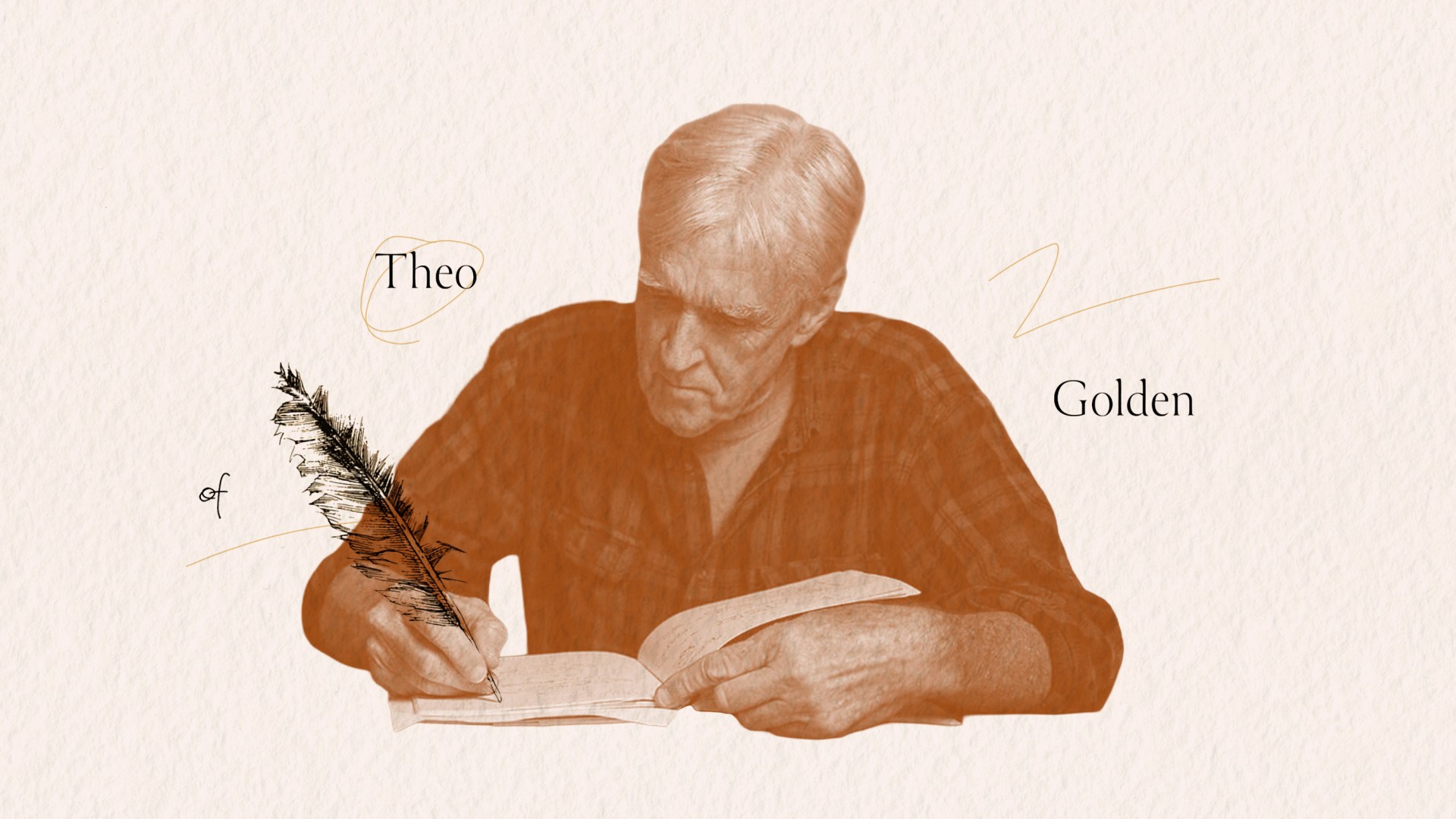
Allen Levi’s friends wouldn’t let him leave his novel in a drawer collecting dust.
After having the idea for Theo of Golden, Levi wanted to see if he had the “muscle” and “patience” to write a novel. He didn’t have plans to do anything with it afterward. But at his friends’ urging, in October 2023 he self-published the completed book. Since then, its sales have steadily skyrocketed, booming in 2025. This past December, more than two years after publication, the novel reached The New York Times’ paperback trade fiction list. It has remained there for ten weeks.
Theo of Golden’s success is unique in some ways, both as a self-published novel and as a book centering on a Christian character. Theo is full of hope and expresses love “in a winsome way through kindness and generosity,” Levi told Christianity Today. But the character hesitates to have conversations about heaven with a curious non-Christian.
Levi lives on family acreage in Harris County, Georgia, and attends two churches regularly: a young plant that began by meeting on a couple’s farm, with chickens and donkeys, and an African American Baptist church. Levi says his vocation is to “use creative gifts to provoke godward thought.”
Theo of Golden begins with Theo, an elderly Portuguese man, visiting a small Georgia town. He sits down for coffee and is enamored by the 92 portraits on the wall. After talking to the shop owner, he begins a mission to buy the paintings and bestow them on the models.
Levi has worked as a lawyer and judge, is a longtime songwriter, and earned a master’s degree in Scottish fiction while living in Edinburgh. In this conversation, Levi discusses the winding vocational path that brought him to a New York Times bestseller list, the novel’s recent popularity, his faith background, creative and spiritual influences on his life, and plans for his next book.
This conversation has been edited and condensed.
How did Theo of Golden begin? Did the idea just come to you one day?
One day I was in a coffee shop down in Columbus [Georgia], and the coffee shop has 92 portraits on the wall. They’re all done by a dear friend of mine who is a wonderful artist with a particular gift for portraiture. And I was looking at the portraits, as I always do when I go to this particular shop. And the idea that came to me was Wouldn’t it be a lot of fun and interesting to buy the portraits one at a time and give them to the people who are portrayed in the frames? That became the seed corn for a story. That was nothing unusual for me as a songwriter. I was constantly on the prowl for things to write songs about. But I thought, This could be a story.
My thinking was not to write a novel for publication but just to see if I had the muscle and the stamina, the patience, to write a piece of long fiction. I actually bought four of the portraits that day, and they all became characters in the book. I didn’t have a plot. I didn’t have any sort of narrative arc that I was working under, but I started writing scenes, imagining that someone came and bought portraits and did what Theo does in the book. I figured out what I wanted the tone of the book to be, and I started writing in fits and starts.
I would maybe work for a week or two, and then I’d quit for six months. I gave up a dozen times. I said, “I can’t do it, and I don’t have the muscle for it.” But I stuck with it. And when I finished it, I patted myself on the back and said, “I’m done.” I put it in a drawer, and that was going to be the end of it. But some friends of mine who knew I was playing with the idea of writing a book asked if they could read it, and I let them read it. They said, “We really think you should do something with this.” That’s what rescued it from the dustbin.


There’s an interesting tension in the book. You seem eager to share Christian truths, but I’ve heard you in another interview resist the title Christian fiction, and the main character repeatedly resists conversations about heaven with a non-Christian character. Still, there are Christian themes all throughout the book. How did you decide on that approach?
As a musician, I always asked myself when I was getting ready for a gig, “Who is the audience tonight?,” because I played for a really diverse swath of audiences. I could play at a Southern Baptist church on a Sunday evening for an elderly congregation one night and then for a college group three nights later. It just made sense to know who I was going to be singing to, because I was there for them.
I think that’s the right approach for me to take as a creative person, as an artist. They are not there for me. I am there for them, to serve them. Good art does serve. In this, I wanted to write to as wide an audience as I could possibly engage. C. S. Lewis says that the first duty of an artist is to teach and delight. And I wanted to do the “teach” part subtly and delight as winsomely as I possibly could.
I wanted to communicate hope. I certainly wanted to communicate that Theo was a man who loved and he was a man who expressed that in a winsome way through kindness and generosity. But I didn’t want the book to be so steeped in this man’s faith that it would run off readers who don’t share our faith perspective. Out of kindness to that audience, I tried to make the story as engaging as possible without denying that this man was a character of faith.
Theo of Golden is spending its eighth [now tenth] week on the New York Times paperback trade fiction bestseller list. Do you think your approach to Christianity in the book has anything to do with that popularity?
Not really. Let me backtrack just a bit. You mentioned that I resist the label Christian fiction. I’m not quite sure what that is. And if you asked me, “Do I consider this book Christian fiction?” I would have asked you to define the term, because I’ve never quite understood what it means. I know that there are books that have so many buzzwords in them that there is no mistaking it for who the author was and what his or her persuasion was.
When I was a lawyer, sometimes people would come to my office and they would say, “I understand you’re a Christian lawyer.” And even then, I resisted that. I didn’t want people to come to my office because I was a Christian lawyer. I wanted them to come because I was a good lawyer, I excelled in my work. And as a writer, I want people to be drawn to the book because it is excellently written. I did the best I could. Not to say that it’s excellent, but I did the best that I could. And I like the fact that the story, again, reaches a broad spectrum of readers. I don’t want to live in a silo. I want to respect the fact that not everybody in the world sees through the same lens that you and I might see through.

I’ve been interested in its popularity. I have friends who aren’t Christian, and if we have dinner and I start going through the gospel with them, they wouldn’t want to get dinner with me anymore. A lot of American readers might feel the same about a book.
You’ve probably heard the term before: pre-evangelism. Sometimes there are things that maybe the church should do just to express the love of God for people, regardless of a message or a response. I think of the Book of James, where he says if somebody comes to you and they’re hungry, feed ’em. Don’t preach to ’em; feed ’em. You’ve got to feed them first. Maybe sometimes our first responsibility is to feed the hungry, and maybe we don’t feed them the real rich food as the first course. We give them something that prepares the palate, so to speak. And that is not to say that we don’t ultimately want to get to the point that we share the gospel of Christ. We want to do that.
There’s a statement by C. S. Lewis where he says that to love and admire anything outside oneself is to take a “step away from utter spiritual ruin—something along those lines. To write a piece of fiction, a story like Theo that makes a godly man attractive, a character like that who might draw the heart of a reader, is to maybe invite that reader to love and admire something outside themselves. It becomes an enticement of sorts, in a good sense of the word, for someone to come look and see.
Is there one specific moment you can remember when you became a Christian? What’s your relationship to the church today?
I grew up in the church in my hometown of Columbus. We were faithful churchgoers to a Presbyterian church. I’ve got a wonderful mom and dad. I’ve got three wonderful sisters and had a wonderful brother who’s now gone to be with the Lord. Faith was probably a somewhat superficial thing for us. We had a respect for it without much understanding of it. I probably saw it as something that was nice but not necessary. Now I see it as something that is necessary but not always nice. It can be a very uncomfortable thing.
When I went to college, I ended up graduating from the University of Georgia, and while I was there, I met some people who were very unashamed Christians. I saw the gospel in them in a way that I had not seen before. February of 1978 is when I kind of chart the beginning of my surrender to Christ, and it has been push and pull and forward and backward and all of that since then. But ever since then, faith has been deeply rooted in me. I’m very much a work in progress, like all of us.
You’ve said your mission statement is to use creative gifts to provoke godward thought. What creative works have provoked godward thoughts in you? Do they tend to be works created by Christians?
I don’t know if you would call the Scripture creative work. I mean, there’s certainly poetry, and there’s prose, and there are parables, and there is fiction used in the right way in the Scripture. So that, first and foremost. I like to think that everything I read in some way informs my faith, even if it’s from Cormac McCarthy or somebody who is nowhere recognizable on the faith spectrum, because it reminds me of what life might look like if I had not surrendered my life to Christ many years ago.
C. S. Lewis is kind of a perennial favorite for me. I seem to always have something of him in rotation. I love to read C. H. Spurgeon. He was a master with the language. His devotion to Christ was undeniable, and the focus that he had on moving the kingdom forward has always challenged me. Wendell Berry, no doubt, even though he doesn’t wear his faith on his sleeve in a lot of ways, has profoundly impacted my view of the world and my Christian view of the world. Just a sense of stewardship and community and cherishing small things.
I’ve read lots and lots and lots of books over the years. My memory is not terribly good, so things tend to slide off of my memory quickly, but I never feel like it’s been a waste of time. I feel like there’s some imprint that they leave behind that rounds me out.


You’ve said that you’re working on more novels focusing on characters from Theo of Golden, particularly Ellen. Can you tell us how that’s going?
It’s been hard. I wrote Theo as a personal challenge, so there was no pressure whatsoever. I never expected anyone to read it. It was arduous, but I was able to do it at my pace, and I didn’t feel like anyone was breathing down my back. With Ellen, I don’t feel like anyone’s breathing down my back, but given the response that people have had to Theo, I do think there’s probably an expectation. I want to write the best book that I can.
I want to make sure that whatever I write really has something to say. I’m all for delighting people and giving them something to read that doesn’t require a lot of deep thought or reflection, but my preference is always to have something of substance in what I write, be it a silly song or a serious novel. I hope my goal will always comport with my mission statement—that I will use stories to provoke godward thought.
Correction: An earlier version of this piece had the wrong location for the coffee shop, which is in Columbus, Georgia, not Columbus, Ohio.