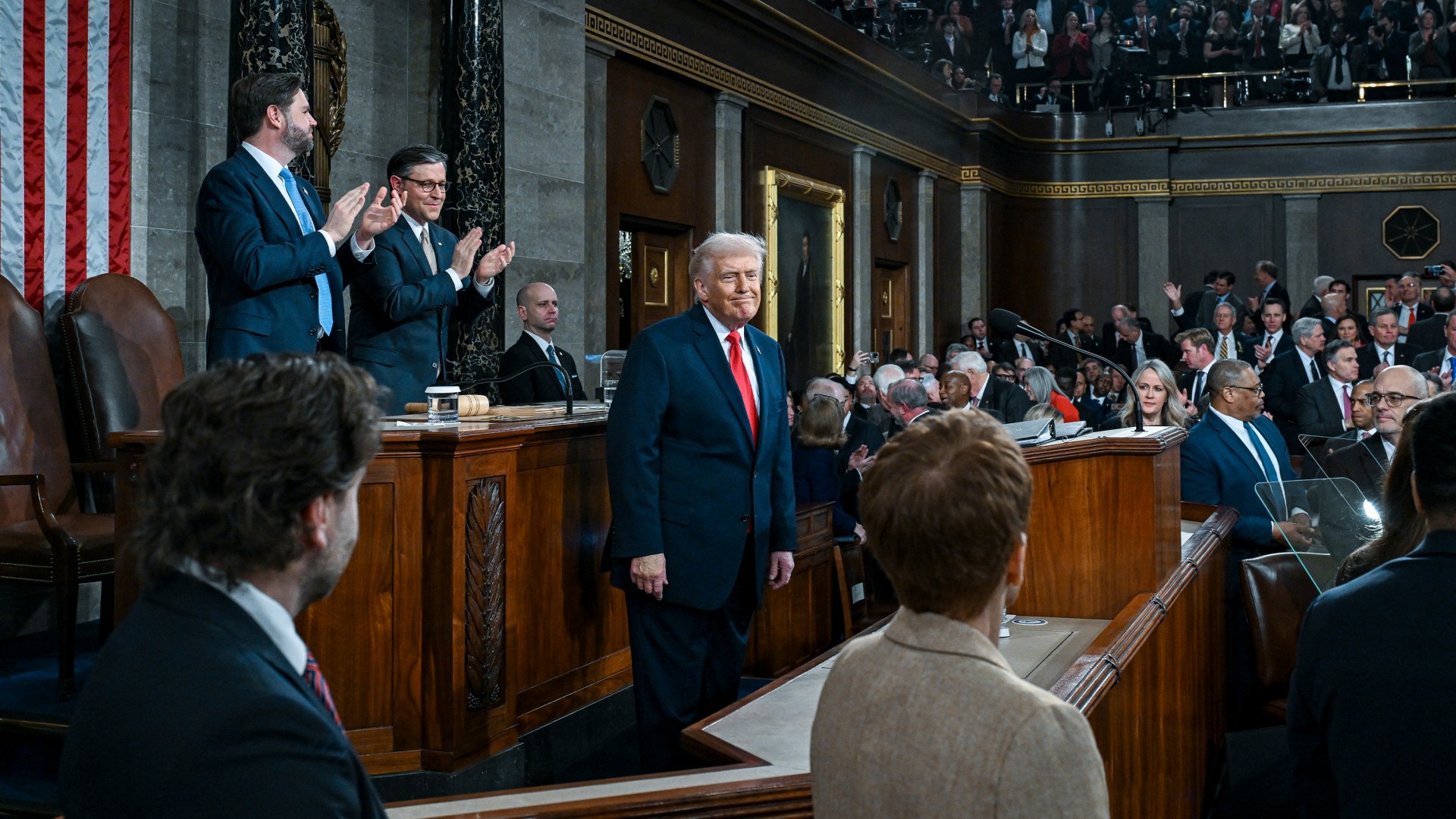
In his joint session address to Congress Tuesday, President Donald Trump said that since he took office a year ago, the United States has experienced a religious revival.
“There has been a tremendous renewal in religion, faith, Christianity, and belief in God,” he said at the State of the Union (SOTU) address.
“We love religion, and we love bringing it back,” he added. “And it’s coming back at levels that nobody actually thought possible. It’s really a beautiful thing to see.”
Eric Loepp, assistant professor of politics at the University of Wisconsin Whitewater, said Trump’s mention may have been more “aspirational” than grounded in evidence: “Religion served as one of the pillars supporting President Trump’s overarching theme: that America is enjoying widespread renewal and entering a ‘golden age’ not only in economic terms but in spiritual and cultural ones as well.”
Trump said the surge was “especially true among young people,” and gave credit for that to conservative political activist Charlie Kirk, whom Trump said had been “martyred for his beliefs.”
At that point in the speech, Trump invited Kirk’s widow, Erika, one of his featured guests at the address, to stand. The chamber’s Republicans stood, whistled, and applauded, with some chanting, “Charlie, Charlie, Charlie.”
“In Charlie’s memory, we must all come together to reaffirm that America is one nation under God,” Trump said. He circled back to religion at the conclusion of his speech: “When God needs a nation to work his miracles, he knows exactly who to ask.”
While Christians said they hope to see a broader cultural interest in faith, political scientists doubt the United States is experiencing the kind of enthusiastic resurgence in Christianity that the president described.
“There’s just no empirical evidence that points to that conclusion,” said Ryan Burge, a professor at the John C. Danforth Center on Religion and Politics at Washington University. “No matter what metric you look at—belief, attendance, or religious affiliation—there’s nothing that points to the conclusion that Gen Z is seeing a revival.”

Daniel Bennett, political science professor at John Brown University, said the president’s remarks “seem to be referencing a vibe shift more than concrete evidence or supporting data.” He added, “On the contrary, there’s plenty of data out there to cast doubt on these sorts of statements, however encouraging they would be if true.”
Pew Research Center’s latest survey from its Religious Landscape Study found that a long-term decline in religiosity in America had relatively stabilized from 2019 to 2024. While the decline doesn’t show signs of dramatically reversing, the share of Americans who identify as Christians has stayed somewhere around 60 and 64 percent from 2019 to 2024.
Around 45 percent of Gen Z Americans identify as Christian, according to Pew—that’s a 10 percent decline from a decade before.
Last year, Gallup found a 17-point drop in the percentage of US adults who say that religion was an important part of their daily life over the last decade, and reported that the share of Americans who actively attend church has also declined.
“It is not surprising that any president may focus on a specific data point or narrow band of activity rather than larger trends if it better aligns with their political narrative,” Loepp said. “Time will tell if President Trump’s vision in last night’s speech will become a reality. At the macro level, I doubt we will see a sudden resurgence to peak levels of religiosity.”
But Loepp said he wouldn’t be surprised if some people were to become more religious, particularly given rapidly changing technology and other challenges of modern life.

“It will not surprise me at all if some segments of the population increasingly turn to religion to help find meaning in their lives,” he added. “Recent developments, particularly among younger Americans, could indicate that the conventional wisdom will evolve.”
While acknowledging that research is divided on the subject, Daniel Darling, director of The Land Center for Cultural Engagement at Southwestern Baptist Theological Seminary, said he’s seen some encouraging signs when it comes to the interest in faith. He mentioned Bible sales and anecdotes of college students having an increased interest in church and Christianity.
“I do think something is stirring, which would be characteristic of God to bring forth a fresh wave of spiritual life in the midst of a tumultuous time,” Darling said. “Ultimately, we will see if this season bears fruit, but we can rejoice even in the pockets of revival we might be witnessing.”
Young people seem to be buying Bibles in greater numbers compared to other age groups, and book tracker Circana Bookscan found in 2024 that Bible sales had increased 22 percent over a year’s time.
Barna Group also found last year that younger churchgoers tend to attend services more frequently than older generations. The survey did not look at the number of people identifying as Christian.

Overall, Trump spent a larger amount of time talking about immigration and the border than religion. In explicit detail, he described crimes committed by individual illegal immigrants against American citizens. He claimed undocumented immigration had fallen to “zero” admissions in the past nine months. Although border crossings are at record low levels, in January, there were still over 6,000 illegal crossings at the US-Mexico border.
Pro-life issues traditionally of interest to evangelicals received scant attention. Abortion received zero mentions. Trump made brief mention of in vitro fertilization (IVF) while highlighting one of his guests who is undergoing IVF treatments, Catherine Rayner. He also touched briefly on transgender policies in schools, highlighting one of his guests, college student Sage Blair.
Bennett characterized Trump’s references to gender ideology and religion as “fleeting” in comparison with his focus on immigration.
“It’s striking that the president’s attention to culture-war issues tended to center on crimes committed by undocumented immigrants,” he said.
“Trump leaned heaviest into the most polarizing issues,” said Mark Caleb Smith, director of the Center for Political Studies at Cedarville University. “These are also the issues where Trump can claim something closer to majority support in some ways. Most Americans agree that a closed border is important, but there is growing concern with how immigration enforcement is happening domestically.”
Democrats’ response to the speech was mixed. Some nodded off, some left early, and around 50 Democrats boycotted to attend counterprotests elsewhere. Virginia governor Abigail Spanberger delivered the Democratic response in a brisk 12 minutes.
Chris Butler, director of Christian civic formation at the Center for Christianity and Public Life, said Trump “probably oversells his claim.”
But he thinks that ultimately, numbers tell only part of the story: “Personally, I think the character of Christianity in America matters more to the nation’s future than its size.”