I teach an undergraduate course called Worship and the Arts during the spring and summer terms. Most of my students in that class aren’t studying theology or religion—the course satisfies a general education requirement in our curriculum. Many of them don’t identify as particularly religious either.
The first week of class, I typically ask the students to write about an encounter with art that has changed their beliefs about or perception of God. The last two times I’ve taught this class, at least one student has mentioned the song “I Can Only Imagine.”
“When I listen to it, I feel like God loves me,” one wrote, “and I have peace about the future.”
That isn’t surprising, given the song’s popularity: “I Can Only Imagine” is the best-selling Christian record of all time and the first Christian song to go platinum and double platinum on digital platforms. If you tune in to Christian broadcast stations like K-Love for the day, you’re likely to hear it at least once. The listenership of Christian radio skews older, but somehow this nearly-25-year-old song is reaching my students and resonating.
“I Can Only Imagine” is a soaring ballad with lyrics that invite listeners to imagine what it will be like in God’s heavenly presence. Its origin inspired the 2018 film I Can Only Imagine, whichtold the story of MercyMe lead singer Bart Millard’s fraught relationship with his abusive father and their eventual reconciliation. The film’s box office success surprised the industry and critics. It was the third-biggest movie in the US during its opening weekend, behind Black Panther and Tomb Raider.

A sequel, I Can Only Imagine 2, will be released by Lionsgate on February 20. Most of the cast members reprise their roles, including John Michael Finley as Bart Millard, country singer Trace Adkins as band manager Scott Brickell, and Dennis Quaid as Millard’s father. The roster includes a new, high-profile addition in Milo Ventimiglia (of Gilmore Girls and This Is Us) portraying singer-songwriter Tim Timmons.
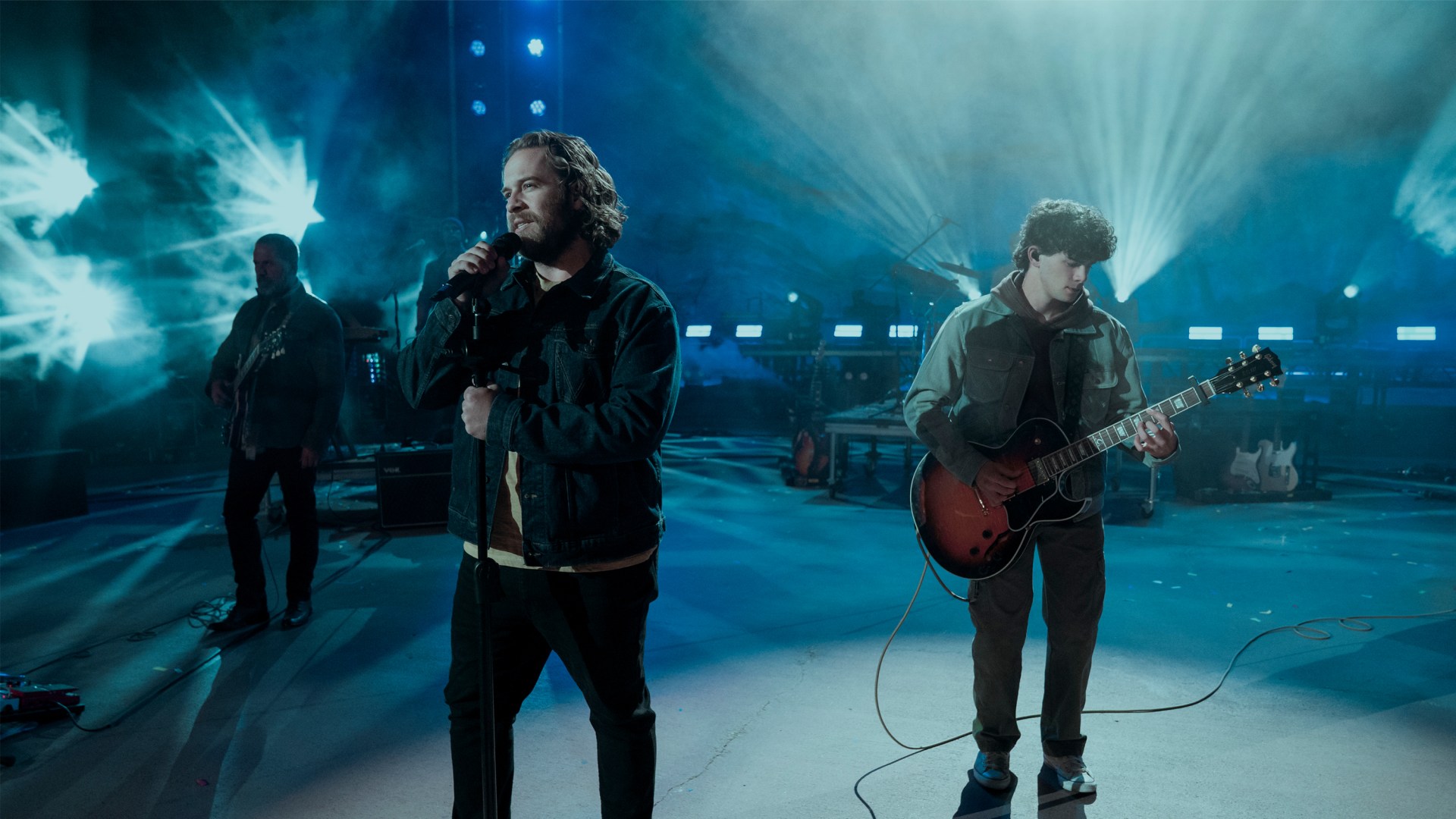
The sequel starts with a drone shot of a MercyMe concert at Red Rocks Amphitheater, with Finley (as Millard) gripping the microphone.
“What comes next when you’ve gotten all your dreams?” his voice asks. “What do you do when the only thing in the whole world that you have to hold on to is a song?”
It’s an odd way to begin a film that is, essentially, holding on to a hit song and stretching its popularity into a franchise à la the God’s Not Dead films. Despite relying on many of the same tropes and formulas of other faith-based films, I Can Only Imagine 2 doesn’t stoke culture war. It participates in some mythologizing and intentionally pulls on heart strings, but its central conflicts aren’t built on confrontation with a caricatured enemy. The story arc is driven by personal struggles, health crises, and the strange professional aftermath of having written the biggest Christian pop song ever.
We get an early flashback of Millard and his wife, Shannon (Sophie Skelton), reeling from a medical episode in which they find out their son, Sam, has juvenile diabetes. Millard, who has just departed for a tour, rushes home to find his family at the hospital, and he has to learn to check Sam’s blood sugar and give him insulin injections. The experience of causing his son physical pain sparks a flashback in which a young Millard is being attacked by his violent father.

Sam’s diabetes is a key plot point throughout I Can Only Imagine 2. The film takes place during his teenage years, when his parents have trouble helping him manage his disease independently. He forgets to check his blood sugar at the right times; sometimes he forgets to eat. Sam is an aspiring musician who is more interested in practicing guitar than taking charge of his health. An offhand comment by Millard to his manager becomes a last-minute decision to take Sam on tour with MercyMe.
A lot of conflicts, personal dramas, and various themes fight for center stage in this film. It echoes the father-son relational struggle of I Can Only Imagine: We watch Millard come to terms with his own shortcomings as a father and the ways his brokenness left him unprepared to build an authentic relationship with his son. Milo Ventimiglia’s character, Tim Timmons (based on the singer-songwriter of the same name who cowrote the song “Even If” with Millard), is battling a rare form of cancer, which he conceals from Millard as they set out on tour. Timmons and his wife are also expecting their first child.
On tour, we see Timmons reading a book titled The Origin of Hymns—which looks like an old cloth-bound classic but is actually a mockup of a forthcoming book that will release with the film—and he talks at length about his love for the late 19th-century hymn by Horatio Spafford, “It Is Well with My Soul.” As Timmons and Millard share a moment of appreciation for the song and the tragic story that inspired it, Millard remarks, “I wish I could write a song like that.” Timmons replies, “You did, man.”
Is “I Can Only Imagine” a modern-day “It is Well with My Soul”? Unclear. The song is 25 years old, but that’s not really long enough to know its staying power. The comparison feels forced—also potentially unearned—but the film leans on it to argue that great songs emerge from great struggle. Millard’s turbulent relationship with his father and subsequent reconciliation before his death gave us “I Can Only Imagine.” Spafford’s tragic loss of his daughters in a shipwreck gave us “It is Well with My Soul.” The film begs the audience to ask, What great song will emerge from this mutually difficult season for Millard and Timmons?
Timmons chips away at the basic theme and structure of a new song while on tour, inviting Millard to collaborate. But Millard is distracted by Sam and his memories of his own father. Eventually, he listens to Timmons’s rough, bare-bones demo, and the song becomes “Even If,” which the credit montage tells us became MercyMe’s biggest hit after “I Can Only Imagine.”
“Even If” was released by MercyMe in 2017. The song samples the chorus of “It is Well with My Soul” and embraces a challenging message: God may not save you from pain, even death.
I know you’re able, and I know you can
Save through the fire with your mighty hand,
But even if you don’t,
My hope is you alone.
It’s still unlikely that “Even If” will ever top the success of “I Can Only Imagine.” To some degree, the fictionalized Millard seems aware of this, but the film’s arc still feeds the will-they-won’t-they tension around the song Timmons is writing and the band’s flagging popularity.
This film had an opportunity to more deeply explore what it’s like to come down from the high of writing a megahit.
At the start, I wondered if we were going to see the uncomfortable soul-searching many artists face as they realize they may never be able to produce a song that reaches as far or gains as much acclaim as something they’ve already done. For Christian artists, the tension between the pursuit of material success and faithfulness is a fertile ground for character development and inner conflict.
I Can Only Imagine 2 sidesteps that trickier territory in favor of perhaps more universally relatable plot points: Sam’s struggle with diabetes, his dream of becoming a musician (real-life Sam is now a musician who performs as Sam Wesley), the challenge of parenting adolescents and young adults while also dealing with your own trauma, Timmons’s cancer, and his wife’s pregnancy.

The film’s numerous mini sermons might deliver what many viewers are looking for in an inspirational faith-based movie. The characters are also generally likeable. One of the film’s more self-aware moments comes during a post-credit scene in which Trace Adkins’s gruff, no-nonsense character stares placidly at a field with his father. He asks, “Say, Dad, do you ever want to talk about your feelings?” His dad replies stoically, “No, not really.” Adkins ends the brief exchange with a “Yeah, me neither,” a winking acknowledgement of the film’s abundant dialogue and sometimes overly acted soul-searching in other scenes.
The film ends with Millard breaking the fourth wall to answer the rhetorical question he asked at the beginning of the film: “What do you do when the only thing in the whole world that you have to hold on to is a song?” We see that he’s speaking in a grief support group.
He poses the question, then looks straight at the camera and says, “You keep holding on.”
“I Can Only Imagine” is still a mainstay of Christian radio. People ask for it to be played at their funerals. MercyMe isn’t a washed-up contemporary Christian music group trying to reinvent itself or manufacture relevance; its hit song hasn’t faded away.
I Can Only Imagine 2 holds on to that hit song, sometimes focusing on it instead of treading new ground. To be fair, though, its audience is definitely holding on to the beloved song too.
Kelsey Kramer McGinnis is the worship correspondent for Christianity Today.