At 13, Cho felt his life split in two. His family moved from South Korea to the United States, uprooting him from his comfortable life and dropping him in a school where teachers and classmates spoke a language he didn’t understand.
Struggling to learn English, Cho became an easy target for bullies. Classmates mocked him, their racial slurs following him down hallways. Cho’s loneliness hardened into anger, and that anger soon found an outlet through his fists. Although he had grown up attending church with his family, he fell away from his faith.
He gravitated toward other Korean American teenagers who seemed to understand him, but this sense of belonging came at a cost: His new friends often settled conflict through aggression, and violence gradually became normalized. CT agreed to provide Cho with a pseudonym due to security concerns, including being identified by other inmates.
In his 30s, Cho returned to South Korea hoping to start over. He got married and became a father. On the surface, his life appeared stable. But unresolved anger toward the world and its treatment of him lingered within.
When Cho fell victim to fraud, his life unraveled. Faced with mounting despair and uncertainty about his family’s future, Cho tracked down the perpetrators and set fire to their office. He ended up imprisoned at the Christian-run Somang Prison in Yeoju, where he remains today, now in his 40s.
Yet in Somang Cho found new life through the prison’s Bible studies and worship services. Before entering prison, he had strained relationships with his wife and daughter. Through Somang’s counseling and family programs, those bonds began to mend. His wife and daughter were the first to recognize changes in Cho’s life: how he spoke and took responsibility for past harm. A pastor baptized Cho, a moment he described as “unforgettable.” Cho saw how God’s grace had sustained him even when he wasn’t seeking God.
“I came to prison as a wounded avenger, full of rage and bitterness,” Cho said. “God’s grace is transforming me into a wounded healer—someone whose scars can bring hope to others.”
Somang, which means hope in Korean, is the only privately run, nonprofit prison in Asia and is operated by the Christian nonprofit Agape Foundation. Rather than viewing incarceration as simply punishment, Somang seeks the restoration of its inmates based on the belief that Jesus can bring real change, according to warden Kim Young-sik. The prison encourages reconciliation first with God, then with their families, and finally with the wider community.
“Punishment may restrain behavior temporarily, but restoration asks something much harder—whether a person is willing to take responsibility, confront the harm they’ve caused, and begin repairing broken relationships,” Kim said.
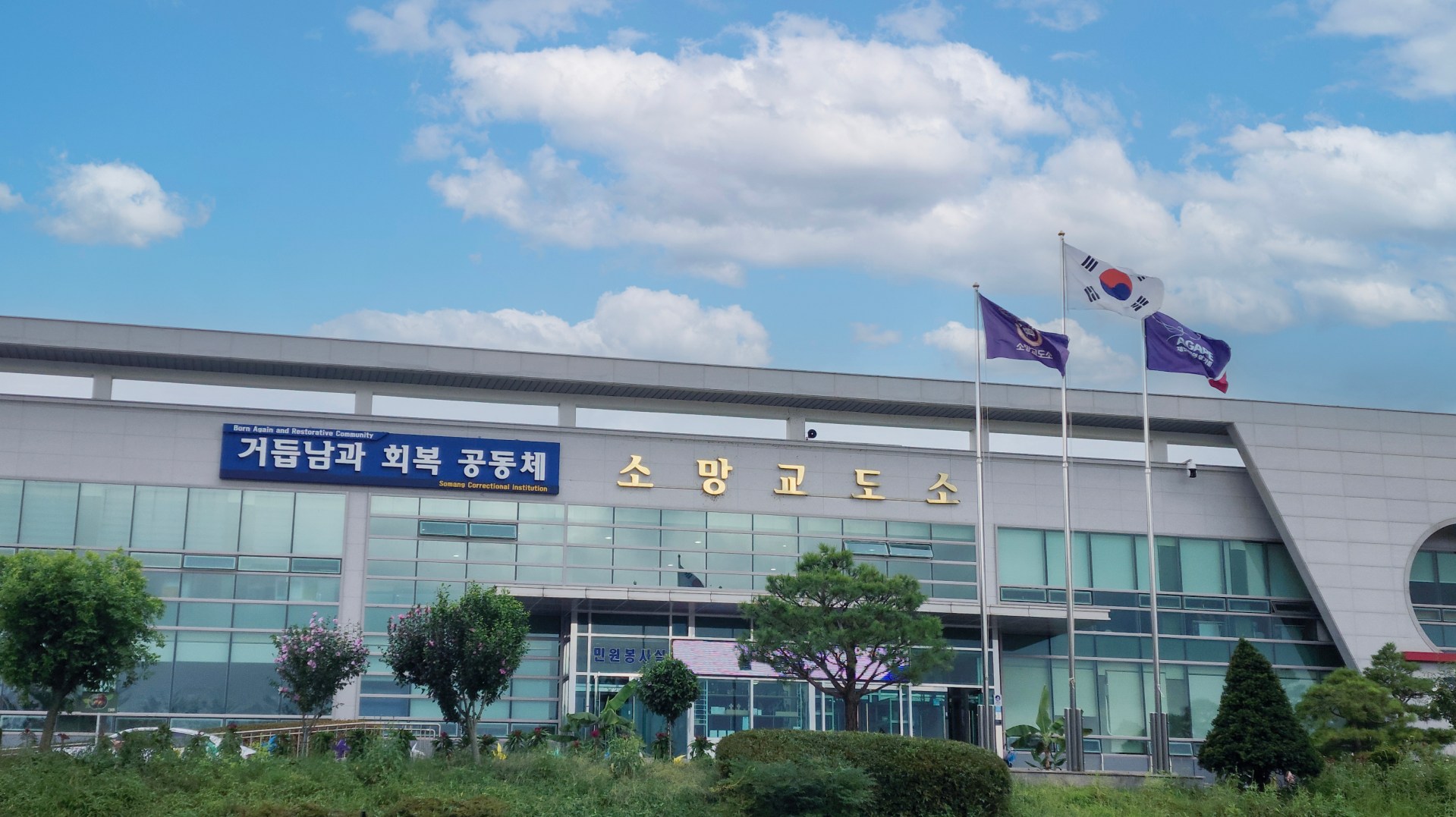
Last December, I drove to Yeoju, a city about 50 miles southeast of Seoul, South Korea, to find out what makes this prison unique. My two-hour drive to the facility brought me out of the city onto a quiet mountain road. Snow lined the narrow climb as my surroundings grew increasingly remote. At the end of the road stood Somang, an imposing concrete building.
Inside, Somang’s atmosphere felt unexpectedly warm. A Christmas tree stood beneath bright lights in the visitors’ lobby, and guards greeted me with kind smiles.
It took a decade for the Christian ministry leaders and legal professionals of the Agape Foundation to come up with an operational plan for Somang Prison and gain government approval for its approach toward criminal justice. They framed the project as a contracted facility fully overseen by the Ministry of Justice.
By allowing the state to control sentencing, security, and legal compliance while Agape focused on daily operations and rehabilitation programs, Somang’s operational structure presented a partnership rather than a challenge to state authority.
Opened in 2010 as the first private prison in Asia, Somang has a capacity of 400 inmates and admits about 20 new prisoners each month. Admission is limited to adult men who are serving sentences of seven years or less, have no more than two prior convictions, and have at least one year remaining on their sentences. Individuals convicted of organized crime or drug offenses are excluded.
Inmates must apply voluntarily and pass a multistep screening process, including a Ministry of Justice review and an interview conducted by Somang wardens, before receiving final approval from the ministry.
Somang’s reported recidivism rates from 2011–2022 are notably lower than national averages (about 10% compared to 21–26%). From 2020–2022, the rate further dropped to between 5 and 8 percent.
One study by a government-affiliated research institute found that Somang’s and public prisons’ recidivism rates were “not significantly different” when accounting for the facility’s selective admissions criteria. Yet Somang pointed to methodological limitations in the study, noting that critical factors influencing recidivism—such as mental health, addiction history, and risk assessment scores—were not fully accounted for in the comparison.
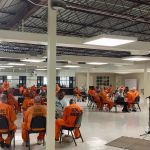
On the Tuesday I visited, the prison held two worship services. Nearly 300 incarcerated men wearing blue prison uniforms entered the main hall in orderly lines, each man wearing a badge that bore an identification number and a photograph of himself—a requirement in South Korean correctional facilities.
A praise team composed of volunteers from a local church led worship as the lyrics were projected onto a large screen behind them. Some inmates closed their eyes while others sang softly, their heads bowed or hands folded. The prison guards also joined in the singing. At the back of the hall sat the family members of the inmates, some holding infants. The inmates were not allowed to mingle freely with relatives, but families could request supervised visitation meetings following the service.
After worship, pastor Ahn Il-kwon preached on Romans 7:19, which says, “For I do not do the good I want to do, but the evil I do not want to do—this I keep on doing.” He reflected on the inner struggle between old patterns and renewed life in Christ, framing the passage as an honest description of how change begins not with denying past failures but with confronting them before God.
Ahn was once in his listeners’ shoes. When he was a young man, authorities arrested him on economic charges, for which he served an eight-month prison sentence. During his incarceration, Ahn embraced the Christian faith. Following his release, he became a pastor and devoted more than three decades to serving the marginalized, particularly Koreans returning from the United States with few resources or support, through his ministry World Cross Mission.
The two-hour service felt like those typically held in churches rather than inside a prison with barred windows, locked doors, and layered security gates. One reason it felt so ordinary was that prison guards called prisoners by their names or brother rather than by their identification numbers.
Kim, the warden, said the practice reflects a Christian understanding of human dignity. Calling inmates by name affirms that they are people before they are offenders, he said. He often returns to Psalm 22:22, “I will declare Your name to My brethren” (NKJV), as a reminder of how he understands his role: serving men who temporarily wear prison uniforms but whom he regards as brothers in Christ.
Several other practices in Somang are unique. Unlike most state-run prisons in South Korea, where guards deliver meals to inmates in their prison cells, Somang allows prisoners to leave their cell blocks and gather in a shared dining hall at mealtimes. The guards and inmates eat the same meals. (On the day I visited, they had bibimbap, a Korean rice dish topped with vegetables and meat.) Eating together reflects a Christian conviction that all people have equal worth before God, even though the prisoners are accountable for their wrongdoing, Kim said.
Somang also offers the option to attend faith-based programs in addition to the standard work assignments and vocational training found in most South Korean prisons. All new inmates take a mandatory month-long course on fatherhood, during which the men often break down in tears as they express remorse and gratitude to their spouses, parents, and children—and commit to live differently.
The prison also runs ongoing family counseling, empathy programs, and reconciliation sessions led by Christian counselors. These initiatives, Kim said, help inmates confront broken relationships honestly, treating reconciliation with God as inseparable from the slow work of repairing trust with others.
These programs changed Cho’s life. After his arrest, he first learned about Somang through his wife, who encouraged him to apply after reading a news report about the facility, he said. He sought a transfer to the facility from the government-run prison where he was held.
Cho’s days soon became structured around Somang’s twice-weekly worship services, along with activities like copying Scripture by hand, attending prayer meetings, and receiving pastoral counseling. At first, he participated out of routine rather than conviction. He wanted something to fill the long hours of the day and liked the structure these programs gave him.
His interest in faith deepened when he enrolled in a Bible study course. “That was the first time I felt peaceful, as I stopped making excuses for myself,” he said. “I had to face what I had done and call it what it was: sin.” This self-reckoning was the beginning of a genuine faith in God.
Former inmate Heo Junseo’s life also took a turn when he encountered Jesus at Somang during his incarceration from 2019 to 2021. One time, after Heo got in a fight with another inmate, guards sent him to solitary confinement for one week. He had little to do but sit and stare at the wall. Then a guard slipped a Bible through the door.
“I didn’t read the Bible because I was seeking God,” Heo said. “I read it because I was resistant. I wanted to know what this book was that people kept insisting could change me—and whether it really had that power.”
As he read the Bible for about six hours each day, his perspective began to change. For the first time, he stopped justifying his past. “I realized I had been lying to myself about who I was,” Heo said. “I wasn’t making excuses anymore. I just started confessing what I had done and who I had become.”
As Heo was increasingly convicted, he felt “a stillness I had never experienced before.” Looking back, he understands that moment through Scripture: “Therefore, if anyone is in Christ, the new creation has come: The old has gone, the new is here!” (2 Cor. 5:17).
On the day of my visit to the prison, he emceed the worship service, introducing speakers to the stage. Now in his 30s, Heo is a husband and the father of an infant daughter and serves in Ahn’s ministry.
Many formerly incarcerated people in South Korea encounter high barriers to reintegrating into society—barriers ranging from public stigma to difficulties securing stable employment. Correctional facilities release more than 50,000 people each year in Korea. Despite government efforts to provide housing and employment support, many struggle to reconnect with society.
To support that fragile transition, Somang maintains ties with former inmates. Twice a year, the prison gathers current and former inmates for a “homecoming” so staffers can walk alongside people navigating reentry. Some former inmates volunteer, offering mentorship, practical help, and spiritual support to those still inside or newly released. Kim described this as an extension of Somang’s restorative vision.
Instead of returning to his hometown, Heo chose to settle in Yeoju. He commutes to Chongshin University, a Presbyterian seminary in Seoul, where he’s studying to be a pastor. With World Cross Mission, he ministers to those struggling with addiction and reentry after incarceration.
He also returns regularly to Somang Prison to serve those still on the inside. “I’m here because God stayed with me when I had nothing to offer,” Heo said. “If God could use my broken years to shape me, then I believe he can use this time too.”
Related