This piece was adapted from Russell Moore’s newsletter. Subscribe here.
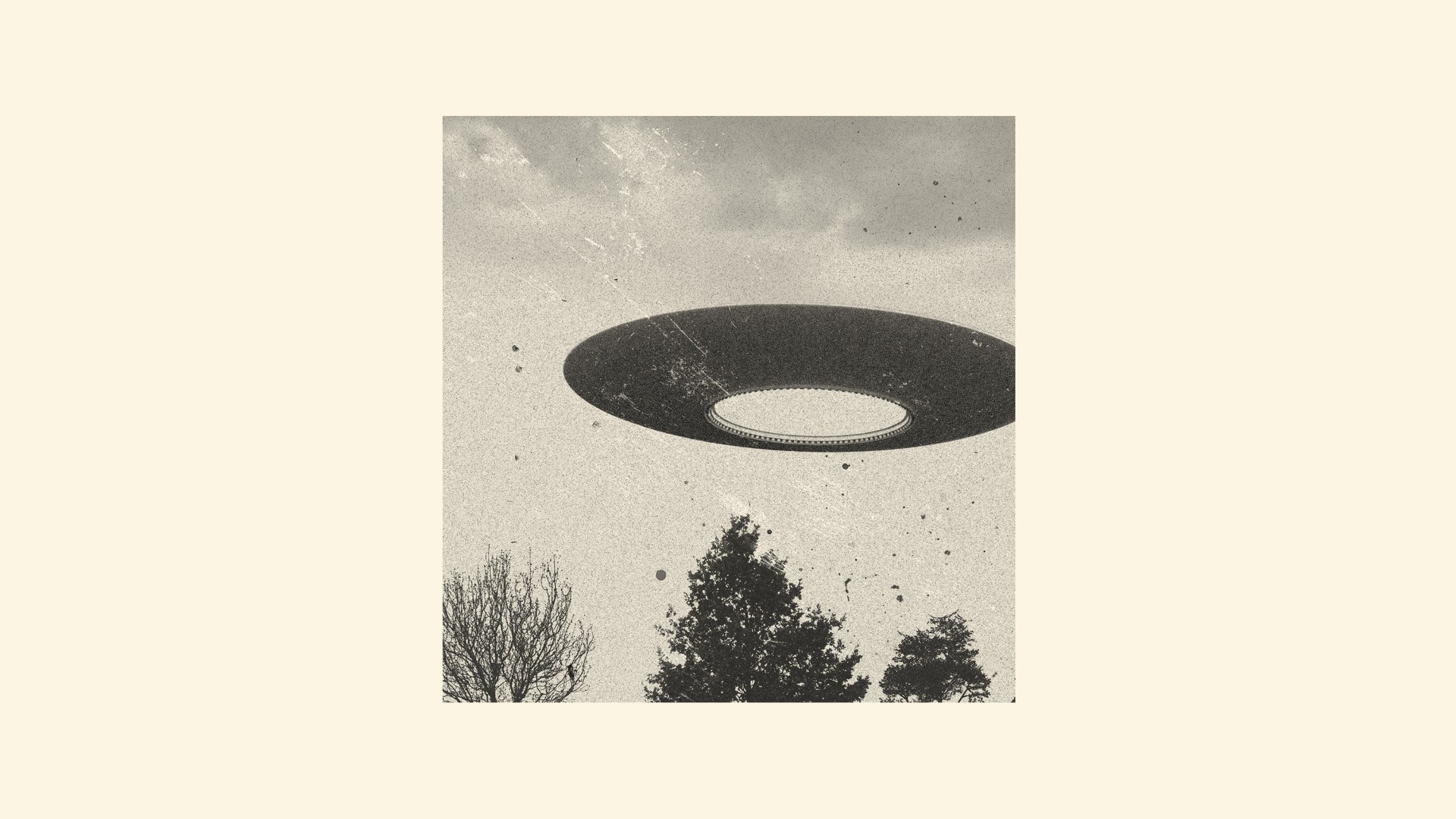
This is how strange our times are: Last week, two United States presidents engaged the question of whether aliens are real, and it wasn’t even in the top 15 stories of the week. The debate was over not “aliens” as in migrants to a country but “aliens” as in extraterrestrial, nonhuman beings.
Former president Barack Obama sparked the controversy by responding to a question about aliens in a podcast interview and saying that “they’re real” before assuring listeners that there are no underground bunkers studying aliens at Area 51. President Donald Trump then accused Obama of giving out “classified information” and then pledged to declassify government documents on what used to be called unidentified flying objects (UFOs) and are now referred to as unidentified anomalous phenomena (UAPs).
Those discussing UAPs these days are not tinfoil-wearing conspiracists but rather the secretary of state and senior military officials who argue that someone seems to have some kind of technology that American scientists can’t explain. Still, I find it highly unlikely that anything substantial will come out of whatever documents are released. But let’s suppose, for the sake of argument, that science does one day prove the existence of intelligent extraterrestrial life.
Obama clarified a few days later, after his interview prompted questions all over the world, that he was not suggesting he has some inside information about aliens. Just the opposite, he said: “The universe is so vast that” he finds it likely that we are not the only conscious species out there. Some people were disappointed by this. Some of them just want the drama of it all, of course, but some want alien life to be out there because they find the prospect of a lifeless universe in which we are all alone to be a depressing reality at best and an existential crisis at worst.
Others have the opposite view. If next week Trump were to give a speech presenting compelling evidence of extraterrestrial life (as his daughter-in-law speculated he at some point will), some people would be terrified. A thousand movies have anticipated how the world would respond—with some picturing panic, others euphoria, still others world peace wrought by having a common enemy.
But what about your church? What would happen the Sunday morning after this kind of news? Some would have a crisis of faith. After all, no doubt people would opine this means Christianity—along with every other religion—is wrong. We are just a cosmic accident, they would say, since most religions but especially Christianity grant human beings uniqueness in the universe.
And if the news were the opposite—proving that we are alone in the universe—some people would be in a crisis of faith then, too. In that case, they would think our aloneness, in light of such a vast universe, means we are just a speck of matter, conscious for a moment, on a little rock circling a star.
The reason I bring this up is not because I have an argument to make, one way or the other, about how likely alien life might be. What I do know is that even if we were ever to definitively solve the question of whether we are alone in the universe, Christianity would be just fine. And that’s because the question is not really all that new.

The David of the Bible did not know what a black hole was, and he wouldn’t have recognized an elementary-school model of the solar system, much less images from the Hubble Space Telescope. But he could see the sky, and its vastness caused him to feel the smallness and seeming insignificance of humanity: “When I look at your heavens, the work of your fingers, the moon and the stars, which you have set in place, what is man that you are mindful of him, and the son of man that you care for him?” (Ps. 8:3–4, ESV throughout).
In Scripture, God himself often communicates that the known world is far bigger and stranger than what the human mind can imagine, much less comprehend. We need not go into outer space for that kind of insight. We need only recognize how unexplored and mysterious our own oceans are: “Here is the sea, great and wide, which teems with creatures innumerable, living things both small and great; There go the ships, and Leviathan, which you formed to play in it” (104:25–26).
Yet the very same Scriptures reveal human uniqueness. David answered his own question about why we should consider a tiny human significant: “Yet you have made him a little lower than the heavenly beings and crowned him with glory and honor. You have given him dominion over the works of your hands; you have put all things under his feet” (8:5–6). Both these things are true: Humanity is a speck in a dizzyingly large universe—and the heir of all of it.
The writer of Hebrews took the argument a step further. He quoted David and then added that the problem is everything certainly does not seem to be under humanity’s feet. Nature is big and wild and chaotic—and ultimately kills us all. How can we say that humanity matters, much less that it is central? “But,” the writer says, “we see him who for a little while was made lower than the angels, namely Jesus, crowned with glory and honor because of the suffering of death, so that by the grace of God he might taste death for everyone” (2:9).
The Christian claim is this: “The Word became flesh and dwelt among us” (John 1:14), and the Son of God is inseparably united with human nature and thus is “not ashamed to call them brothers” (Heb. 2:11). That was no easier to accept in the first century than it is now. After all, no one in the first century knew what satellites were, but they did know that the cosmos was unspeakably big.

And of this one workman rabbi from Nazareth, the apostle Paul wrote, “For by him all things were created, in heaven and on earth, visible and invisible, whether thrones or dominions or rulers or authorities—all things were created through him and for him. And he is before all things, and in him all things hold together” (Col. 1:16–17).
The gospel has already grappled with the fact that we as the human race seem alone and microscopic. We are “fellow heirs with Christ” (Rom. 8:17) not because we can conquer but because he was crucified. His defeat of death accomplished the promise that boggled Abraham’s mind when he looked at the night sky over Canaan: “Look toward heaven, and number the stars, if you are able to number them,” God said to him. “So shall your offspring be” (Gen. 15:5).
If a spacecraft were to arrive and an alien say, “Take me to your leader,” we might be unnerved. But we would not, as Christians, be facing a dilemma we hadn’t seen before. We have always known there are nonhuman intelligences out there in the created order—principalities and powers, angels and demons. And it was just as stunning in the first century to ask why Jesus died for us and not for them:
For surely it is not angels that he helps, but he helps the offspring of Abraham. Therefore he had to be made like his brothers in every respect, so that he might become a merciful and faithful high priest in the service of God, to make propitiation for the sins of the people. (Heb. 2:16–17)
Paul wrote of bad circumstances and of good, “I know how to be brought low, and I know how to abound” (Phil. 4:12). The same is true here. We know how to be in a universe where there’s no other planet with intelligent beings. And we know how to be in a universe where there is. We’ve encountered phenomena far more anomalous than whatever the Air Force has tracked. The problem isn’t aliens, and it’s not even human fragility. The problem is misunderstood glory.
Even if there’s something out there watching us, and even if it were to ask, “Can anything good come out of Nazareth, or from the little rock to which Nazareth clings?” we still have the same answer we always had: “Come and see.”
Russell Moore is editor at large and columnist at Christianity Today and leads its Public Theology Project.