This piece was adapted from CT’s books newsletter. Subscribe here.

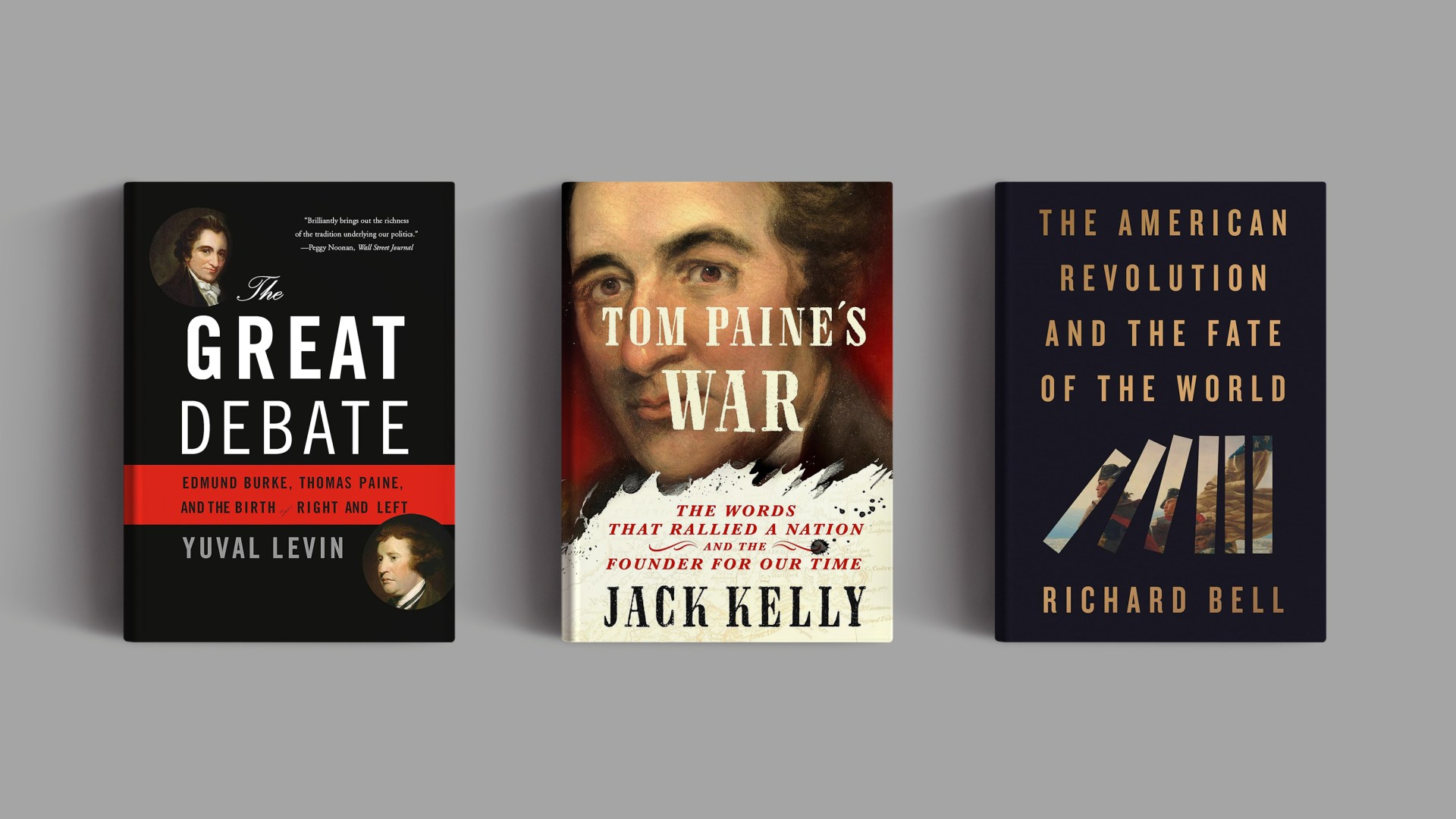
Tom Paine's War: The Words That Rallied a Nation and the Founder for Our Time
St. Martin's Press
352 pages
Jack Kelly, Tom Paine’s War: The Words That Rallied a Nation and the Founder for Our Time (St. Martin’s Press, 2026)
Many excellent books on the American Revolution will help us mark this 250th year of the country’s birth. Founders such as George Washington and Thomas Jefferson will get the most coverage this anniversary year. But our understanding of America’s independence is incomplete without considering Thomas Paine, a then-recent immigrant from England and the author of Common Sense, the most influential pamphlet arguing for American independence.
Jack Kelly’s Tom Paine’s War is a lively introduction to Paine’s critical role in the Revolution. Kelly, a novelist and history writer, doesn’t break much new ground regarding Paine, but he crafts a dramatic narrative that makes Tom Paine’s War a good introductory read.
Kelly notes that Paine is a somewhat forgotten Founding Father, though most American History courses mention Paine’s Common Sense and The American Crisis, best known for its stirring line “These are the times that try men’s souls.” Paine’s lesser status among the Founders is partly explained by his unorthodox religious beliefs. Paine had a family background in Anglicanism and Quakerism and may even have served briefly as a Methodist preacher in England. (Kelly unequivocally says he did, but the fact is not confirmed.)
During Paine’s tenure in France during the French Revolution, however, he embraced radical anti-Christian and anti-clerical ideas. This resulted in his inflammatory The Age of Reason (1794), in which he denounced the Bible and Christianity and declared that “my own mind is my own church.” Traditional Founders saw Paine as a dangerous incendiary and did not wish to associate him with America’s Revolution.
Richard Bell, The American Revolution and the Fate of the World (Riverhead Books, 2025)
A highly illuminating treatment of the Revolution’s international implications is Richard Bell’s The American Revolution and the Fate of the World. The global dimensions of the Revolution were everywhere, from the East India Company’s Chinese tea that rioters dumped into Boston Harbor in 1773 to the treaty signing in Paris that ended the war in 1783. But Americans have understandably downplayed these dimensions because of the symbolic importance the nation attaches to American “exceptionalism.”
Bell’s impressive and readable book won’t let us be satisfied, however, with the Revolution’s usual battle scenes from Bunker Hill, Massachusetts, and Yorktown, Virginia. With each chapter connected to a global-facing vignette, Bell reminds us that in the world perspective, the Revolution was really a series of interlocking gears that turned events in lands as distant as India and Australia.
Bell posits there were at least four simultaneous wars happening during the 1770s and ’80s. These began with many American colonists fighting against British imperial rule. But there was also a French gambit to weaken Britain and reconfigure the European balance of power, a similar Spanish effort to regain and protect imperial domains in the Western Hemisphere, and the undeclared but urgent efforts by Native Americans and Africans in America and the Caribbean to secure their autonomy and freedom.
Yuval Levin, The Great Debate: Edmund Burke, Thomas Paine, and the Birth of Right and Left (Basic Books, 2014)
A deeper examination of Paine’s role in the “Age of Revolutions” is Yuval Levin’s brilliant The Great Debate: Edmund Burke, Thomas Paine, and the Birth of Right and Left. Levin focuses on Burke and Paine’s clashing perspectives on the French Revolution. In Reflections on the Revolution in France (1790), the Anglo-Irish parliamentarian Burke attacked the French upheaval as precipitous and foolish. Burke’s book arguably marked the beginning of the modern conservative tradition. Paine’s response to Burke, The Rights of Man (1791), expressed great confidence in man’s ability to re-create society based on the ideals of liberty and equality.
Paine argued that progressive societies should continually pursue a return to man’s (supposed) natural state, in a society composed of individuals free from arbitrary rules and hierarchy. Virtually all churches and nations, to Paine, erect traditions designed to benefit the few and oppress the many. The people must constantly press against state and church for their natural rights. When necessary, the people should “begin the world over again” (as stated in Common Sense) by initiating revolution.
Paine was sure that when people applied reason to politics and religion, they would jettison traditional structures such as monarchy, established churches, and the historic fallacies propping up these institutions. Like Thomas Jefferson, Paine was certain that reason would eventually demolish Christian doctrinal claims such as the Trinity or the divinity of Christ.
Burke, of course, placed greater confidence in the stabilizing force of political institutions and Christian tradition. Although Burke was a British monarchist, his worries about idealistic and revolutionary social change matched those of conservative American founders, including George Washington, John Adams, and Alexander Hamilton.
Thomas S. Kidd is research professor of church history at Midwestern Baptist Theological Seminary.