





On the descent, Portland looks like it did more than a decade ago, when I first started flying home from college for visits. The little city glimmers in light reflected between the river and the overcast sky. There’s the tallest building, iridescent pink, where my dad used to work. Still pink. There are the ubiquitous trees. Still green. There are the warehouses and houseboats and a series of bridges spaced across the Willamette River like a line of shoelaces strung through eyelets.
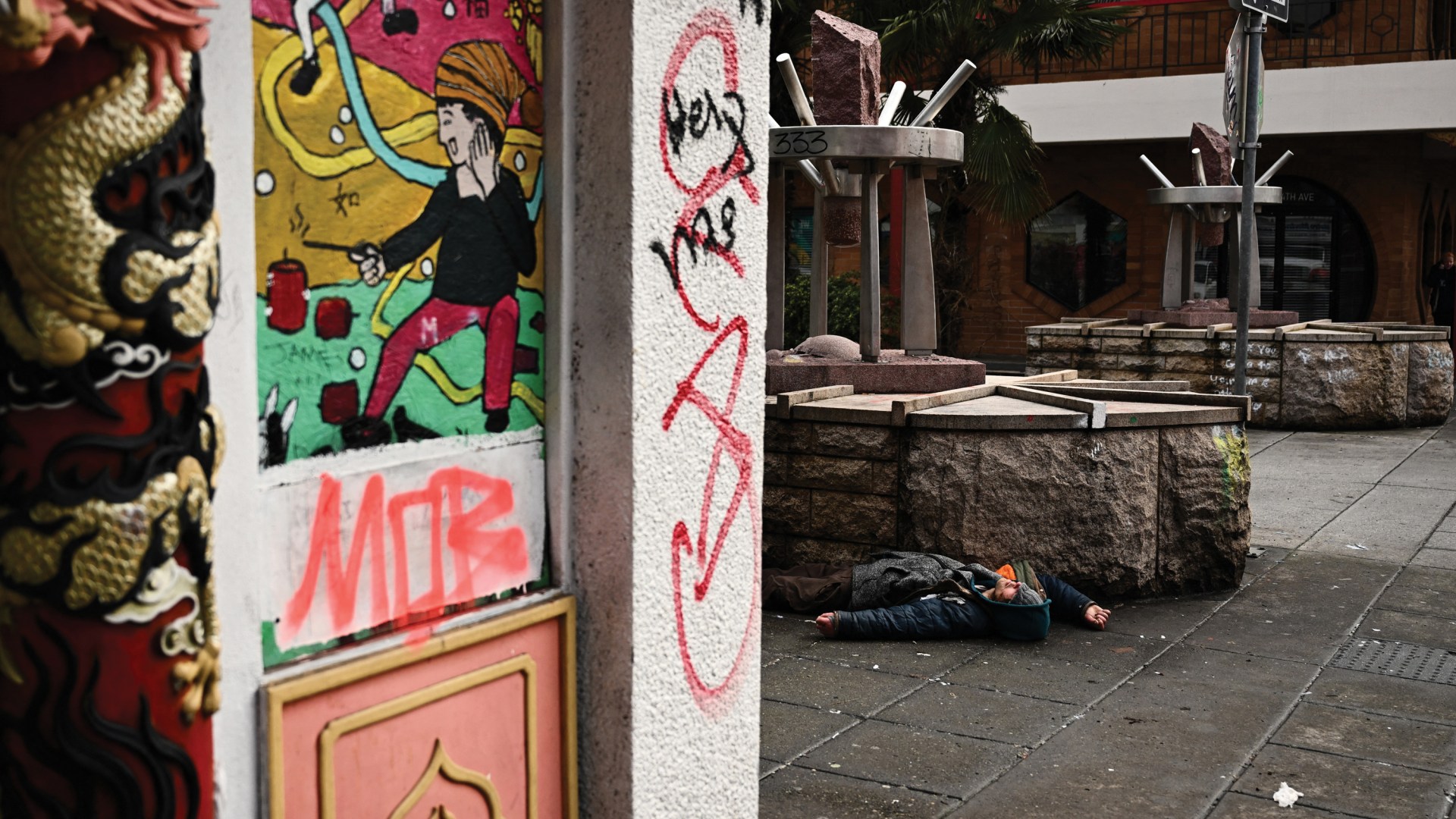
My feeling of relief as the plane touches down has stayed the same as time has passed. I’m home. But in the years I’ve lived away from Oregon, Portland has reeled. A broken-glass summer of 2020 protests preceded a failed attempt to decriminalize drugs in 2021 and a record-breaking number of homicides in 2022. (The Old Town Chinatown neighborhood suffered in particular, earning the nickname “the Skid Row of Portland.”) In September 2025, riffing on a round of demonstrations outside the city’s Immigration and Customs Enforcement facility, President Donald Trump declared that living in Portland was like “living in hell” and said he was considering sending in National Guard troops.
Later reporting revealed that the troubling footage the president had seen on Fox News was actually from Portland’s summer of 2020—not 2025. The network had mislabeled the clips and otherwise mischaracterized the most recent unrest. Yes, police had fired tear gas in those encounters, ProPublica said, but it found “no evidence of what could be termed a coordinated assault [by protestors],” and “on most of the days or nights when officers and protesters clashed, local police and federal prosecutors ended up announcing no criminal arrests or charges.”
Hell doesn’t describe the city’s tentative upward trend lines. Since “record-breaking violence” in 2021 and 2022, reports The Oregonian, homicides and shootings have decreased precipitously in Portland. So have, to a lesser extent, aggravated assaults and robberies. In 2024, legislators rolled back the drug-decriminalization legislation. By the end of 2025, under the leadership of the city’s new mayor, Keith Wilson, Portland had opened more than 1,500 shelter beds and enforced a ban on camping in public places. Last summer, downtown foot traffic was the highest it’s been post-pandemic.
But Target, REI, and other big-box stores that left the downtown core haven’t come back. From January to August 2025, Portland office-worker presence was at only 50 percent of 2019 levels. (The national average was around 73 percent.) The city’s economy is down: Last fall, an industry report ranked Portland “80th of 81 markets for the second year running for overall real estate prospects across property types,” beating out only Hartford, Connecticut.
The owner of the popular Mother’s Bistro & Bar, which serves cornflake-encrusted French toast, said her dining room is noticeably emptier: “Without weekday traffic, our city looks abandoned. It is abandoned.” (When I ate brunch at Mother’s last spring after running a popular St. Patrick’s Day 5K, I was shocked to be seated immediately.)
recommended


Pastor Tyler Michel grew up in Portland. He left in 2011, a time when the popular comedy series Portlandia shaped public perception. Bustling breweries, a thriving art scene: Portland was the place to be. Now Michel is back to pastor the 48-year-old Greater Portland Bible Church (GPBC). He says, “The level of optimism has completely changed.” Now, graffiti urges, “Don’t give up on Portland.”
While pastoring, Michel is also working on a doctorate at Wheaton College focusing on how churches can partner with civic and business organizations—and Portland is a living laboratory. He wants his congregants to skip the outrage about the state of their neighborhoods and focus on practical, local interventions. GPBC runs a food pantry that serves 150 guests every weekend, and the church is hoping to host a tool library in its space.
The church is also thinking through plans to use its property—a former dairy farm sprawling over 14 acres—as a community gathering hub. Recently, it sold two acres to Habitat for Humanity to build affordable housing. GPBC tries to support local businesses by ordering in food from nearby Thai and Mexican restaurants. Michel dreams of helping would-be entrepreneurs start their own shops and micromanufacturing outfits.
“Devastation leads to desperation that leads to transformation,” Michel said. “Sometimes churches choose either gospel proclamation or community development.” He wants to do both: “maintain a commitment to the gospel, which is the ultimate way people can thrive personally” and also “step into areas of common grace.” Michel wants churches like his to “take a seat at the table” with business and civic leaders while recognizing that, especially in a secular city, the table doesn’t belong to them.
Tim Osborn takes the same approach. He’s pastored on both the east and west sides of Portland for almost 20 years, planting five churches along the way. He’s seen the city shift as job security—especially at big employers like Intel and Nike—has risen and fallen and housing costs soared past income levels.
Osborn said the church has to help with those common-grace concerns. Young married couples need coaching on how to make budgets. A friend in the restaurant industry needs support as he crafts drinks for a brand-new eatery, working late-night shifts. A Christian can “revitalize the city” by “being a good manager … being faithful in whatever vocation you’re in.”
Mayor Keith Wilson recently gathered pastors into a room to share his shelter-bed vision. Osborn found the outreach encouraging, that “12, 13, 14 years, they said, was the last time a mayor actually opened up and said, ‘Yeah, I want to hear from and … partner with pastors and churches.’”
Osborn also teaches at Western Seminary and sees “a new wave of leaders coming … young men and women [who still have] a vision for church planting … caring about the inner core of the city.” And that seat at the table? Yes, take it!


Perhaps literally. Last fall, a prayer room called Garden Space PDX set up a long table along Burnside Street in beleaguered Old Town—bedecked with donated flowers and laden with salmon and chocolate mousse. The group sold some tickets in advance but also left chairs for unpaid guests and anyone who walked by, including those in vulnerable situations. Hungry people who didn’t want to take a seat simply filled their plates and hung out around the block.
The Garden Space prayer team recalled “Scripture that talks about Go out to the highways and the byways” (Matt. 22:8–10), said Renee Boucher, a member of the Garden Space lead team who’s done ministry in Portland for nearly 40 years. Old Town is “still so dark,” she acknowledged. “It’s a place people are afraid to go.” But for three years now, the ministry has led prayer walks around the district. And they’re getting results.
“I see the same language that we’re using in our prayers coming out of our mayor or business owners. … There’s a desire to see Old Town revitalized in a way that actually allows for the flourishing of all people,” Boucher said.
In the midst of more plans for 2026—prayer campaigns against human trafficking, workspace for artists in the “urban abbey” (as Garden Space is known), more dinners—she’s relying on a “phrase that seems to be a tagline for many of us now: Hope blooms in the City of Roses.”
“We’re believing that for downtown,” she declared. “We’re believing that for the city.”
Kate Lucky is a senior features editor at Christianity Today.
This article appeared in the March/April 2026 issue of Christianity Today as "Portland’s Rebirth?".
Related









