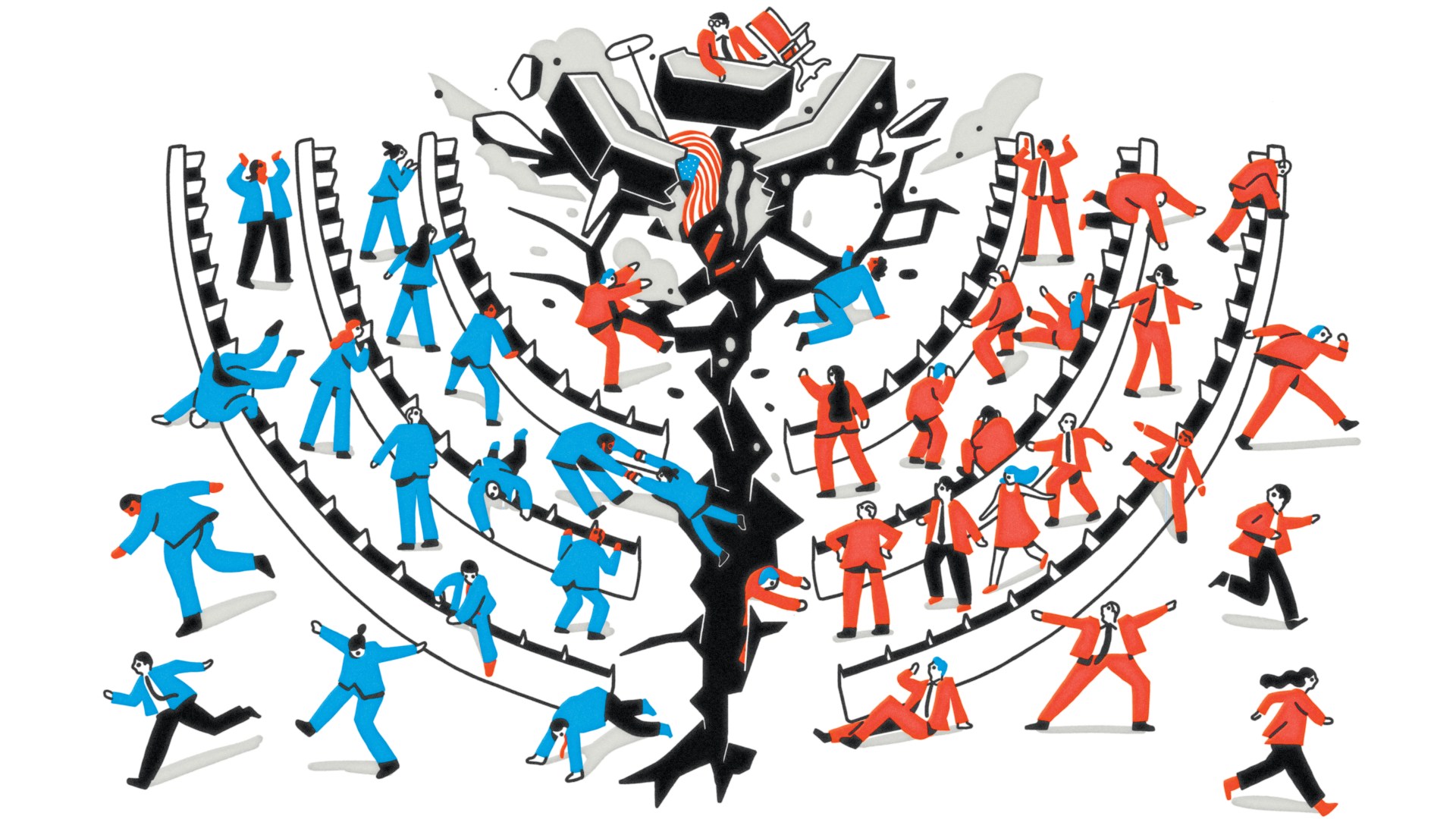
Representative Chip Roy was staring at me, baffled. I had sidled up to the Texas Republican while he was leaving the House chamber one afternoon last spring to ask him about the tech billionaire Elon Musk. Roy was used to me pestering him as he walked to and from votes—all Hill reporters do it—but this question was particularly outlandish to him.

Stuck: How Money, Media, and Violence Prevent Change in Congress
Johns Hopkins University Press
280 pages
“Do you feel like Congress,” I’d wondered aloud, “needs to be leading the audits here instead?”
At the time, Musk was at the height of his cost-cutting paroxysm. With President Donald Trump’s thumbs-up, he’d been unilaterally canceling congressionally approved spending. But Roy wasn’t worried about encroachments on the power of the purse. He was just glad that someone was looking at outlays.
“I have 14 people in my office,” Roy told me after he’d recovered from my question. “How the frick am I going to go through every report of every dollar that’s being spent?”
Musk’s short-lived initiative, the Department of Government Efficiency, wasn’t quite the picture of independent, dedicated oversight. But Roy’s answer was telling nevertheless. How indeed might a member of Congress today conduct any meaningful oversight when lawmakers can’t hire enough staff, aren’t able to hold on to the employees they do have, and keep retiring themselves?
A few months after our conversation, Roy announced he would leave the House to run for a state-level office. If he wins, he’ll have far more resources at his disposal as Texas attorney general than he ever did as one measly member of the world’s greatest deliberative body.
related


Roy’s answer that day encapsulated a problem that gnawed at me throughout the nine years I spent as a journalist on Capitol Hill. In those years, almost every article I wrote about lawmakers’ foibles and triumphs could be tied into the same overarching story: Congress is on the verge of being a failed institution.
And that’s a charitable way of putting it, placing failure at a vague point in the future. (Chatting with close friends, I’ve sometimes stated my verdict in the past tense too.) My disillusionment isn’t just some jaded outsider’s view, nor is it particularly rare. People from both parties who work in Congress often feel the same way.
House members are drowning in constituent casework, with district sizes that have ballooned and are far too large for them to actually represent. Congress can barely keep track of the gargantuan executive branch’s public activities, let alone its inner workings. And members can’t even tell if the laws they pass are being implemented correctly. On multiple occasions in the course of my reporting, I had to tell congressional staff that the agencies they were supposed to be keeping track of had ignored the plain meaning of laws to entirely sidestep congressional oversight. Overburdened with other work, the staffers hadn’t noticed.
This decay is largely a capacity problem. Congress isn’t investing in itself enough to be able to represent the American people well or to provide meaningful checks and balances.
Many Republican lawmakers have taken this broader trend of congressional disempowerment to absurd new heights over the past ten years—committing themselves to the president so devotedly that they’ve shrugged off rightful powers to declare war, set economic policy on matters like tariffs, and control the purse strings.
related


A new book from Johns Hopkins University Press, Stuck: How Money, Media, and Violence Prevent Change in Congress, explains that this situation isn’t just a this-decade disaster. It’s the result of many decisions by lawmakers to treat Congress as a scapegoat for America’s political woes. For more than 30 years, members have slashed their own resources and frozen staff and member salaries, motivated by a desire for short-term political wins. If most Americans hate Congress, those lawmakers reason, perhaps they can win votes if they act as if they also hate Congress.
Glaring ethics violations by members have demanded reform throughout US history. But largely freezing the Hill’s resources has left the place a lot more dysfunctional in the long run.
Much of the brokenness I witnessed while reporting on the Hill sprang from this self-interested self-loathing. Congressional staff are overwhelmed and often leave for jobs with better benefits. Smart lawmakers who earnestly want to work on some of the nation’s most pressing problems burn out and quit. And committees bumble through hugely important investigations with just a handful of dedicated staff members.
These aren’t sustainable working conditions, especially when you factor in the death threats faced by members and staff. A review of employment data last year found that the “probability of a staffer departing the House and Senate in a given year is 13% and 17%, respectively,” a rate far higher than the rest of the federal government at an average of roughly 6 percent. A record number of lawmakers have, like Roy, already announced they won’t run for reelection in 2026.
Throughout Stuck, Maya Kornberg—a researcher at New York University’s Brennan Center for Justice—describes how members allowed the legislative branch to stagnate, gutting nonpartisan research agencies that provided technical information and blocking their own cost-of-living pay increases. The book is at its most useful for newcomers when Kornberg identifies the structural changes Newt Gingrich implemented to push most power into the House speaker’s office, changes she notes Democrats simply turned around and kept in place later.
related


“Before the change in ’94, for fifty years the chairs ran things,” a former Democratic lawmaker told Kornberg, referring to congressional committees. Gingrich, a Republican, instead told the chairs “what bills he wanted and in many instances gave the specifics of what he wanted in the bills,” the representative said. “When we retook the House in 2006, because at that point most people had only been under the Republicans and that’s the way it was done, they said f— ’em. We will do it that way too. And we did it exactly the same way.”
This style of top-down legislating has led to some of the most toxic moments in recent congressional history. And it has also prompted a quiet atrophy among rank-and-file members, many of whom now don’t have the muscle memory or expertise to legislate on their own.
To Roy’s credit, he ardently fought that trend while he was in the House, demanding more power for regular members. But it’s a red flag when even the lawmakers who most want to cut spending and conduct oversight feel they have to outsource that job to the executive branch.
“Our committees do some of it,” Roy said of oversight during that interview about Musk, “but that takes a while to get through the system.”
The answer is not just to kick Congress over and over again until it repents but instead to give regular lawmakers the tools they need to do their jobs. Those rank-and-file members are from our communities, sent to DC to represent us. Representative democracy can be a beautiful system when carried out in earnest—and with the right resources.
Kornberg urges tweaks to empower new members, including more robust rules training so they can navigate the Hill without marching in lockstep with party leaders. She also calls for Congress to spend more on itself, growing its staff and offering salaries competitive enough to draw talent.
Her ideas make sense; plenty of political scientists have argued for similar changes. But a more ambitious plan—expanding the number of members in the House itself—would do a lot more to revive the institution.
related


George Washington once envisioned a ratio of one representative for every 30,000 constituents. But for more than a century, while America’s population has grown, the House has been frozen at 435 members. Each House member today instead represents an average of 760,000 people.
In one stroke, expanding the House would bring members closer to the communities they work for, reduce their casework to more manageable levels, and make it harder for party leaders to insist on their hyperpartisan, top-down machinations.
But even considering a change like this one seems far outside the realm of possibility for this Congress. Today’s lawmakers can hardly keep the government’s lights on.
Still, throughout Stuck, Kornberg strikes a hopeful tone.
“Congress is always changeable,” she writes, “shaped and reshaped by the people who walk its halls.”
It’s true: Congress really is just people. I’m reminded, whenever I think about Capitol Hill, of Augustine’s quote about bad times. “We make our times,” he said. “Such as we are, such are the times.”
That sort of admonition is what I wished for most while reading Stuck. Much of this malaise raises questions of virtue and courage. Members broadly agree Congress is broken, but they can’t seem to will themselves to rebuild it.
Someone—perhaps a former lawmaker or a longtime Hill reporter—should write a more uninhibited, prophetic version of this book, reminding members of what Congress ought to be.
It won’t be me. After nine years, I found I couldn’t keep spending so much of my time around an institution that respected itself far less than I did. Like so many others, I quit.
Haley Byrd Wilt is a writer based in the DC area. Her reporting has been published in Foreign Policy, The New York Times, NOTUS, and CNN.
This article appeared in the March/April 2026 issue of Christianity Today as "Is Congress a Failed Institution?".
Related