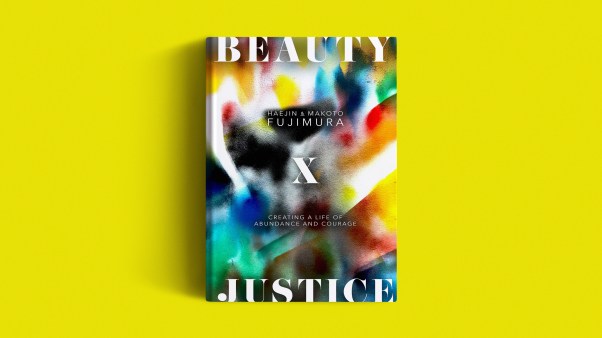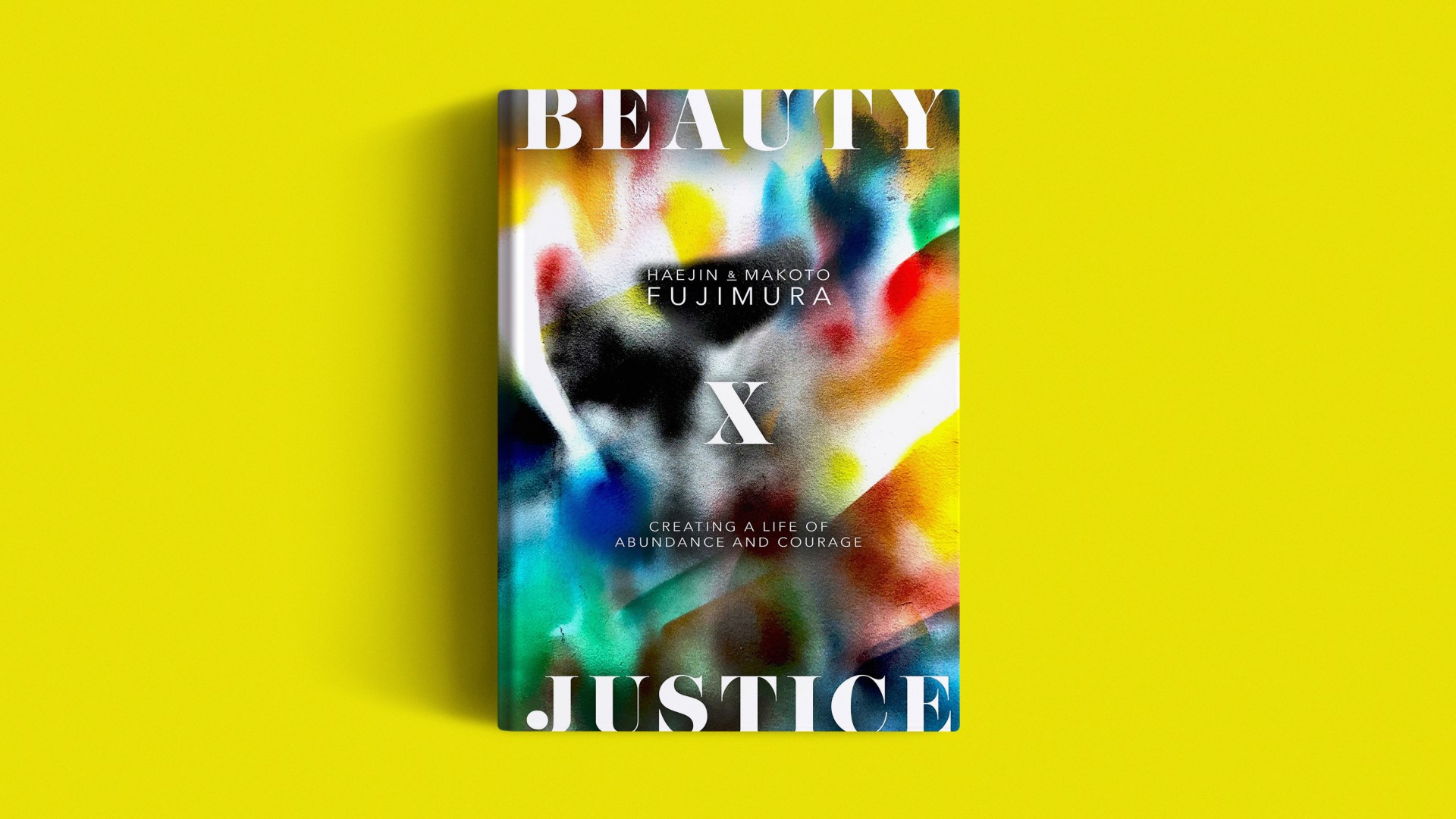
Haejin and Makoto Fujimura’s coauthored book, Beauty and Justice: Creating a Life of Abundance and Courage, posits that “beauty and justice are two sides of the same coin of the gospel.” Beauty by its nature will work toward justice, and justice is more than the absence of wrong: It is also beautiful. For readers who see beauty as less important than utility, or the work of justice as always exhausting or strident, the message that both are right responses of all who bear the image of God is welcome.

Beauty and Justice is the marriage of the authors’ vocations. Haejin, a lawyer and entrepreneur, shares stories of the humanitarian justice work her global nonprofit, Embers International, has executed in Indian brothel neighborhoods. Mako, a world-renowned artist, describes the intertwining of justice with his artistic process and the Fujimuras’ work with destitute children.
And the book is also personal. In the afterword, the Fujimuras include their wedding homily on Isaiah 61, given as a charge to them “to proclaim good news to the poor” and “to bestow on them a crown of beauty” (vv. 1, 3). Mako writes about the dissolution of his first marriage, the way he unexpectedly met Haejin in 2020, and their pandemic-era vows. They share glimpses of loss and pain—from Mako’s experiences at Ground Zero on 9/11 and his subsequent PTSD to Haejin rescuing trafficked children who live in despicable squalor. Yet these stories are often told from a distance.
As an observer, I get the sense that Haejin’s and Mako’s work and lives are better together than apart. But when reading a book on beauty and justice, I desire both an aha moment of realization and a story so well-crafted I can feel its beauty in both diction and syntax. While their painting and humanitarian work eminently show rather than tell, the telling in Beauty and Justice doesn’t quite deliver.
Perhaps the book falls short because, frankly, it’s hard to write about beauty and justice. Beauty always seems to catch us off-guard. It’s a feeling in the gut, an electric warmth, a mouth-agape moment that nails our feet to the floor. In a similar way, the longing for justice can feel like fire shut up in our bones: It can be hot, intense, maybe even full of tears. And when we try to pin down these words, they seem to slip away.
Mako agrees. He points out that beauty is “not so much a term to be defined but something to be experienced.” He mentions he’s tried to answer the question “What is beauty?” in all his books but has never felt successful. Even still, I applaud another attempt.

The couple’s vocations focus on what they call “generative living,” pursued in creating beauty and justice, that they define in five movements: genesis moments (creating into the future), grit, generosity, gratitude, and generational stewardship. Although the Fujimuras provide a general outline for this mode of living, echoing what Andy Crouch calls culture making, a reader looking for practical applications may expect more of a guided journey through the five g’s.
Because words like beauty and justice are so hard to pin down, the book kept circling around common themes. For those familiar with Mako’s previous works, much is replayed. Throughout the book he repeatedly returns to the concept of kintsugi, the Japanese art of mending broken vessels with precious materials. Makoto championed the art and extended the metaphor to the Christian life over the last several decades, and it has since become ubiquitous in books and sermons.

Throughout, we read a plethora of abstract nouns. Beauty and justice “[require] imagination,” and they are “inherently relational.” “Beauty is a portal” that “can bring justice into our bodies.” Sometimes the images are even combined in one sentence: Haejin says we should believe that we are a new creation, “a winged horse that can and will fly, a Kintsugi vessel that is more beautiful and valuable because of its scars, not despite them. Therefore, we must grow our wings and train them to fly (our new wineskin).”
It’s understandable for writers to keep searching for adequate language for concepts as resonant as beauty and justice. I understand the words’ slipperiness. But at some point, we need stories and concrete language that not only tell but also show us how to make these concepts a reality in our own lives. The sentences in the book sound nice, but ultimately, I’m not sure what they look like on the ground.
Even though the book did not forge new trails, much of it is entirely correct. We read of the redemptive arc of creation, fall into sin, redemption, and unification of beauty and justice in the new heavens and new earth. The authors make thoughtful connections and write true words (“Sacrificial love leads to generative fruit.”)
But at the end of the day, what am I supposed to do with a sentence like that, standing in my kitchen on a Wednesday night with my elbows in dishwater? How do I make the connection between my ordinary chores and sacrificial love, and how do I imagine “generative fruit”? That’s what many Christians want to know.
The challenge for writers is not only to see and do but also to communicate in fresh ways what they have seen and done. One of the most affecting scenes in Beauty and Justice involves Haejin narrating the work of Embers International. Because of the Sahasee Embers Center the nonprofit runs in an Indian slum, a young boy whom Haejin calls Amir has received hope through an education outside thearea. As a low-caste child, he did not have a birth certificate and would have been educated in ways that affirmed generational poverty. Yet Embers International helped him obtain a birth certificate, an education, and a loving community.

On one of Haejin’s prayer walks, a volunteer at the center invited her to see Amir’s home. The stench was overwhelming. Approximately 1.5 million pounds of waste were dumped daily in the nearby landfill. Down a corridor, Haejin saw Amir’s home: a public toilet he shared with his alcoholic father. She knew that aside from Amir’s days at a private school, with both bussing and afterschool care provided by the Sahasee Embers Center, his days were as noxious as the systems that oppressed him.
Haejin, wiping away her tears, made a pinky promise with Amir where he promised to say hello to her the following day at school—she was doing all she could, while giving him dignity, to ensure he would keep coming. His chin glued to his chest in shame, he still grasped her pinky. The authors write, “From the public toilet to a private school to Sahasee Embers Center and back to the public toilet, Amir experiences heaven and hell every day.” I wish the book had more of these stories.
Make no mistake, I am a fan of the Fujimuras. Mako has an illustrious career and has remained faithful to the gospel. I have marveled at his works in person, lingering over their layers. They are breathtaking. My family has a copy of his illuminated Four Holy Gospels on our coffee table. Haejin’s systematic thinking combined with her compassion is a force to be reckoned with—and one of many reasons I wanted to read the book.
Although Beauty and Justice fails to deliver adequate language commensurate with its titular nouns, I commend the attempt. For what else might an artist or advocate—or any of us—do but try to show and tell of the goodness we’ve seen? We all fall short. Gratefully, we’ve got all eternity to witness to the inexplicable reality of both.
Ashley Hales is editorial director for features at Christianity Today.