So much of pregnancy is numbers. How many days since your last menstrual period? How many babies are in there? How long is the femur? How thick is the placenta? What’s the angle of the nasal tip? How many centimeters is your fundal height? How many weeks? How many more weeks? Are you sure it’s that many weeks? Are you sure it’s just one in there?
With labor comes a new metric: hours. This is the worst number of all. You’ll hear tantalizing tales, intended as encouragement, of labors measured in minutes. I myself know a baby who made a sudden appearance at home after a short spell of light contractions spaced 15 minutes apart.
Alas, that was not my baby. My first pregnancy was twins. They were delivered—unusually for multiples—without a C-section or epidural, by a doctor who specialized in complicated births with few medical
interventions. At a prenatal visit, I asked about the longest time gap he’d seen between babies. Two hours, he said. I was reassured.
After my delivery, I assume that doctor has revised his approach to this query, because my gap between babies was four hours and 45 minutes. That’s not reassuring at all.
But it was instructive. It taught me how time matters in birth—and how much a provider’s posture toward time can reveal about the nature of their care. My doctor was on no schedule but mine. Those 285 minutes were very uncomfortable but never unsafe or uncertain.
In a more conventional hospital setting, however, they wouldn’t have been allowed. I’d most likely have been bundled off to the operating room, then tasked with caring for two infants while recovering from both kinds of delivery at once.
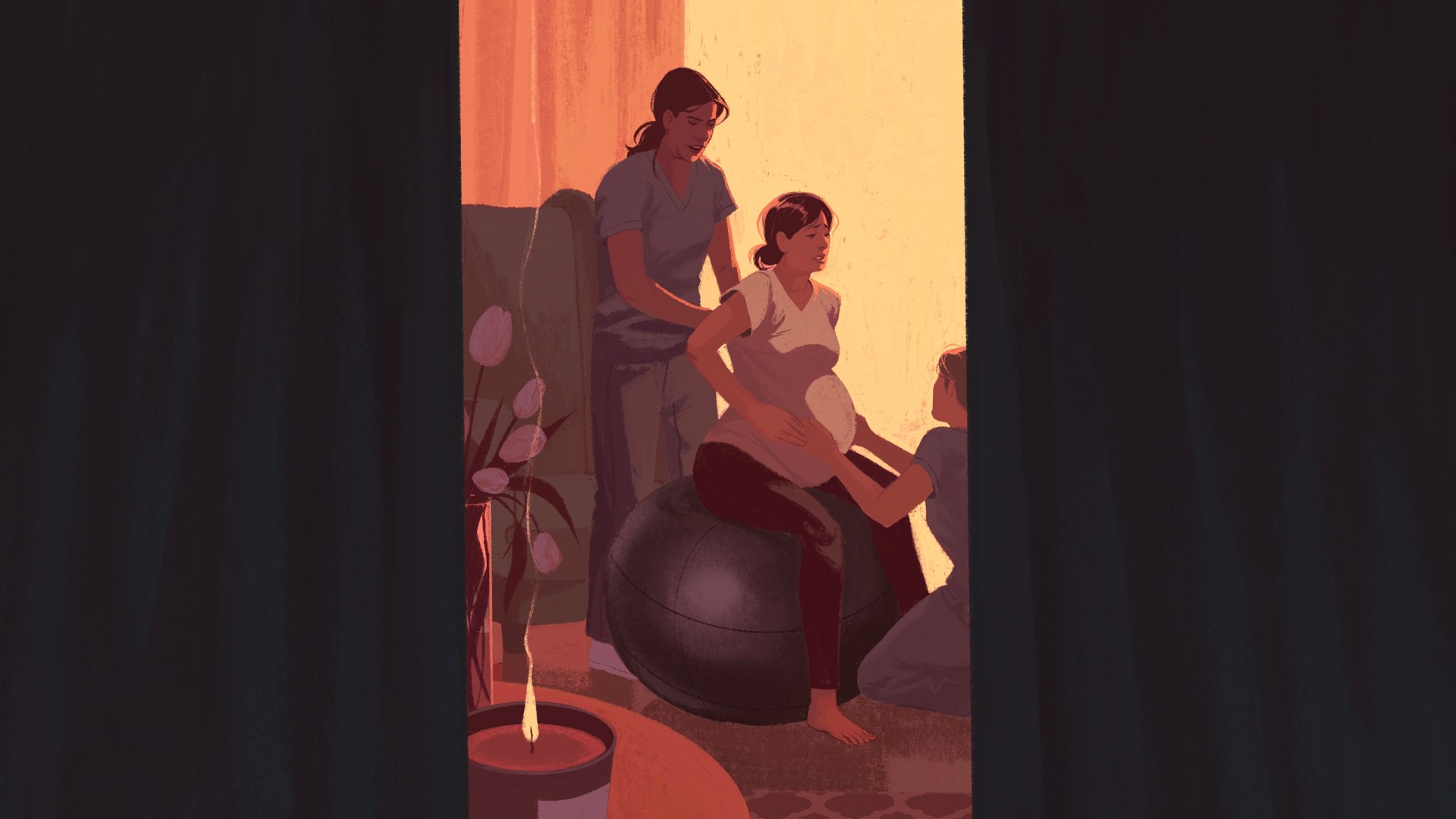
My second birth reinforced the time-and-care lesson, albeit on the other end of the timescale. I went to our midwife-run birth center at 8 a.m., had the baby at 5 p.m., and by 10 that night was at home in my own bed.
Everything was different, yet the philosophy of care was the same. And though the primary provider at my first birth was an ob-gyn, his team was heavily populated with midwives and his style of care more resonant with theirs than with many of his medical peers. That was exactly why we’d sought him out.
Midwife-attended deliveries like mine are uncommon in America, and that’s a shame. Of course, midwifery isn’t appropriate for all pregnancies. There are many women and babies for whom hospital care, up to and including a scheduled C-section, is the right and prudent choice. Freestanding (not hospital) birth centers are only equipped to handle low-risk, uncomplicated deliveries, which means some women will “risk out” of their care, as midwives tend to phrase it. Twin pregnancies like mine are automatically high-risk.
But most pregnancies aren’t multiple, and far more births could be safely handled in birth centers than the 12 percent attended by midwives today. Not only could, in fact, but should, because midwife care in low-risk births correlates with better outcomes for mothers and babies alike.
Midwifery is the default option for low-risk deliveries in countries other than the US with the safest maternity care, and in America, peer-reviewed research shows that states with more midwife integration see “significantly higher rates of spontaneous vaginal delivery, vaginal birth after cesarean, and breastfeeding, and significantly lower rates of cesarean, preterm birth, low birth weight infants, and neonatal death.” There’s even evidence suggesting that expanding use of midwives could slow the worrisome decline in American birthrates by making pregnancy and its aftermath less of an ordeal.
This all might seem counterintuitive, I realize. Wouldn’t the greater resources of a hospital mean greater safety? For high-risk pregnancies, yes. But for low-risk pregnancies, a midwife-led birth center is more likely to avoid unnecessary medical interventions—like a C-section, which, being a major abdominal surgery, is good to avoid if it’s safe to do so—while offering women a greater supply of the resources needed most: patience, attention, and time.
“During my long labor in the hospital with my first, the doctor would stop by periodically to see how I was doing. The labor-and-delivery nurse on duty was also spread thin,” recalled Margaret St.Jean, a retired teacher in Virginia who also happens to be my mother-in-law. In the hospital, “I didn’t feel personally supported by anyone except my husband for hours of labor,” she said, but “when you opt for midwifery care, they act as their title describes. They are ‘with woman,’” as per the etymology of the term.
Following that difficult first birth, which ended in a C-section she’s long believed could’ve been avoided with more attentive care, Margaret sought out midwives for the delivery of her six subsequent children.
“Midwives keep their eyes on the laboring woman, not on machinery spitting out information,” she recalled of those births. “In later stages of labor, you cannot ask for what you need. A good midwife’s skills of observation guide her to help you. The obstetrician is trained as a surgeon. Sometimes their skill is essential to saving lives, but they don’t spend hours by your side.”
For Margaret, the practical advantages of midwifery are linked to her duty as a mother before God. Today, a birth-center delivery is often more affordable than a hospital birth—that, as well as “transparent, upfront pricing,” was “a huge selling point” for Austin Gravley, a youth ministry director in the Texas panhandle whose wife chose midwife care. But 30 years ago, midwives were the more costly option for my in-laws. Their decision was born of the biblical conviction that “children are a heritage from the Lord” (Ps. 127:3), and parental responsibility a weighty trust.
Most other parents and providers I interviewed didn’t see quite so direct a connection between their faith and their choice of midwifery. But many described a real resonance.
“My perspective as a Christian leads me to view bearing and birthing children both as a blessing and a part of normal life, but also as something cursed and difficult,” said Elisabeth Young, who works at a Christian nonprofit in Maryland. Though her choice of midwife care was mostly about its demonstrated benefits, she appreciates that midwives don’t treat “pregnancy and birth as an illness,” she told me. That’s not a theological position, exactly, but it makes good theological sense.
Ann Ledbetter, a certified nurse-midwife in Wisconsin who attends 40 to 60 births a year, said her faith “definitely” shaped her choice of work. “I have always felt in a weird way that I was guided toward midwifery,” she said, recounting a college-era pledge to God at the University of Notre Dame—
made in a moment of desperation over an organic chemistry class—to “honor [God] with my work, whatever it may be.”
The Reformer Martin Luther famously entered ministry under similar circumstances—though his distress was over a lightning storm rather than sophomore-year o-chem—so perhaps it’s appropriate that Ann is a Lutheran today. Still, she’s held on to the Catholic idea of a “preferential option for the poor,” which means following Jesus in prioritizing the “least of these” (Matt. 25:34–40).
For Ann, that’s meant working at a community health clinic where 8 in 10 patients are low-income. “It has always been my dream to provide high-quality maternity care to people who often have very few choices when it comes to childbearing,” she told me, “and I feel so lucky to have ended up in a job where I can do this every day.”

Midwife care isn’t infallible, of course. Some midwives are incompetent, as are some members of any field. And sometimes things go awry—even dangerously awry.
Austin, the youth ministry director, initially preferred a hospital delivery “out of an anxious sense of ‘What if?’ ” His wife, Melissa, had been intrigued by home birth with a midwife’s help, but for Austin, this was simply too much risk. (It’s too much for me as well, though I know several women who’ve had midwife-attended deliveries safely at home.) Austin and Melissa settled on a birth center as a middle ground.
After delivery, their son was doing well, but Melissa was losing too much blood and needed surgical repair. An ambulance rushed her to the hospital. “At first I was deeply angry about the whole ordeal,” Austin said, because “this was the exact ‘What if?’ that I had feared.” But the midwife in attendance “proved her trustworthiness,” he continued. “I respected the fact that she made the call for help and would not leave Melissa’s side until she was safe.” Their second baby, due in April, will be delivered at the same birth center.
The midwife’s assistant at that birth, Austin noted, was “a super-crunchy, progressive woman who was not a Christian,” whereas he and his wife are “theologically conservative Reformed evangelicals.” Melissa and the assistant “had some fascinating conversations about Jesus, the gospel, and church,” he said, and the couple was able to “pray for her and show to her a confidence in Christ throughout, especially after the birth when the medical emergency began.”
This pairing—of theologically conservative Christians with crunchy, often-secular progressives—is a birth-center distinctive I’ve noticed as well. Sometimes, sitting in a waiting room for a prenatal appointment, I’d marvel at who else was there with me: a homeschooling mom of five in skeins of denim next to a first-timer with grown-out purple hair and a pronouns pin. Where else in this polarized country would we all so naturally, intimately, and congenially converge?
“Most midwives I have seen, I would guess, do not align with me politically or religiously,” said Hallie Skansi Toplikar, a nurse in Central Texas who’s observed this pattern too. “Yet the friends I have that are most likely to use a birth center or even home birth are my Catholic mom friends.”
Christine, a nurse in Pennsylvania who wanted to be identified by only her first name given the sensitivity of her work, sees this unusual social mix as an asset. “One of the really beautiful parts about a birth center is that it’s a place where maybe not all of your values or all of your ideals overlap” with the people you’ll encounter, she said. “But your ideal for a low-intervention, natural birth is what brings everyone together.”
At her birth center, staff and patients alike vary widely in their views. “Certainly, I fit into that Christian-mom demographic, but we have staff from lots of different perspectives,” Christine said, and they work to serve every mother well.
My mother-in-law Margaret saw this three decades ago. “I think there may be a ‘fellow traveler’ feeling that links the conservative Christian and the crunchy progressive,” she mused—“the value of principle above convenience. These principles may not be exactly matched—for instance, on the issue of abortion. But I think there is a shared value of independence and personal responsibility.”
In her experience of midwife care, “people got along in a very comfortable way” across wide ideological and demographic divides, Margaret said. “Pregnancy, labor, and delivery are ties that bind women deeply together.”

Supporting his wife through labor can bind a man to good fatherhood, too, by offering an intensive tutorial in the long, often weary yet lovely responsibility of raising children.
“I definitely sympathize with husbands who are concerned” about risk in nonhospital births, Austin reflected. “But even after my wife’s situation, the birth center was a genuinely beautiful and unique experience, and I don’t think that’s something to take lightly if it’s something your wife wants and it’s safe to do. It pushed me completely out of my comfort zone,” he added, “but if your midwife is trained and trustworthy, the upsides are valuable.”
That value extends beyond any one family. Birth deserts—places where women have no nearby facility offering maternity care—are an urgent and dangerous problem in America. It’s a lot more feasible to start and support a freestanding birth center than an entire hospital. Even so, it’s not easy.
Some states maintain unfriendly legal environments for midwives, with limited licensure options or onerous and counterproductive supervision requirements. Birth centers often operate on thin margins, organized as nonprofits to accept much-needed grants and other charitable giving. They try to keep costs low to make midwife care as accessible as possible, yet even with a small sticker price, insurance companies can be obstructive and reimbursements too few.
Money woes are common, Christine said, telling me that the sole freestanding birth center in Philadelphia closed in February. After nearly half a century and 16,000 babies, rising “financial and regulatory challenges” finally made it impossible to continue.
Talking about delivery practices can be difficult, because even dispassionate conversation about birth centers might feel like judgment for women who of necessity or choice took a different route to motherhood. It’s a prickly subject, and understandably so. But I have no qualms in saying that this facility closure is a severe loss for the women of Philly. That’s not because midwife care is right for every birth but rather because it’s a blessing for many.
“My midwives were strong Christians, and I did feel God was very present and active in my births with them,” said Carrie Stallings, a writer and tutor in West Texas who chose midwife care for its practical benefits. “But he was also present and active in my hospital birth.”
We know that God will be attentive either way, but if you want a birth provider ready to stand vigil, consider calling a midwife.
Bonnie Kristian is deputy editor at Christianity Today.