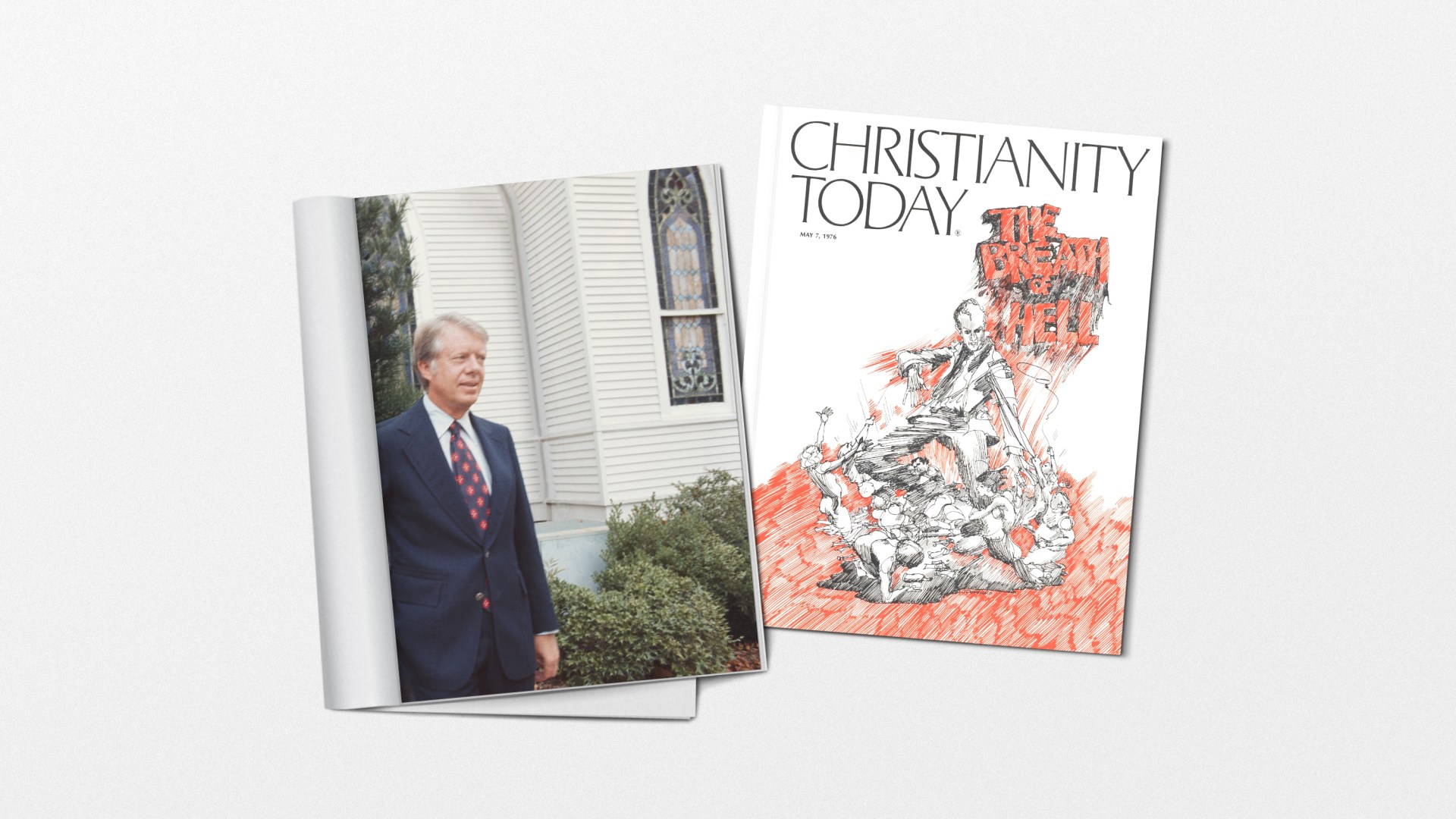
CT started 1976 on a contrarian note. As the nation prepared to celebrate the 200th anniversary of the Declaration of Independence, a Gordon-Conwell Theological Seminary professor argued that the real birth of America happened not in 1776 but in 1740. The January 1976 cover story argued, “We’ve picked the wrong year.”
What occurred in [1740] was nothing less than an inner American revolution, a spiritual declaration of independence that made the political reshuffling thirty-six years later an inevitability. The year 1740 was the crest of that wave of spiritual power called the Great Awakening. …
The message of personal commitment and individual decision central to the Awakening reached a wider audience than the issue of taxation without representation. The merchant class of the port cities might be inflamed by the irritating tax laws, but how much popular appeal did that issue have? Colonial America was a rural society. One authority states that only one out of twenty Americans lived in the city. While Boston was certainly a powerful radiating center, it could influence only a minority in the northern colonies, and by no means the whole seaboard.
To inflame the colonists sufficiently against Great Britain there had to be embers that were rekindled by the taxation issue, not created by it. The spiritual independence fostered by the Great Awakening saturated the colonies from Massachusetts to Georgia, from the Atlantic deep into the Appalachians.
Secondly, as a cause for rebellion the Great Awakening had a deeper appeal than the taxation issue. The spiritual appetite aroused in 1740 created a search for “something more,” a dissatisfaction with the status quo that refused to fade with time. Two centuries before, the Puritans of England had followed religious impulses that led to the beheading of King Charles. Is it any less likely that in 1740 transformed hearts would seek a transformed society and would want to free themselves once again from a monarch’s rule?
Most Christians, of course, were happy to celebrate 1776. CT reported that more than 1,000 overtly religious celebrations across the country were “thanking God for America.”
These endeavors range from production of a new hymnal, drama and musical presentations, and a conference on religious liberty to bell-ringing and large-scale outreach efforts. In addition to the officially recognized projects are many by individual churches and other religious groups in just about every city in the land. They all add up to a gigantic religious celebration of the nation’s first two hundred years.
The [American Revolution Bicentennial Administration] wants every bell in America rung on July 4 for two minutes at 2 p.m. EDST (11 A.M. Pacific time) when the Liberty Bell will be rung in Philadelphia. The American Bible Society is promoting participation by churches in the bell-ringing observance. In conjunction with it, the ABS is distributing to churches and synagogues a copper-colored bell-shaped pamphlet containing verses from Isaiah 61 and bearing the title “Proclaim Liberty Throughout the Land.”
CT’s regular arts column, Refiner’s Fire, noted a surge of interest in science fiction in the 1970s but couldn’t decide what it meant.
Michael Crichton’s Andromeda Strain may have contributed to bringing scifi out of the closet. Crichton placed the action of the novel in the near enough future to avoid the fantastic ethos that has usually been a part of this genre.
The most visible evidence of the new popularity of science fiction is the continual replaying of the television series “Star Trek.” It has gathered a group of fanatical fans among the young. …
All this new activity may be deeply significant or it may simply mean that the Saturday morning “Jetson” fans have grown up and are unwilling to leave science fiction behind. I leave that profound determination to someone else. …
The subjects of science fiction are overwhelmingly politics, technology, and their interaction. Religion, sex, and other interesting social activities normally appear only peripherally or occasionally.
A review of Bob Dylan’s music—from his early protest songs through his electric turn and the Rolling Thunder Revue tour—reached sharper conclusions about his “almost Christian” music.
He views man in the light of the cosmic struggle between good and evil. Man must choose to follow God and truth or fall into death, decay, and ultimate judgment. …
Bob Dylan pioneered the message song; he remains at its forefront. He asks metaphysical questions and tries to give some answers, which are less than Christian. But he has affected many young people and continues to do so. We need to understand what kind of spiritual guidance he gives.
CT also reviewed some notable names in literary fiction, including Saul Bellow, Joyce Carol Oates, and the madcap maximalist conspiracy-theory capers of Thomas Pynchon.
The vision of Pynchon is one of apocalypse, of decadence, of a streamlined Doomsday Machine tooling, to the accompaniment of a kazoo chorus, down “the street of the twentieth century, at whose far end or turning—we hope—is some sense of home or safety. But no guarantees” (V.).
At age thirty-nine, Thomas Pynchon is perhaps one of the most accomplished American writers of our time. He has published short stories in various magazines, but his reputation rests primarily on his three novels. … He synthesizes philosophy, sociology, science (he was an engineering major at Cornell), popular culture, the humanities, and theology. And his novels are brilliant collages of literary modes and styles, defying classification. One reviewer commented that it is easier to nail down a blob of mercury than to describe a novel by Pynchon.
The three novels have been aptly characterized as an extended meditation on the twentieth century.
CT’s most controversial article of the year challenged readers to rethink the way they understood the gospel, taking cues from James Cone’s Black liberation theology. The author, described as “an angry evangelical from Chicago,” wanted readers to join him in the declaration, “Down with the Honky Christ—Up with the Funky Jesus.”
Most white people understand what a black person means when he calls someone a “honky.” If they can’t define it verbally they feel what it means—oppressor, bigot, slave-trader, exploiter, and in many ways, middle-class. A honky belongs to the status quo, the safe, the comfortable.
“Funky,” on the other hand, may be a new term to many of you. In black parlance funky often has certain positive connotations. For example, if I call a song funky I mean that either voice or instrument stepped creatively from behind the strictures of the notes, boldly and freely authenticating his or her own soul in the rendition of the number. Funky stands opposite to honky—liberated, authentic, creative.
These two adjectives used in relation to the Gospel incarnate in Jesus pinpoint the problem I see in traditional evangelical circles, black or white. We and our leaders have been preaching a honky Christ to a world hungry for the funky Jesus of the Bible. The honky Christ stands with the status quo, the funky Jesus moves apart from the ruling religious system. Jesus stood with and for the poor and oppressed and disinherited. He came for the sick and needy.
A Black Baptist minister from Boston offered a more measured reflection on the racial politics of the era, looking at efforts to integrate public schools through busing programs.
First, the problem is racism. Certain minorities are not wanted, not liked, and/or feared. Many bugaboos, superstitions, and stereotypes have been resurrected, if they ever were dead, against blacks, Hispanics, and other minorities.
Second, some people have found the issues of integration and busing advantageous. Because of greed and overt political ambition, they are willing to exploit the school situation for their own self-aggrandizement and political advancement.
Third, too many flame-feeders wanted to keep the busing crisis alive because they have profited by it, particularly in overtime pay, while the situation remained heated. That is the economical issue.
Psychologically, the cost of busing cannot be measured …
The big political story of the year was the presidential election. The Democrats nominated Jimmy Carter, a populist peanut farmer who told people he was a “born again” Christian, to run against incumbent Gerald Ford. The candidates’ religious commitments became a major campaign issue.
Ford is open, though not vocal, about his religious views. A lifelong Episcopalian, he credits the spiritual deepening of his life in recent years to involvement in prayer groups, study of the Bible, and the influence of other Christians, especially evangelist Billy Zeoli.
In a letter to Zeoli he stated that he had received Christ as his personal saviour and was being helped through prayer and Bible study (he and Zeoli study together periodically using the paraphrased Living Bible). He encouraged his son Michael to select an evangelical seminary. But he smokes a pipe, dances, and drinks cocktails before supper, and these practices disturb many conservative Christians (Episcopalians traditionally have not looked on them as vices). …
Carter, a Southern Baptist who takes a regular turn teaching a men’s Sunday-school class at the rural Plains (Georgia) Baptist Church, is the most outspoken of the four about his faith. He grew up in the church but not until 1966 did he have a conversion experience. He won’t discuss details but says he emerged from the experience a transformed person and began spending a lot of time in prayer and Bible reading.
He said he spent more time on his knees during the four years he was governor than in all the rest of his life put together. He tells his critics that he’s never tried to use his position as a public official to promote his beliefs, adding, “and I never would.” But whatever role he might have in the future, he explains, it will be with the same personal relationship with Christ he’s had in the last ten years.
The year 1976 seemed like “the year of the evangelical.” Political reporters asked candidates if they were “born again,” and analysts asked each other, “Will evangelicals swing the election?”
It is commonly acknowledged that America’s fastest-growing religious configuration is the evangelical Protestant community, whose current size is usually estimated to be some 40 million members—or at least 20 per cent of the population. If this percentage is projected to the electorate, it means that of, say, 80 million votes cast in the presidential election, 16 million will be by members of evangelical churches (both inside and outside the big denominations) and by those who identify with evangelical cultural traditions.
Evangelical voters are strongly concentrated in eleven southern states and six border ones (Maryland, West Virginia, Delaware, Kentucky, Missouri, and Oklahoma). They are also found in fairly large numbers in several midwestern and north-central states (such as Illinois, Indiana, Iowa, Kansas, and Nebraska). The southern and border states have 177 electoral votes, and Indiana, Iowa, Kansas, and Nebraska have 33, for a total of 210. This is short of the 270 needed for election, but evangelicals in other states (Ohio and Pennsylvania, for example) could provide the victory margin in a close election.
It is the candidacy of former Georgia governor Jimmy Carter, a Southern Baptist Sunday-school teacher that has people talking about a possible evangelical voting bloc. Carter’s public expression of down-home religious commitment has raised questions—and eyebrows—for some voters (especially Jewish ones), but it has unquestionably gained him evangelical support. Evangelicals and Carter speak the same born-again, Christ-is-my-Saviour language.
Not all evangelicals were happy with Carter. Some specially questioned his judgment when he gave an interview to Playboy, known for its nude centerfolds, and were disappointed by his stand on the moral issue of abortion.
Carter’s positions appear ambiguous to some evangelical critics. His views on abortion have evoked the most vocal controversy to date. Contrary to many accusations, Carter says he had no input at all on the Democratic platform plank on abortion. That plank opposes a constitutional amendment to limit abortion. Carter says his position is similar, “but I would have worded it differently.” He also states that he personally opposes abortion and “will do everything possible to minimize its need” if he is elected President.
In a speech for anti-abortion candidate Ellen McCormack, convention delegate James Killilea cited opposition to Carter on the abortion issue by a Catholic writer and by Harold O. J. Brown, a teacher at Trinity seminary in suburban Chicago and a leader in the anti-abortion Christian Action Council. In describing Brown as “an evangelical like [Carter],” he quoted the theologian as saying: “For someone to say that he is morally opposed to abortion and then that he is against doing anything to stop the present flood of abortions is rather like Pontius Pilate’s action in washing his hands at the trial of Jesus.”
One pro-life picket outside the hall carried a sign saying, “Carter is nothing but a 621-month-old fetus.”
Many Republicans didn’t seem interested in talking about faith and tried to tamp down religious messages at the national convention. CT called readers’ attention to one conservative who seemed different: Ronald Reagan.
Talk-show host George Otis of Van Nuys, California, recently interviewed former California governor Ronald Reagan on spiritual and moral issues. Excerpts of Reagan’s views: …
When you go out across the country and meet the people you can’t help but pray and remind God of Second Chronicles 7:14, because the people of this country are not beyond redemption. They are good people and believe this nation has a destiny as yet unfulfilled. …
I certainly know what the meaning of “born again” is. … In my own experience there came a time when there developed a new relationship with God and it grew out of need. So, yes, I have had an experience that could be described as “born again.” …
You cannot interrupt a pregnancy without taking a human life. And the only way we can justify taking a life in our Judeo-Christian tradition is in self-defense.
Carter won in November, receiving about 1.6 million votes more than Ford. CT’s editor in chief reflected on what that said about prayer.
I have been musing over an indisputable fact: some Christians were praying for the election of Jimmy Carter and others were praying for the election of Gerald Ford. All had their prayers answered—God said no to some and yes to others.