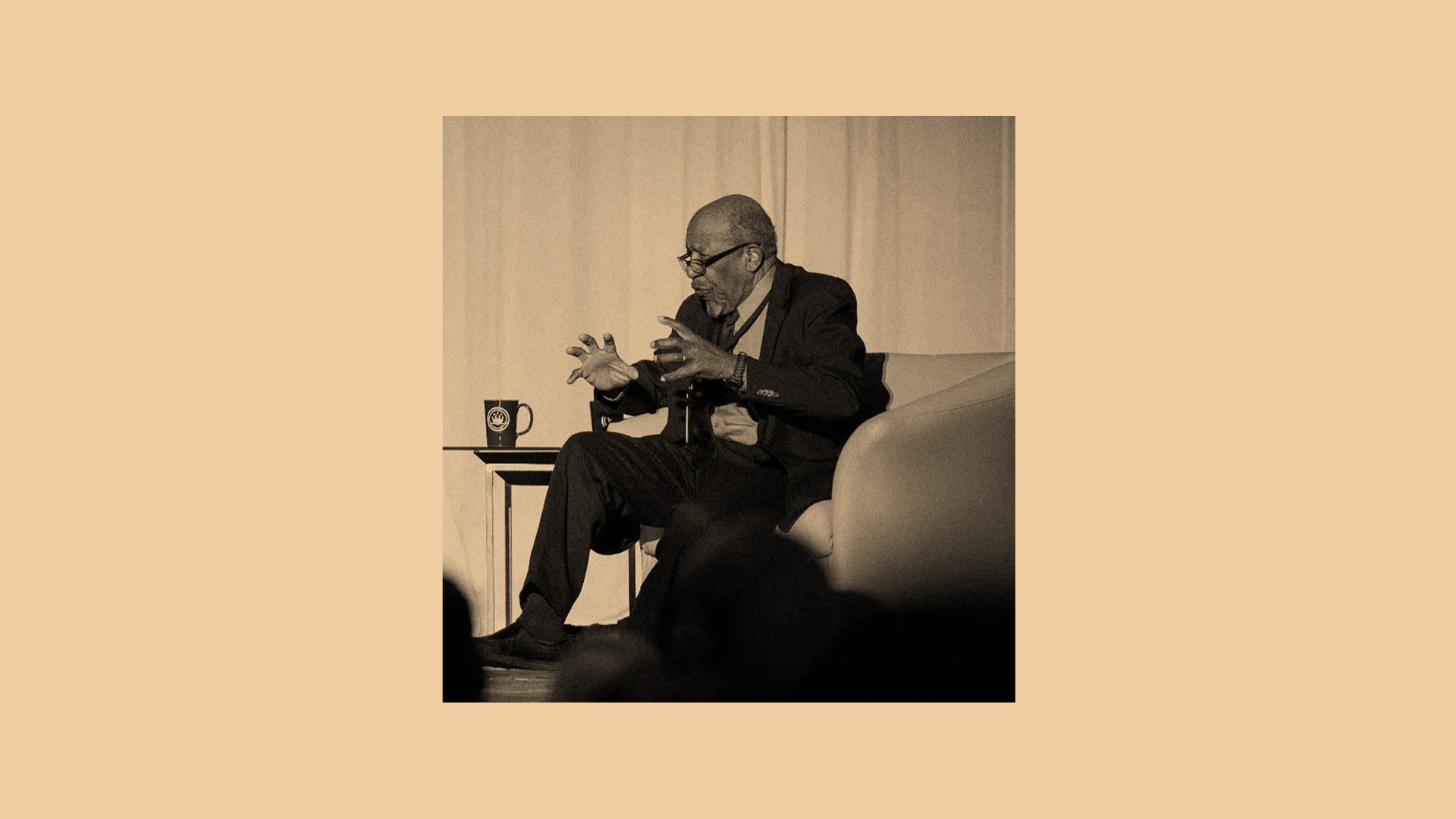
This piece was adapted from Russell Moore’s newsletter. Subscribe here.
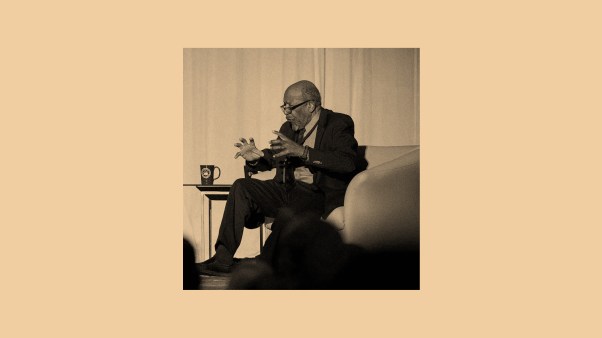
John Perkins died this week, and I can’t believe it.
When I say that, I don’t mean his death was a shock. He was in his 90s. I also don’t mean what we often say when someone we love and respect dies: “I just can’t believe he’s gone.” No, what I find hard to believe is that we were alive at the same time. That’s because Perkins seemed too large for this age.
Perkins seemed to be someone we should read about in history books, not someone we could know. Whenever I saw his face and name on the screen of my pulsing phone in an incoming call, I felt as if I were being contacted by George Whitefield or John Wesley or Martin Luther King Jr. Perkins seemed strange in this time in the world, and that’s because he is as close as we get in the present day to what people meant at one time when they said “martyr.”
He was no martyr the way the word’s been reduced and degraded. The psychological category of martyr complex did not fit him at all. He was a Black Mississippian of one generation, and I am a white Mississippian of another, and I could see what he was up to. He had left our home state, after all, and come back with a burden—to preach the gospel, to see lives changed, to stand up to white supremacy and the oppression of the poor, and to empower people to escape from poverty.

And he did that in the Mississippi of the 1960s—a race-nationalist police state that sought to make examples of everyone who, like Perkins, did not “know their place.” He was beaten, jailed, and hounded in every way possible, but he never yielded. Neither did he give up on what drove him to act in the first place. He never gave up on reconciliation.
After a certain point in the 1980s or 1990s, racial reconciliation became a phrase of deflection for many believers. Many American Christians, often white evangelicals, used reconciliation in reference to race as a way to signal, “We want multiethnic churches but only with white culture, except for an occasional gospel choir” or “We don’t want anyone to use racial slurs, but we also don’t want anyone looking at anything in the Bible that might sound like social justice.”
Seeing this linguistic trick, some who rightly opposed racial inequality became suspicious of the very word reconciliation. Perkins never did. He would no sooner give up that concept than he would give up the word grace because some television evangelists had used it to excuse their latest sex scandals.
Perkins truly believed what Paul wrote:
All this is from God, who through Christ reconciled us to himself and gave us the ministry of reconciliation; that is, in Christ God was reconciling the world to himself, not counting their trespasses against them, and entrusting to us the message of reconciliation. (2 Cor. 5:18–19, ESV throughout)
To those who wanted to honor civil rights and care for the poor but couch their concerns in vague generalities about “the divine,” Perkins thundered, “Jesus!”
And to those who wanted to keep the Jim Crow mentality, just substituting modern complaints for the language their grandparents would use, Perkins stood with the Bible: “Behold, the wages of the laborers who mowed your fields, which you kept back by fraud, are crying out against you, and the cries of the harvesters have reached the ears of the Lord of hosts” (James 5:4).
Perkins combined preaching the gospel, registering people to vote, advocating for justice and civil rights, and starting neighborhood initiatives to give the poor hope—not only for the life to come but also for escaping poverty now. Yet he never gave up on reconciliation, even with those who hated him.

Perkins refused to treat the greatest commandment (“Love the Lord your God,” Matt. 22:37) and the second-greatest commandment (“Love your neighbor as yourself,” v. 39) as separate options on a multiple-choice quiz.
Some will blanch at the word martyr because it doesn’t seem to apply to someone who passes quietly at home, holding hands with his wife, in the tenth decade of life. Perkins’s death doesn’t seem to fit in the same category as the deaths of those who were burned at the stake or drowned in rivers or fed to lions for their faith. But the term martyr is rooted in the Greek word for witness, and that’s what Perkins was.
A witness, like Scripture itself, is a two-edged thing. Ezekiel saw the idolatries going on in the temple, and God said to him, “Son of man, have you seen what the elders of the house of Israel are doing in the dark, each in his room of pictures? For they say, ‘The Lord does not see us, the Lord has forsaken the land’” (Ezek. 8:12). A witness has seen something and bears witness to it.
In a time when the government has proposed removing language about, for instance, the murder of our fellow Mississippian Medgar Evers being motivated by racism, we need a witness to say, “These things happen in darkness but will not be hidden forever.”
But witness is not only an act of judgment. The Book of Hebrews gives us a series of examples of men and women who were “commended through their faith” (11:39). This commendation was not from other people—indeed, some of these Christians were sawn in two or exiled—but from God, because they “endured as seeing him who is invisible” (v. 27). These are not past-tense examples, the book reveals: “We are surrounded by so great a cloud of witnesses” (12:1). The language of a “cloud” here describes an overwhelming multitude—the kind of assembly Revelation refers to as a “multitude that no one could number” (7:9).
The cloud does not witness to itself but spurs us to “run with endurance the race that is set before us, looking to Jesus, the founder and perfecter of our faith, who for the joy that was set before him endured the cross, despising the shame, and is seated at the right hand of the throne of God” (Heb. 12:1–2).
We could be tempted to think we are in a time of drought, without a cloud in the sky. But witnesses don’t just see something that’s already happened; they also look for something to come. And they sometimes get a glimpse: “Behold, a little cloud like a man’s hand is rising from the sea” (1 Kings 18:44).
Perkins stood with ideas and action and the kind of moral authority that can come only from testing those ideas with his life—standing for something true and loving something real. That’s the kind of witness Perkins was. And that’s what made him seem so strange in this juvenile, demoralized time.
John Perkins was alive. He still is. I believe it.
Russell Moore is editor at large and columnist at Christianity Today as well as host of the weekly podcast The Russell Moore Show from CT Media.