CT greeted 1982 with a big profile of a televangelist trying break out of “the Christian ghetto.” The magazine reported that Pat Robertson’s Christian Broadcasting Network (CBN) was developing programming designed to attract nonreligious viewers.
Posing a prime-time threat to ABC, CBS, and NBC is little more than a distant hope, but CBN’s momentum is unmistakable, attracting widespread notice in broadcast trade publications. By this month CBN will have nudged its way into the industry’s Nielsen ratings by gaining nationwide access to nearly 14 million households able to receive cable television programs. …
By presenting a smorgasbord of shows with the whole family in mind, CBN is bucking a trend toward “narrow-casting”—a term for cable broadcasters and networks that opt for a single specialty such as all-news, all-sports, or R-rated movies. CBN’s leap of faith is a high-risk venture, and it has never succeeded before.
But, as Robertson sees it, the time is right. … CBN’s splashiest attempt to communicate a Christian alternative is “Another Life,” a soap opera that attracts 100,000 viewers in New York City alone, according to Arbitron, an industry rating service.
The daily half-hour drama stars a happy, intact Christian family whose members pray their way through difficulties.
Entertainment with overtly religious themes could please wide audiences—and even win best-picture at the Academy Awards in 1982. CT praised that year’s Oscar winner, Chariots of Fire.
In conversation among many intelligent people, the mention of Jesus Christ often brings an awkward silence. In film, it is even worse. Attempts to grapple with truth, Scripture, or God are regularly greeted with hoots of derision. But there may be hope.
The British Chariots of Fire is a work of restraint and intensity that offers the Christian moviegoer a variety of admirable cinematic and real-life achievements. …
In other hands, the film would easily have taken sides—after all, each man represented a certain different approach to life—but their spirit of competition is peripheral to the real drama. It is to the film makers’ credit that they centered on the internal struggles and aspirations of the pair. In so doing they created a work that allows these two people to be just that—two real people and not idealized figures in a calculated, contrived sports or religious story. It is this integrity that is the film’s transcending strength.
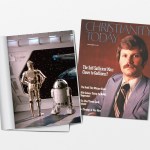
Other popular films were not so sympathetic to Christianity. CT reviewers worried one of the year’s biggest box-office hits, E.T.: The Extra-Terrestrial, promoted a counterfeit of Christianity.
Spiritual metaphors abound in E.T., a captivating tale of a seemingly timid, misshapen creature from outer space, and Elliott, the young boy with whom E.T. develops a psychical relationship after he is marooned on earth. E.T. is no ordinary fantasy, but a sophisticated production by Hollywood’s foremost director, Steven Spielberg. …
Spielberg intends for his audience to have a spiritual experience. Even the movie’s newspaper ad invites a direct comparison to Michelangelo’s creation scene—only the hand arching downward is not God’s, but E.T.’s.
The relationship of Elliott to E.T. is a “type” of the Christian’s relationship to Christ. In a touching scene, Elliott says to E.T., “I’ll believe in you all my life.” And we, too, want to place ourselves in E.T.’s hands and believe. As E.T. prepares to leave earth, he lifts his glowing finger to Elliot’s forehead and cryptically states, “I’ll be here.” A new Pentecost?
A review of the film Blade Runner was more positive, even though director Ridley Scott cut a significant Christian subplot when he adapted Philip K. Dick’s novel, Do Android’s Dream of Electric Sheep?
The film is a chilling allegory about man’s relationship to God. But more disturbing is the fact that Deckard himself, unlike his targets, has no Maker to confront. … This isn’t a family film, and it’s not for the squeamish. But of all the summer’s releases, only Blade Runner is truly adult in its thoughtfulness and complexity. If you enjoy science fiction, by all means see this.

CT reported Christian publishers were trying to adapt a popular new exercise trend for evangelical audiences, faith-based versions of best-selling aerobic workout videos such as Jazzercise, Jane Fonda’s Workout Record, and fitness celebrity Richard Simmons’s Reach.
Word discussed the concept a year and a half ago, according to Director of Public Relations Walt Quinn. But, wary of adverse reaction, Word decided to put the project on hold. When the New Benson Company, a competitor of Word, Inc., discussed an aerobics project, similar concerns surfaced.
“There were some questions within the company,” said Don Klein, Benson’s public relations director. “But enthusiasm began to build. There were those who had an ear for what was needed. And we became convinced that the idea was right for the time. I think that’s been proven by the fact that it has worked.”
By “worked,” Klein means “sold.” Since the release of Aerobic Celebration in May, the Benson Company has moved 130,000 copies, which by any standards is respectable; by Christian standards it’s very respectable. The market: fitness-conscious women, ages 18 to 30.
In response to Benson’s success with Aerobics Celebration and the recent release of its sequel, Word, Inc., has unveiled Firm Believer, “a complete exercise program featuring today’s finest Christian music.” …
But as the Christian music machine turns out fitness products and as the religious public buys them, the questions of skeptics and critics persist: At what point does giving people what they want become crass commercialism? Does it cheapen sacred music to have it obscured with exercise instructions on the toning of thighs, abdomens, and buttocks?
Keith Green, an established Christian music icon with a record of being critical of commercialization, died in a plane crash in July at age 28. The tragedy seemed to mark the end of the Jesus People era.
For Keith Green—whether he was singing in concert or on his five albums, writing in the newsletter, or pastoring at Last Days—the message was “get right with God.” …
His stand against the commercialism of contemporary Christian music was unique and radical. He once told Contemporary Christian Music magazine, “The central reason there are record companies is for corporations to make money. Anybody who honestly believes that a record company is there as a service is grossly mistaken.” After making two strong-selling albums for Sparrow, Green had his contract suspended so he could put Matthew 10:8 (“Freely you have received, freely give”) into practice. …
Green didn’t charge for his concerts either, and said, “I repent of ever having recorded one single song, and ever having played even one concert if my music and, more importantly, my life has not provoked you in godly jealousy to sell out completely to Jesus!”
CT told readers of another evangelical attempt at adaptation happening in Oregon: the country’s first Christian bank.
What separates this bank from the rest of the crowd is that it gives 10 percent of its profits to Christian schools and organizations. Furthermore, its 350 stockholders tithe their dividends, sending more money into Christian work. The idea has caught on, say bank officials, and not only has the bank attracted depositors from around the world, it has received a shower of press coverage. …
The idea does appear to be catching. Similar banks are organizing in Wheaton, Illinois; Billings, Montana; and in the Los Angeles area.
The pace of cultural change seemed to be speeding up in 1982. Only a year after CT reported on churches adopting VCRs, the magazine announced more new technology was on the way.
Americans use computers at work, at play (with video games), and finally, irresistibly, at church.
In the church? Very much so, according to Jack Gunther, vice-president of Church Growth Data Services, one of the many rapidly proliferating firms that provide computer hardware and software (programs) for churches.
“The computer in the church is an idea whose time has come,” said Gunther, who formerly worked for IBM. “Five years from now virtually every church is going to have a computer.” The machine, Gunther and others predict, will soon be as commonplace in churches as typewriters and telephones. …
There are obvious applications, such as using the machines for financial record keeping. Less obvious—and requiring special programming—is the use of computers to help congregations grow.
For example, a church might have a computerized membership profile with categories such as the member’s name, address, and marital status when he joined the church, his health, talents, interests, and spiritual gifts. The pastor of a large church, unable to know each member personally, can use the computer to match persons of similar interest in a Bible study or arrange a block party for members living in one area.

Through a Storm of Violence
Some Christians fought efforts to force change, as CT reported in “Bob Jones versus Everybody.”
Bob Jones University in Greenville, South Carolina, citing a biblical injunction against mixing of races … still prohibits dating and marriage between races. …
The Bob Jones doctrine holds that joining of races contributes to “one-worldism,” which it says is man’s attempt to unite against God, and that God intended the races to remain separate when he dispersed the people at the Tower of Babel. …
Bob Jones III, the school’s president (his father and grandfather preceded him as president), testified in detail on the school’s beliefs during a federal trial in 1978.
Evangelical scholars disagree with nearly every point Jones makes. …
For the last 12 years, Bob Jones University has battled the Internal Revenue Service to retain its tax exemption, with the IRS contending the school cannot qualify as a charitable institution eligible for tax exemption because its practice violates public policy.
Evangelist Billy Graham, meanwhile, was in the Soviet Union, preaching the gospel and warning about the dangers of nuclear war. CT defended its founder against what editors described as “a roar of disapproval.”
He thought he could accomplish more through quiet diplomacy and public preaching of the gospel than by openly denouncing the Soviet government for lack of religious freedom. Was that price too great? Billy Graham thought not. We agree. …
Those of us who believe the gospel of Jesus Christ is the dynamite of God, able to blast away sin and the sinful structures of an unjust society, may indeed regret any slips and the unfortunate infelicities of unplanned spontaneous comments. But we rejoice at the opportunity to preach the gospel—actual and potential—with the hope that the power of the gospel can change the hearts of men, as well as the evil structures of even a Communist society.
Some evangelicals tried to get creation science taught in public schools. CT reported on a legal battle in Arkansas:
In many public schools, evolution is taught explicitly as the rational alternative to the biblical teaching about creation held by uneducated fundamentalists!
All evangelicals resent this. It is a violation of their constitutional right to the free exercise of their religion. They will make laws to secure their rights, and they will battle them through the courts and beyond. Eventually they will win—if America is to remain a free nation.
But evangelicals are equally committed against any infringement of the religious rights of others. For conscience’s sake they support separation of church and state and reject the establishment of any particular religion, including their own.
CT asked theology professor Norman Geisler to make “a case for equal time.” Historian George Marsden opposed the legislation:
The law institutes a false choice. As evangelicals are well aware, there is a variety of views, even among conservative, Bible-believing Christians, relating the biblical and the scientific accounts of origins. … I am convinced that it is a great disservice to evangelical Christianity to identify it with one very narrow argument from science.
CT published a special issue on the topic in 1982 with four different authors taking different views and answering questions. An editorial established “guideposts for the current debate over origins.”
There is no general agreement as to precisely what Scripture teaches about evolution. …
The principle for the evangelical Christian is clear: When the Bible speaks, he must stand firmly by what it says; but when the Bible is silent, he must be silent as to what he believes on biblical authority.