This piece was adapted from Russell Moore’s newsletter. Subscribe here.
As of my writing this, the United States and Iran have agreed to a two-week cease-fire. Earlier this week, the president posted a profanity-laden Easter message promising that Iranians would be “living in Hell” if they did not reopen the Strait of Hormuz. After that, he threatened to wipe out “a whole civilization” in what would have been at best a war crime and at worst a genocide. Regardless of whether the cease-fire holds, we have crossed a scary threshold in American life. And in this flurry of words, there is one Christians especially should not miss: hell.
Back in the days of hippie counterculture, a song by John Lennon asked the world to envision world peace. All we had to do was “imagine there’s no heaven.” “It’s easy if you try,” Lennon told us—and indeed it is, in this world red in tooth and claw. The result would be people all over the world uniting as one, Lennon sang, “living for today.” The song was silly and utopian and brings to mind how easy it was for Joseph Stalin and Mao Zedong to imagine that above them was “only sky.”
Now we face a mirror image of all that, and it has a bit more truth to it: Imagine there’s no hell. And if there’s not, bombs away.
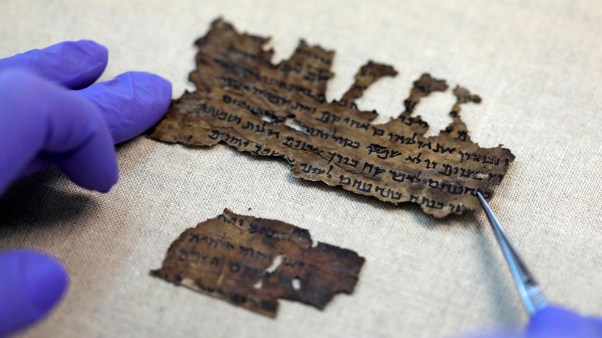
What’s more is that some of those justifying or looking away from the possibility of war crimes use the Bible to make their claim. One person, in telling me he supported the carpet-bombing of entire civilian populations, told me we would be no less justified in doing so than Joshua was in taking out the Canaanites in the Land of Promise. We can expect to hear that language more in the days to come, whether in the Middle East or elsewhere, whenever someone wants to advocate in a social media attention economy for what any previous American generation would have seen as war crimes.
But that’s not true.
I write those words as someone who is not the least bit embarrassed about Joshua. One of my first sermons was on 1 Samuel 15:33, which says, “And Samuel hacked Agag to pieces before the Lord in Gilgal” (ESV throughout). And I would preach it today exactly the same way. I have no sympathy whatsoever for those who suggest the Old Testament version of God is bloodthirsty and immoral. Instead, I agree with the assessment of Marilynne Robinson: “A great many of us feel an emphatic moral superiority to the God of Abraham, Isaac, and Jacob. This is surely bizarre, since to say the least Jesus shows no impulse at all to dissociate himself from him.”
The problem is not with Joshua but with those who do not read the Bible and then hide behind it to justify what it condemns. This is precisely the problem the Orthodox Presbyterian scholar Edmund Clowney identified in those who try to apply the Bible as a jumble of chaotic examples to follow rather than one coherent story line held together by Christ.
“Dreadful consequences have ensued when blindness to the history of revelation was coupled with the courage to follow misunderstood examples,” Clowney wrote. “Heretics have been hewed to pieces in the name of Christ, and imprecatory psalms sung on the battlefields.”
Joshua against the Canaanites and Samuel against the Amalekites fit into the flow of redemptive history. They were part of a covenant nation with specific revelation from God for those entrusted with the sword of his justice. It is not immoral for God to take life. He holds every breath, and when he takes it away, we die (Ps. 104:29). But it is immoral for someone to take the life of another innocent human being (Ex. 20:13)—even more so when the murderer pretends to speak for God (1 Kings 21:8–19).
The warfare of Joshua and of the kings immediately following him was the warfare of the anointed, those tasked with carrying out God’s judgment, precisely for the purpose of demonstrating what God’s ultimate justice would look like. The warfare of the Old Testament points us not toward future armies of Christian jihadists but to the Cross, where God’s justice and mercy meet over Jesus himself (Rom. 3:21–26).
As Clowney noted, the task of judgment has now been handed to another Joshua: the Lord Jesus Christ. He did not tell us to use a sword—he specifically disarmed the church by telling Peter to put away his weapon (Matt. 26:52–54). Instead, he gave us “keys” (16:19) through a gospel that warns of judgment but offers mercy.
That’s why the apostle Paul applied the language of warfare specifically not against “flesh and blood” (Eph. 6:12) and specifically not to earthly violence (2 Cor. 10:3–4) but to the proclamation and embodiment of the gospel. The Old Testament’s command to the covenant nation to “purge the evil person from among you” now applies not to the civil authorities but to the church, not to physical violence but to spiritual discipline, not to the outside world but to the inside (Deut. 17:7; 1 Cor. 5:1–13).
There is a place for the sword of justice in maintaining order, but God has carefully limited who can carry it, how it can be wielded, and whom it can strike (Rom. 13:1–6). Anyone who claims to speak for God in using means of violence he has forbidden claims an anointing in conflict with Jesus himself—meaning it is, quite literally, anti-Christ. To speak for God where God has not spoken is to take his name in vain. To speak for him to justify what he has forbidden is even worse (Deut. 18:15–22).

Those who would use the Bible to justify setting no moral restrictions on war (other than the power to carry it out) treat the Scriptures much the way a prosperity-gospel evangelist treats the promises of blessing, fertility, and abundance to Israel in the Old Testament. In both cases, the arguer bypasses Christ and goes directly to the believer, as though the blessings and curses were not mediated through the goal to which they pointed: Christ and him crucified (Gal. 3:10–14).
To apply the warfare of Joshua or Saul to the United States or any other military is akin to seeing Solomon’s concubines as an example to apply directly to our own marriages, an option Jesus specifically denied (Matt. 19:3–8).
But in line with the Bible, those who wield the sword are held accountable for the use of it. And that means the language of hell is quite relevant. We can do in God’s name what he forbids only if we really do not believe that he is there, that we will stand in judgment before him. In other words, to do this evil, we must be convinced that there is no hell. When we take that bargain, we had better be right. Otherwise, there’s quite literally hell to pay.
War is complicated, and often it generates morally ambiguous questions with which we must wrestle. Targeting civilian populations and wiping out entire civilizations are not among those hard dilemmas. War is not hell, but war can make us hellish. And the way we wage war can send us there.
Let’s pray for those who make these decisions and for those who must bear the consequences. But let’s also pray for souls. Those who sing “Onward Christian Soldiers” must ever ask in what direction they’re marching.
Russell Moore is editor at large and columnist at Christianity Today as well as host of the weekly podcast The Russell Moore Show from CT Media.