Was Billy Graham out of step with evangelicalism? In the article “Candid Conversation with the Evangelist,” CT asked the magazine’s founder if he had drifted to the left while the grassroots movement was moving toward the Religious Right. Graham had a different view of what was happening:
I do not agree with that observation. … There are, perhaps, some differences on social and political questions that are more evident today because of our visibility. The pendulum swings back and forth on some of the social, economic, and political issues. But most evangelicals recognize they have responsibilities in these areas in certain contexts. I have been called “liberal” in some areas because of my stand on certain social issues; I have been called “conservative” theologically. I accept both labels, and believe that I stand in the mainstream of evangelicalism.
CT also profiled Moral Majority leader Jerry Falwell, asking whether he was “bandit or crusader.” The magazine noted that, as a fundamentalist, Falwell would not cooperate with Graham on evangelistic events, and asked Falwell whether the Moral Majority was fundamentalist. He said:
The most aggressive leaders in Moral Majority are fundamentalist pastors. That isn’t necessary, because Moral Majority is not a religious organization; it’s political. There is no theological agreement in Moral Majority. At the same time, fundamentalists like me were taught to fight before we were taught to read and write. There is no lack of courage among fundamentalists. Fortunately, fundamentalists like me have been growing up over the past 20 years. We have been finding we can fellowship only in truth, but that we can have friendship in many other affinities. …
My definition of a fundamentalist is one who, first, believes in the inerrancy of Scripture, and second, is committed to biblical separation in the world and to the lordship of Christ. …
What we’ve said from the beginning is that the Moral Majority is a political organization. You’re not going to hear doctrine there. We are not going to try to witness to you there. You come as an American who shares the moral views of the membership, and to fight together on a prolife, profamily, promoral, pro-American position.
Pro-life Christians faced political setbacks in 1981. Elected leaders told them banning abortion was politically impossible.
That route requires two-thirds approval of each house of Congress and ratification by 38 states. Advocates of a constitutional amendment have been unable to agree on wording or strategy, and none of the many versions has been reported out of committee.
Ardent antiabortion activists themselves are hopelessly split: some want exceptions for such reasons as rape and incest included in the wording; others are holding out resolutely for no exceptions. And some Catholics among them have blended their opposition to unnatural contraception with their antiabortion views, further clouding the amendment cause. …
Proabortionists generally see little chance of an amendment being passed in the near future, but a statute is conceivably within easy reach since both houses are ruled by a conservative majority. Some antiabortionists fear that debate over a statute, whose continued existence would be subject to the ideological whims of future congresses, will distract from efforts to win an amendment. Others—including some stalwart antiabortionists on Capitol Hill—believe [North Carolina Jesse Helm’s proposed legislation defining an unborn child as a person] is unconstitutional.
Then, President Ronald Reagan nominated Sandra Day O’Connor to the Supreme Court. She had long called abortion a right that should be legally protected. CT reported the response of Christian activists who had mobilized pro-life support for Reagan.
Prolife leaders gathered in Dallas … a week before Senate confirmation hearings were to begin in Washington on O’Connor’s nomination, to proclaim their chagrin and do what little they could to fight the confirmation. It became clear during the long day of speeches and sermonizing that whatever their hopes for defeating O’Connor, the prolifers were not yet ready to give up on Ronald Reagan. It was the day’s most surprising development.
“Ronald Reagan is the greatest president we’ve had in my lifetime, and history may record that he’s the greatest president ever,” declared evangelist Jerry Falwell. Falwell promised Reagan he would withhold all comment on O’Connor until after the confirmation hearings. He turned down repeated opportunities provided by the press to denounce Reagan because of O’Connor.
When Carolyn Gerster, an Arizona physician and long-time leader in the prolife movement, met with candidate Reagan early in his campaign, he convinced her of his commitment against abortion. The interview led her organization, the National Right to Life Committee, to endorse him for president. During the Dallas rally, she spoke heatedly against the O’Connor nomination, but she was steadfast in her belief in Reagan. She believes Reagan was misinformed about O’Connor’s abortion record, either by O’Connor herself, or by a Justice Department staff member who researched her record.
In 1981, CT looked at another way Christians could demonstrate commitment to the value of life, publishing multiple articles on the need to include disabled people in church. A pediatrician wrote about why churches should welcome children with Down syndrome.
In my work with developmentally delayed children, I have seen and attended creative and innovative church school programs where there was an environment of love and acceptance. But in many churches, which find themselves faced with children like Jason for whom they have no program and whose very presence evokes strong feelings, rejection results. …
The act of rejection … is based on the notion that because of his retardation, Jason could not comprehend “church,” and, therefore, could not benefit from it. That is a very dangerous attitude, yet it is one that pervades our society and characterizes many of the attitudes toward retarded individuals. …
But the church has not only a commitment to accept, but the opportunity to provide a specific ministry. It is the ideal place to establish the fact that functional and intellectual abilities are not synonymous with acceptability as a person—nor, most certainly, acceptance into the kingdom of God.

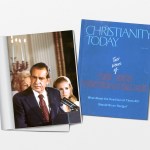
CT Reports from Nixon’s Trip to Communist China
CT called attention to a “new area of responsibility” in 1981 with an editorial on “genetic engineering.”
Having witnessed how Congress has handled, or mishandled, abortion, the energy crisis, the post office, Amtrak, and the economy, one is not given to much optimism about how our legislators will do with biotechnology and a definition of what constitutes “life.” There is no doubt that the lines of battle are already being drawn. Those who were not alarmed by the Supreme Court’s decision played down fears by noting that the oil-eating bacterium was not life, but matter. The invention was a manipulation of matter, not the creation of life in a godlike sense, they explained.
On the other hand, a strong cry of protest arose from others in both science and philosophy (not necessarily Christians, by the way), who warned against a dangerous “foot in the door” situation. Their argument is that genetic engineering makes no distinction between life and matter. They warn that the ultimate conclusion is that all of life’s properties can be reduced to the “physico-chemical.” …
What to do about splicing genes, it seems to us, will be decided on the same basis as abortion and euthanasia. If “life” is purely material, then anything goes; there are no moral boundaries. The trend in public policy in recent decades decidedly has been away from a definition of life as something special and sacred and toward a definition that is “physico-chemical.” We agree with the alarmists on this point.
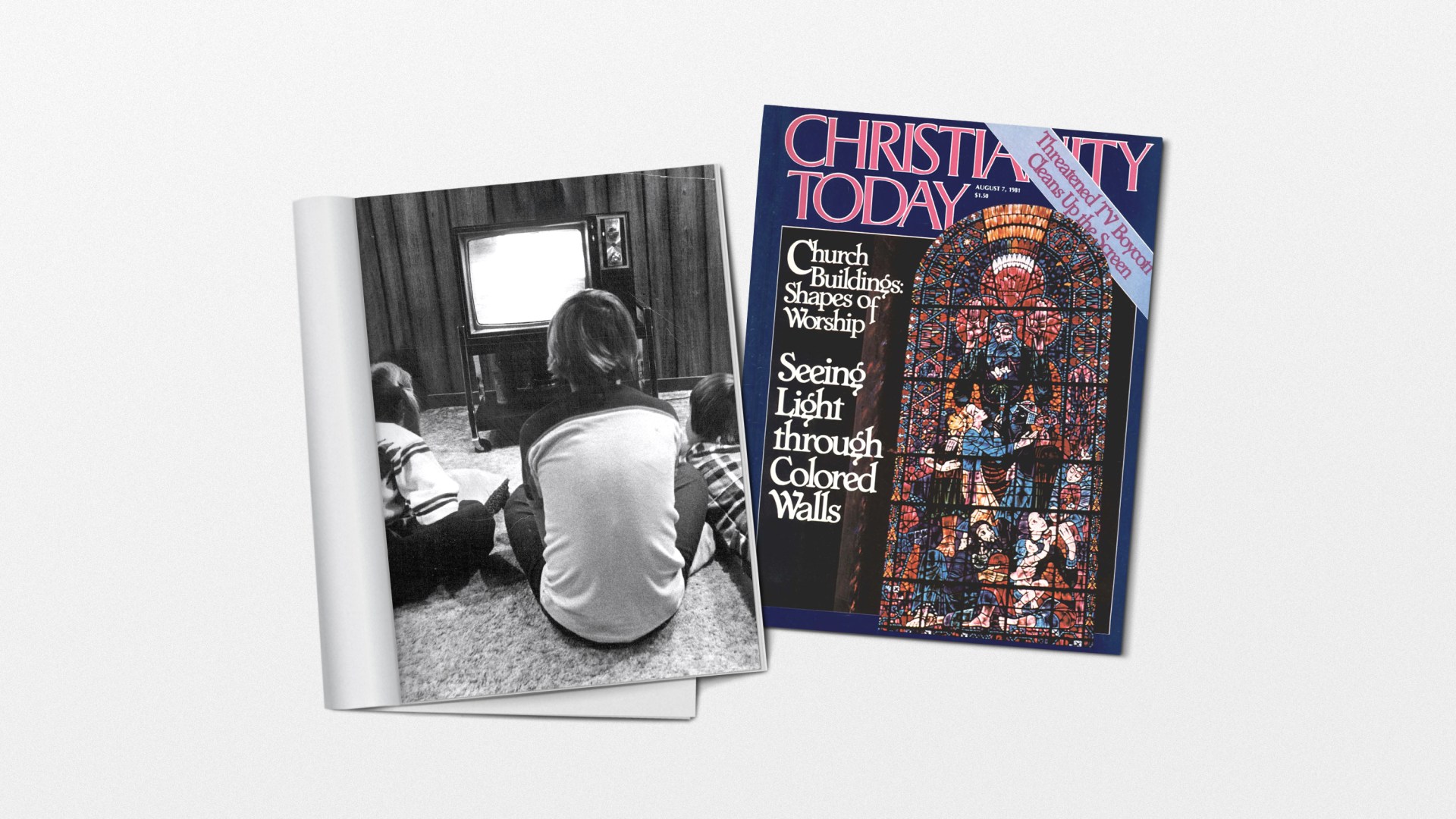
Evangelicals embraced another kind of activism in the early 1980s: boycotts. CT noted one apparently successful effort to convince television networks to stop airing offensive material.
If you want to do something to rid television of profanity, sex, and violence, switch off your set, write protest letters to network officials, or join a PTA lobby. But if you really want to do something, pull together a large group of people (three to five million will do), get backing from the Moral Majority, and plan a boycott. Threaten to stop buying products of companies that sponsor offending programs—and watch the fur fly.
That’s just what Donald B. Wildmon, founder of the Coalition for Better Television, did. He proposed a one-year boycott of products from sponsors of television shows marked offensive by 4,000 volunteer monitors during a three-month period. … The monitors produced a list of sponsors—but Wildmon never used it to effect his boycott. One week before the scheduled announcement of his list, Wildmon met with advertisers in Memphis and made an eleventh-hour decision to hold off on the boycott.
Justifying the boycott, Wildmon, a United Methodist clergyman, had said, “Our values, our principles, our morals—those things which are very dear and meaningful to us—have been ridiculed, belittled, mocked, and insulted by the networks. We feel the boycott will be criticized very loudly by the networks and the companies, but that’s nothing new to us. The only thing that matters to them is money and we’re ready to see the boycott through to prove our point.”

Christians concerned about the quality and morals of television in 1981 were also exploring the use of a new technology, the video cassette recorder, or VCR. CT said it might be the “key to taming the TV monster.”
Our family decided it was time to stop talking about television’s potential for harm and do something about it. … We looked for a workable alternative that would let our preteens feel privileged, not punished. For us the answer is a video cassette recorder (VCR). We play what we judge the very best programs. Add an occasional rented videotape, and a birthday party or slumber party becomes special. …
Saturday morning cartoons, often called TV’s most violent hours, once kept our children entranced. Now they usually give way to a replay of Sound of Music, “Little House on the Prairie,” “Star Trek,” or “Those Amazing Animals.” …
Taping costs are not unreasonable. We record six hours of material on a $15 videotape. We paid $850 for a fully portable A.C./battery-operated, 11-pound VCR. Used standard table-top models go for $350 and up. As a result of our new control over TV, we watch it less and we watch it constructively.
CT told readers their churches should also consider VCRs.
Video—specifically, prerecorded videocassette programming—could become the church’s “now and future” audio-visual tool. … While newer, lighter, portable VCR units are becoming increasingly available (remember those ads?), even carting an older machine to the home of a shut-in, plugging it into the TV, and turning on, say, John Stott, would add a new dimension to home visitation.
If you start thinking about the possibilities that exist when you possess your own VCR camera, the sky is suddenly the limit. Now you can take last Sunday morning’s service or the Sunday school Christmas program to that shut-in. Or, add a five-foot projection screen to the TV set at church: John Stott or Chuck Colson or John Mac Arthur or Oswald C. J. Hoffmann or a host of others can teach your congregation—almost in person—for a relatively small tape rental fee.
Evangelical media had its own big controversy in 1981 after CT investigated the story behind Jack Chick’s Christian comic book Alberto.
It purports to be the true story of a Jesuit priest named Alberto Rivera, who was raised and trained in a Spanish Jesuit seminary, and whose job was to infiltrate and destroy Protestant churches. … A year ago, Alberto Rivera himself issued a sworn statement defending the allegations. He declared in part that, “Alberto is a true and actual account and I will face a court of law to prove the events actually took place.” …
This reporter’s investigation shows that not only was Rivera not a Jesuit priest, but also that he had two children during the time he claimed to be living a celibate life as a Jesuit. Neither, it seems, does he have a sister in England who was a nun. Rivera has been sought by police for writing bad checks in Hoboken, New Jersey, and for stealing a credit card in Florida. Those revelations taint the credibility of the fantastic stories Rivera tells in the comic books.
Evangelicals were also debating the issue of male headship in the home in 1981. CT published multiple female authors sharing personal stories of how they submitted to their husbands. A woman in Pennsylvania wrote about how she navigated a difference of preference in holiday decor.
Hale and I have varying tastes in music, literature, hobbies, home decorating—and even in Christmas trees. He doesn’t like Christmas trees, and wouldn’t care if we never put one up. My family always had real trees that scraped the ceiling and filled the house with their fragrance. The conflict came when we were given an artificial tree as a wedding present.
For the first several years we had more than just a “discussion” on real versus artificial trees. Finally, my husband said he didn’t want to hear about it any more. So, during some years when the children were temptable babes, we didn’t put up any tree; the rest of the time I have had to be satisfied with an artificial tree, with no mention of a real one at all. … I know there is no substitute for the peace and security of having a biblically ordered home.