





Are modern Christians focusing too much on identity or not enough? How should Christians think about injecting their beliefs into civic leadership? What are some words of wisdom for church leaders who are asked questions about public policy?
These are some of the timely listener questions that Russell and producer Ashley Hales discuss on this episode of The Russell Moore Show. They talk about how Jesus navigated a cultural context that hypervalued political alignment. And they consider what it looks like to prosper in confusing times.
Questions addressed during this episode include:
Where does Russell get his news?
How can Christians focus on their identity in Christ?
What is the relationship between Christians and culture?
How can church leaders exercise wisdom as they engage questions of politics and public policy?
What should Christians do when the churches in their community preach dogma over doctrine?
What do love and justice look like in practical, concrete terms (like yard signs)?
Why aren’t people tired of perpetual panic?
What does it look like to maintain hope?
Resources mentioned in this episode include:
“Sphere Sovereignty”
Joseph Loconte
The Fellowship of the Ring by J. R. R. Tolkien
Do you have a question for Russell Moore? Send it to questions@russellmoore.com.
Ashley Hales is the producer of The Russell Moore Show, the founder of The Willowbrae Institute, and an author. Find out more at aahales.com.
Click here for a trial subscription at Christianity Today.
“The Russell Moore Show” is a production of Christianity Today
Executive Producers: Erik Petrik, Russell Moore, and Mike Cosper
Host: Russell Moore
Producer: Ashley Hales
Associate Producers: Abby Perry and McKenzie Hill
Director of Operations for CT Media: Matt Stevens
Audio engineering by Dan Phelps
Video producer: Abby Egan
Theme Song: “Dusty Delta Day” by Lennon Hutton
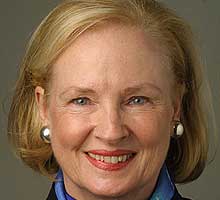
Citing the University of Notre Dame’s decision to host President Obama at its May 17 commencement ceremony, former U.S. ambassador to the Vatican Mary Ann Glendon has declined to accept the school’s prestigious Laetare Medal and to speak opposite Obama at commencement. In a letter sent this morning to Notre Dame president John Jenkins, Glendon, a pro-life Harvard Law School professor, writes:
“A commencement . . . is supposed to be a joyous day for the graduates and their families. It is not the right place, nor is a brief acceptance speech the right vehicle, for engagement with the very serious problems raised by Notre Dame’s decision – in disregard of the settled position of the U.S. bishops – to honor a prominent and uncompromising opponent of the Church’s position on issues involving fundamental principles of justice.”
The “settled position” Glendon mentions is the U.S. Conference of Catholic Bishops’ 2004 request that Catholic institutions “not honor those who act in defiance of our fundamental moral principles” and that such persons “should not be given awards, honors or platforms which would suggest support for their actions.” Glendon also expresses concern that Notre Dame’s decision could set off a “ripple effect” among U.S. Catholic universities.
President Jenkins released a brief response Monday: “We are, of course, disappointed that Professor Glendon has made this decision. It is our intention to award the Laetare Medal to another deserving recipient, and we will make that announcement as soon as possible.”
Glendon’s entire letter is below. See Francis Beckwith’s response to Notre Dame’s decision here, and Richard Mouw’s and David Dockery’s responses here.
April 27, 2009
The Rev. John I. Jenkins, C.S.C.
President
University of Notre Dame
Dear Father Jenkins,
When you informed me in December 2008 that I had been selected to receive Notre Dame’s Laetare Medal, I was profoundly moved. I treasure the memory of receiving an honorary degree from Notre Dame in 1996, and I have always felt honored that the commencement speech I gave that year was included in the anthology of Notre Dame’s most memorable commencement speeches. So I immediately began working on an acceptance speech that I hoped would be worthy of the occasion, of the honor of the medal, and of your students and faculty.
Last month, when you called to tell me that the commencement speech was to be given by President Obama, I mentioned to you that I would have to rewrite my speech. Over the ensuing weeks, the task that once seemed so delightful has been complicated by a number of factors.
First, as a longtime consultant to the U.S. Conference of Catholic Bishops, I could not help but be dismayed by the news that Notre Dame also planned to award the president an honorary degree. This, as you must know, was in disregard of the U.S. bishops’ express request of 2004 that Catholic institutions “should not honor those who act in defiance of our fundamental moral principles” and that such persons “should not be given awards, honors or platforms which would suggest support for their actions.” That request, which in no way seeks to control or interfere with an institution’s freedom to invite and engage in serious debate with whomever it wishes, seems to me so reasonable that I am at a loss to understand why a Catholic university should disrespect it.
Then I learned that “talking points” issued by Notre Dame in response to widespread criticism of its decision included two statements implying that my acceptance speech would somehow balance the event:
? “President Obama won’t be doing all the talking. Mary Ann Glendon, the former U.S. ambassador to the Vatican, will be speaking as the recipient of the Laetare Medal.”
? “We think having the president come to Notre Dame, see our graduates, meet our leaders, and hear a talk from Mary Ann Glendon is a good thing for the president and for the causes we care about.”
A commencement, however, is supposed to be a joyous day for the graduates and their families. It is not the right place, nor is a brief acceptance speech the right vehicle, for engagement with the very serious problems raised by Notre Dame’s decision – in disregard of the settled position of the U.S. bishops – to honor a prominent and uncompromising opponent of the Church’s position on issues involving fundamental principles of justice.
Finally, with recent news reports that other Catholic schools are similarly choosing to disregard the bishops’ guidelines, I am concerned that Notre Dame’s example could have an unfortunate ripple effect.
It is with great sadness, therefore, that I have concluded that I cannot accept the Laetare Medal or participate in the May 17 graduation ceremony.
In order to avoid the inevitable speculation about the reasons for my decision, I will release this letter to the press, but I do not plan to make any further comment on the matter at this time.
Yours Very Truly,
Mary Ann Glendon
Mary Ann Glendon is Learned Hand Professor of Law at Harvard Law School. A member of the editorial and advisory board of First Things, she served as the U.S. Ambassador to the Vatican from 2007 to 2009.







