A thoughtful reader of the Bible sometimes finds it hard to reconcile the Christ portrayed in church with the one we read about in Scripture. The Jesus of the Bible acts so strangely. His words are stranger still. The values and strategies that shaped his ministry seem counterintuitive, if not completely contrary to the spirit of the modern age. It is a wonder we feel so comfortable talking about him, not to mention speaking for him. Perhaps we are too comfortable. Could it be that we have missed something?
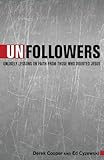
Unfollowers: Unlikely Lessons on Faith from Those Who Doubted Jesus
Wesleyan Publishing House
192 pages
In Unfollowers: Unlikely Lessons on Faith from Those Who Doubted Jesus, Derek Cooper and Ed Cyzewski observe that in the Gospels, "Jesus consistently defied people's expectations of what the Messiah would be and do." This was the majority of those who heard Jesus. The authors characterize these "unfollowers" as "rather indifferent, not choosing to follow or oppose Jesus but always grateful for a free lunch or a nifty miracle story." Although he did not initially identify with them, Cyzewski credits the Bible's non-followers of Jesus as a surprising and much needed source of insight into his own spiritual life. "Years of studying the people who got it right only resulted in convincing me that I was right" he explains. "Studying the people who got it wrong provided the most effective insight into the flaws of my own heart."
Unfollowers focuses on "the people who got it wrong" in the Gospels and invites us to see these familiar stories in a new light. When we see ourselves in their stories we are able to better understand their reaction to Jesus. We also begin to see ourselves more accurately. We would like to think that if we had been present when Jesus taught and performed miracles, we would have been among the few who believed. But this is probably not the case. The authors want us to consider the possibility that we might have responded to Jesus with skepticism, disappointment, and even outright rejection. In the process, they propose to deconstruct our view of Jesus. This is necessary because our tendency is to "imagine that Jesus looks just like and wants the same things as us." But the book's real objective is to deconstruct the view we have of ourselves. Or if not to completely deconstruct it, at least provide us with a needed reality check.
Stories About Us
The book directs our attention to the unfollowers of the Gospels in the hope that it will close the distance between the lives we live and those we read about in Scripture. Cooper and Cyzewksi do not want us to view these biblical accounts as stories about religious or irreligious people who are now long dead. They want us to understand that they are stories about us. The specific events and people in the life of Christ are used to highlight our own spiritual problems. John the Baptist shows us the folly of projecting our own expectations into God's plan for our lives. The townspeople of Nazareth cast a light on the shadows of our ambivalence toward Christ and reveal that we expect too little from God, despite all our affirmations of faith. The Pharisees expose our tendency to exclude others, along with our tendency to judge them based on the "external markers of religious devotion" that we have set.
Like the Galileans, we prefer the bread that comes from Jesus' hand to the hand that offers it. We do want Jesus but we want our stuff too, like the rich young ruler. We try to co-opt Jesus' plans and reengineer them to our own specifications (Judas). We use our theological constructs to set boundaries for God in an effort to control him (the Judeans). We resort to manipulation and force in a vain attempt to guard the perimeters of our meager kingdom (Pilate). We tell ourselves that we are protecting God's interests, when in reality we are pursuing our own selfish interests, as well as aiding and abetting the enemy (Caiaphus). The rocky terrain of our personal path causes us to stumble, and we begin to question whether we were mistaken about Jesus all along (the Emmaus disciples).
The book's angle of vision is both a strength and a weakness. Unfollowers helps us to see the story of Jesus that is being played out in our own lives today. The authors are right to suggest that we should slow down our reading of the Gospels and question why Jesus challenged the assumptions of his original audience. "In a sense, we have become too familiar with the Gospels," they explain, "overlooking events, sayings, and reactions that should give us pause." Overfamiliarity has left us with a view of Jesus that is two-dimensional, as flat and cartoonish as the flannel graph images once used by our our teachers in Sunday school. Readers will find the background information about the people and customs of the New Testament to be helpful and easy to understand. Unfollowers is plainly written. The tone is casual and friendly, sympathetic to the audience, and honest about the struggles we face as we attempt to follow Christ. Personal experiences put a human face on the spiritual principles being discussed.
Only One Hero
While helpful in many respects, this book ultimately fails to radically recast our vision of Jesus and the Christian life. The Jesus we find portrayed in its pages may not be the "hip" Jesus who gives us a wink, a smile, and the thumbs up, as caricatured in the introduction. But he is still the mainstream Jesus of the contemporary church. The admonitions we receive about what it means to live for Christ are also fairly standard. We should get involved. We should live more simply. We should care about social justice. We should get out of our comfort zone. We should not be so rigid about our theological constructs. We have heard this before. Probably last Sunday.
The chief weakness of the book is that its approach tends to relegate Jesus to the margins, both in its portrayal of the Gospels and in our own lives. Because the authors want us to see ourselves among the unfollowers of the Gospels, the book ends up being more about us than about Jesus. We may not be the hero in this tale, but we are at the center. "While Jesus only needs faith the size of a mustard seed to work in our lives," the authors explain, "there is something about persistent doubt that can snuff out the work of God among us."
There you have it. Jesus needs us. Jesus is all powerful, but he needs our faith in order to exercise that power. Not only are we the problem, it would seem that we are also the solution. If we are the only thing keeping the power of Christ at bay, then we must also be the key to its activation. Perhaps we are the hero in this story after all. But that cannot be true. One of the most surprising aspects of the Gospels is that nobody gets it right. The Gospels' followers and unfollowers alike misunderstood who Jesus was and what he came to do. There is only one hero in the Gospels, and his name is Jesus.
John Koessler is professor of pastoral studies at Moody Bible Institute and the author of The Surprising Grace of Disappointment: Finding Hope When God Seems to Fail Us (Moody).