Long before the horrendous day we now simply remember as 9/11, there was another tragic September 11.
On that date in 1857, a wagon train of 120 emigrants bound for California was slaughtered under a white flag, apparently by Utah Mormons. In his documentary, Burying the Past: Legacy of the Mountain Meadows Massacre, director Brian Patrick investigates the incident—and demonstrates that, contrary to the old adage, time does not heal all wounds.
The Mountain Meadows Massacre was the worst massacre of Americans by Americans until the 1995 Oklahoma City bombing. In September of 1857, nearly 140 members of the Fancher-Baker wagon train left Arkansas en route to California—and through Utah at a time of extraordinary tension and mistrust between Brigham Young’s Mormon territorial authority and the federal government.
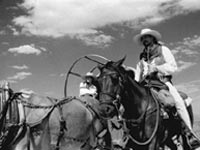
For reasons that are still unclear, after a six-day siege by a group of Mormons dressed as Indians, all but 17 small children were killed in cold blood after they were lured by a white flag and promise of a settlement. The two wagonloads of children who survived were adopted into Mormon homes until they were recaptured by the U.S. Army and returned to their families in 1859.
Using black-and-white re-enactments, a young girl’s first-person account, and interviews with historians, Patrick builds a convincing case that full responsibility for the massacre lies with the Mormon militia under the orders of their leader, Brigham Young. To this day, however, the Mormon Church blames the Indians who lived in the area, along with another Mormon man, John D. Lee, who became the designated scapegoat and was executed 20 years after the massacre.
Patrick, a professor of film studies at the University of Utah, took six years to make Burying the Past, which has won various awards at film festivals. Still, while the outcome of the massacre is not disputed, the entire truth about the event itself may never be known because most of the documents and diaries of the participants were destroyed.
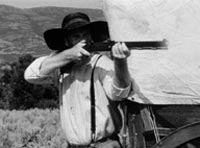
Production quality of the documentary is quite good, although the re-enactments are a bit cheesy; as befitting a documentary about a massacre, they are also rather violent. This in part motivated the Idaho SpudFest film festival to pull Burying the Past from its lineup last summer.
But the film’s real story is not that of the massacre, but of its impact on the descendants of the Fancher-Baker party and in the Mormon Church. Patrick’s research is convincing, but Burying the Past is most compelling as a study in forgiveness, or the lack thereof.
It has been nearly 150 years since the Mountain Meadows Massacre, but the wounds are still fresh in the hearts and minds of hundreds of Fancher-Baker descendants, as seen in Patrick’s footage of their family reunions and interviews. These folks want an official admission of guilt and an apology from the Mormon Church, and are unwilling to forget or even forgive until they receive them. A host of websites chronicles the massacre, the historical efforts to memorialize the site and honor the dead, and the genealogies of the victims’ families.
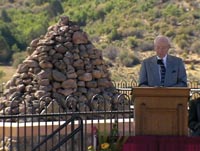
In 1999, the bones of the victims finally received a decent burial after they were unearthed by a bulldozer. The memorial ceremony included a speech by Gordon B. Hinckley, President of the Mormon Church (officially known as The Church of Jesus Christ of Latter-Day Saints). While Hinckley expressed the Church’s official sorrow for the Mountain Meadows Massacre, he did not accept the Church’s responsibility or issue an apology for the atrocities, further angering the descendants.

And so the saga continues. Mistrust abounds—of the Mormon Church and its leaders, of course, but also between the victims’ descendants, some of who are more willing to move on. Ironically, the descendants of John D. Lee have made peace and allied themselves with the Fancher-Baker descendants, as both parties feel their ancestors were victims of Brigham Young and his followers.
Burying the Past is an excellent documentary with much to say about the Mountain Meadows Massacre, the most important being that the lives of the victims were not the only casualties of September 11, 1857.
Burying the Past is only available for purchase online.
Talk About It
Discussion starters- Exodus 34:7 says God “punishes the children and their children for the sin of the fathers to the third and fourth generation.” Do you think that’s true—or fair? Do you think that’s what has happened in the story of the Mountain Meadows Massacre?
- Should a modern-day generation of people be held accountable for the sins of its forefathers? Why or why not?
- Can true forgiveness happen without a confession or an apology by the offending party? What did Jesus mean when he said we should forgive “seventy times seven?” (Matthew 18:21-22) Can you think of someone whom you need to forgive?
The Family Corner
For parents to considerWhile this movie is not rated, its massacre re-enactments are violent and intended for mature audiences. There is no nudity or vulgar language.
Photos © Copyright
Copyright © 2004 Christianity Today. Click for reprint information.