It might not be the biggest issue in the upcoming presidential election, but it’s arguably among the top ten: immigration. Specifically, what to do with the estimated 11 million people who currently live in the U.S. illegally. While the candidates discuss the staggering statistics and proposed policies, Under the Same Moon shows us the more personal (if not a tad heavy-handed) side of the issue.
On a macro level, Under the Same Moon is a story about immigration, but on a micro level it’s a story about Rosario (Kate del Castillo), an illegal immigrant working three jobs in L.A., and Carlitos (Adran Alonso), her nine-year-old son back in Mexico. Rosario snuck across the U.S. border four years earlier with her friend Alicia (Maya Zapata), a harrowing journey that left Rosario with a nasty scar on her arm. As is the story of many immigrants, Rosario came to the States to earn a better life for her son than she ever could back in her economically depressed hometown in rural Mexico. Her son’s father isn’t in the picture.

While Mom is away, Carlitos lives with his ailing grandma. Thanks to the $300 his mom sends each month, he’s able to attend a good school, unlike some of his friends who spend most of their life on the street. Though he enjoys a decent life, Carlitos still aches for the mom he hasn’t seen in four years. Their weekly phone call, with each on a local pay phone, isn’t nearly enough for this precocious boy who’s wise and mature beyond his years.
Rosario previously tried to bring her son to live with her, but the lawyer she hired split with her hard-earned money. She needs $4,000 to hire a new lawyer, and she’s saved only $2,300 so far. She knows it will take another year or more to save the needed funds from her house-cleaning jobs. Faced with this truth and with Carlitos’s growing desperation in their weekly phone calls, she contemplates moving back to Mexico.
Meanwhile, back in Mexico, Carlitos’s grandmother dies suddenly, leaving him vulnerable to a creepy uncle who seems more interested in the monthly money his mom sends than in Carlitos’s personal welfare. So Carlitos quietly sneaks away to go find his mother. He finds a pair of young Hispanic Americans willing to smuggle him across the border for the $1,000 he’s saved. But when a border guard impounds the van due to the pair’s unpaid parking tickets, Carlitos finds himself in a random parking lot just inside the U.S. border.

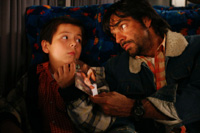
What follows is a daring and scary adventure as Carlitos attaches himself to a string of strangers—some good, some bad—in an attempt to get to the return address on the letters he receives from his mom. Rosario has no idea her beloved son is going to such risky lengths to find her—mirroring the risks she once took, and continually takes, to provide for him.
While I’m no expert on the immigration issue, I have known a few illegal immigrants over the years in the English as a Second Language classes I’ve volunteered with. The story of Rosario and Carlitos rings true to many of the people I’ve known—hard-working souls striving for a better education or a better life for themselves or for the beloved sons, daughters, wives, or siblings they hadn’t seen in years. As with so many dicey issues in our culture, it was easier to see immigration as much more black and white until I met Carlos and George and Rosalita.
One can only hope Under the Same Moon helps those who think illegal immigrants are all lazy moochers here to drain our economic system realize that illegals are people with very real needs, loves, fears, and talents. They may have disrespected the laws of the land to get here, but maybe it’s worth looking at how user-friendly those laws are—at how easy, or more realistically, difficult it is to come to this country legally. This is a key aspect of the immigration issue that I wish Under the Same Moon had covered.
I also wish Under the Same Moon had let Rosario and Carlitos’s story bring needed personal perspective to the immigration issue without trying to add its own heavy-handed agenda. Only one of the many Caucasians included in the story shows any ounce of kindness to Hispanics. Police officers and INS officials—none of them Hispanic—all use excessive force when interacting with illegals. A few bits of dialogue and prominent song lyrics say pretty pointed things about the immigration issue—as if telling us how to think about this dicey issue instead of the much more powerful route of allowing us to absorb and draw conclusions of our own.
While the storytelling is a bit heavy-handed, the acting is mostly superb—most notably Adrian Alonso as Carlitos. Adrian brings bits of humor and gravitas to this role, saving Carlitos from being one-dimensional or cloying. To a lesser degree, Kate del Castillo imbues Rosario with a wide range of believable emotion. Immigration is a complex issue, and we need these complex characters—both flawed and inspiring—to do it justice.
In the end, Under the Same Moon is ambitious, flawed, moving, and frustrating—in other words, as complex and messy as the issue of immigration.
Talk About It
Discussion starters- If you were in Rosario’s shoes, what would you have done?
- Why do each of the illegal immigrants we’re introduced to come to the U.S.? What’s noble or less-than-noble about their motivations?
- Were your attitudes about the immigration issue altered at all from watching Under the Same Moon? If so, how?
- What has informed your knowledge and attitudes about immigration? How might you become more informed about local/regional implications of immigration?
- What do you think is a proper Christian response to illegal immigrants and the overall issue of immigration? How might God be calling you get involved in this issue?
- Were you satisfied with the final scene of the movie?
The Family Corner
For parents to considerUnder the Same Moon is rated PG-13 for some mature thematic elements—most notably Carlitos finding his grandmother dead as well as various scenes of mild violence from government officials toward illegal immigrants. For these reasons—and for the fact that the police are mostly shown as bad and untrustworthy—younger children might not be the best fit for this film. However, for mature teens, this could be a great discussion starter about the complex issue of immigration—and the Christian’s call to “love thy neighbor.”
Photos © Copyright Fox Searchlight
Copyright © 2008 Christianity Today. Click for reprint information.