





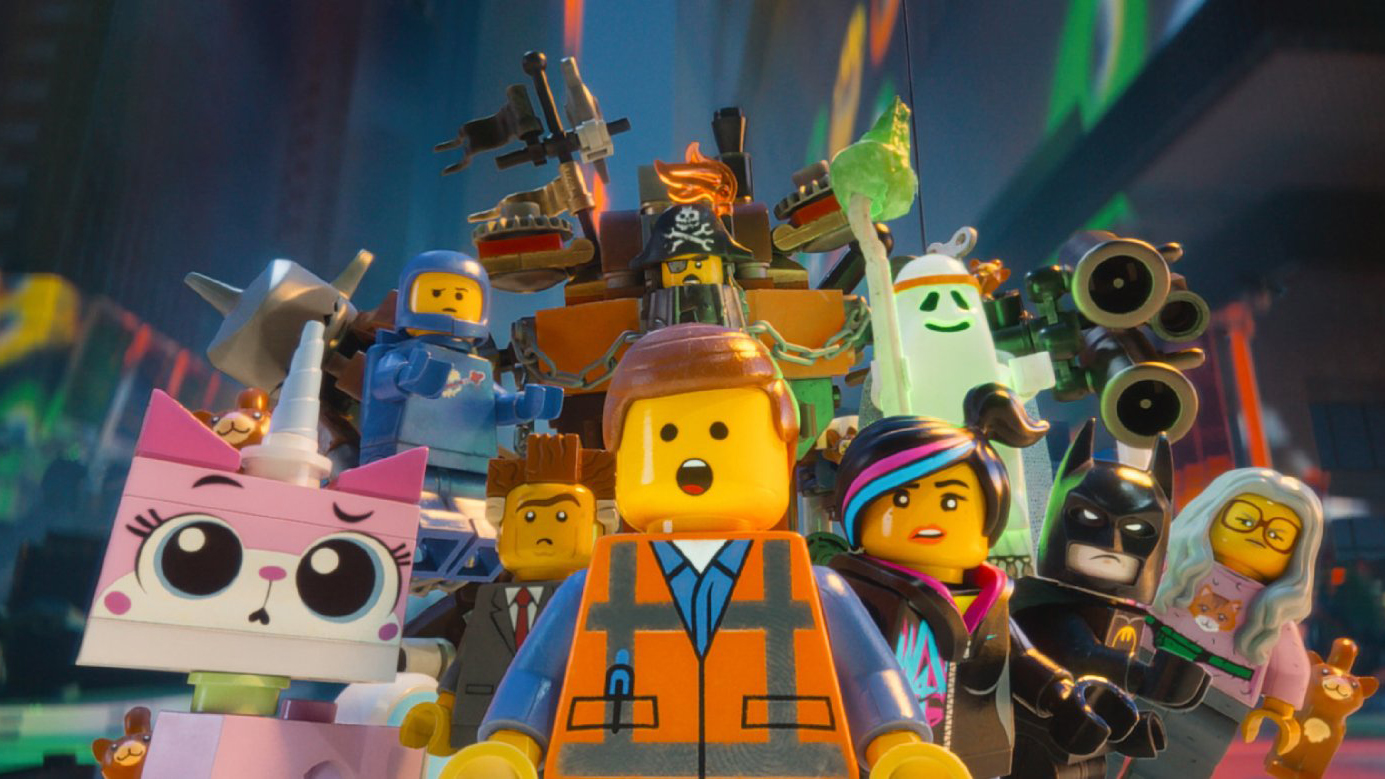
I can barely even imagine how hard it is to make a good children's movie—that is, a good movie for children. Not a movie for good children, which would be silly.
That's because, as I've suggested, all kids' movies are on some level didactic. They're meant to teach their audience something about The Way The World Is, because the audience is presumably still receptive to stuff like that. Kids don't generally leave theaters initiating sophisticated worldview conversations with their parents, so a lot of the subtle thematic or formal devices you can use with adults—irony, complex themes, really anything that requires extended rumination—is totally off the table. That's not because kids are stupid, but because movies themselves teach kids how to be smart about movies. Kids aren't dumb for not understanding algebra if they don't even know their times tables yet.
So most kids' movies are incessantly entertaining to combat the low attention span of children (perhaps only rivaled by the attention spans of people reading articles online). And their message has to be clear, and correct, but not so overbearing that parents roll their eyes.
To me, this sounds insanely difficult, which is probably why so few movies do it well. Play it too straight, and you risk reinforcing cultural assumptions and being super boring. Try too hard to subvert expectations and you send weird, confusing, deeply problematic messages.
So hopefully you'll understand why The Lego Movie made me so happy, why I left the theaters smiling from ear to ear, texting all my friends to let them know that this was a really, really good movie.
It's not particularly artistic or deep, but it does give you the thrill of lowering your critical defenses for a movie and being rewarded. It decided not to be lazy. The Lego Movie is excellent and exciting, never stooping to lowest-common-denominator shenanigans. It is constantly entertaining all the way through.
The story begins with Emmett (Chris Pratt), a remarkably ordinary Lego man, who becomes embroiled in a struggle between the megalomaniacal President Business (Will Ferrell), whose nasty Parmenidean streak makes him want to freeze the entire Lego world in place, and Vitruvius (Morgan Freeman), the leader of the Master-Builders, who want to keep the world free. The important point here is that by touching a sacred artifact Emmett is declared the Special—the most important, most interesting Lego alive, destined to save the world and stop President Business.
Maybe the best surprise in The Lego Movie is the way it flips the common convention of The Chosen One on its head. It lands staunchly on the same side as The Incredibles, insisting that everyone can be special, but that doesn't mitigate the how of people's specialness. The Incredibles suggested—like Batman Begins—that it was our actions, not our abilities, that define us. The Lego Movie proposes that our different roles in the larger story make each of us totally necessary and special, even if we don't all look and act the same.
But while the message of The Lego Movie is good, it's certainly not the most good thing about the movie. The Lego Movie is a relentlessly creative endeavor, hilarious in unexpected and subversive ways. It's the best kind of kids' movie: while it's unashamedly for kids, it's not content to just stop there. So you get tons of references to 80s and 90s-era toys, movies, and pop culture, none of which is ever raunchy or off-color.
In fact, the entire movie is fascinating for being both squeaky-clean and not overt about it. Most movies that lack "potty humor" lack it so self-consciously that you can almost smell the ammonia radiating from the movie poster. In contrast, the cleanliness of The Lego Movie isn't a product of a moral high ground so much as the recognition that there were better jokes to be made.
I'd expect nothing else from Phil Lord and Christopher Miller, who previously wrote the hilarious and equally-inventive Cloudy With A Chance of Meatballs. The duo have shown that no matter what medium or audience they're writing for (the two not only wrote and directed Cloudy, but the 21 Jump Street reboot), they can consistently deliver a hilarious script and compelling movie. Similarly, it's been years since I've seen a star-studded cast utilized this well in an animated movie: Chris Pratt is, as always, excellent, Elizabeth Banks kills it, and the chorus of guest voices make for a deeply involving meta-movie watching experience of Guess the Voice.
Go see this movie. It's hilarious. It proposes an interesting response to the modern problem of Specialness, and is so creative and unexpected that it'll just make you happy. That's part of the reason I think I'm proselytizing for this movie so hard—how often can you let down your critical defenses and have the movie not just meet but even surpass your expectations? How often can you come to a movie like a child?
Isn't that one of life's best, richest experiences, to come at something with the openness and trust of a child, and be rewarded for it? It just makes me so unironically happy—and I'm pretty sure it'll do the same for you, too.
Caveat Spectator
Some dangs and oh my goshes, but nothing intense or weird or offensive. A character is actually decapitated at one point, but the effect is lessened by the fact that he's a Lego character, and that your child has absolutely at some point perpetrated the same violence against one of his or her Legos. (Like: when you do that thing where you bite the head off one gummy bear and the bottom off another and then put the left-over pieces together, so like a blue head and green body, like some sort of gummy-bear Frankenstein's monster or whatever; point being, all kids do this.)
Jackson Cuidon is a writer in New York City. You can follow him on his semi-annually updated Twitter account: @jxscott







