





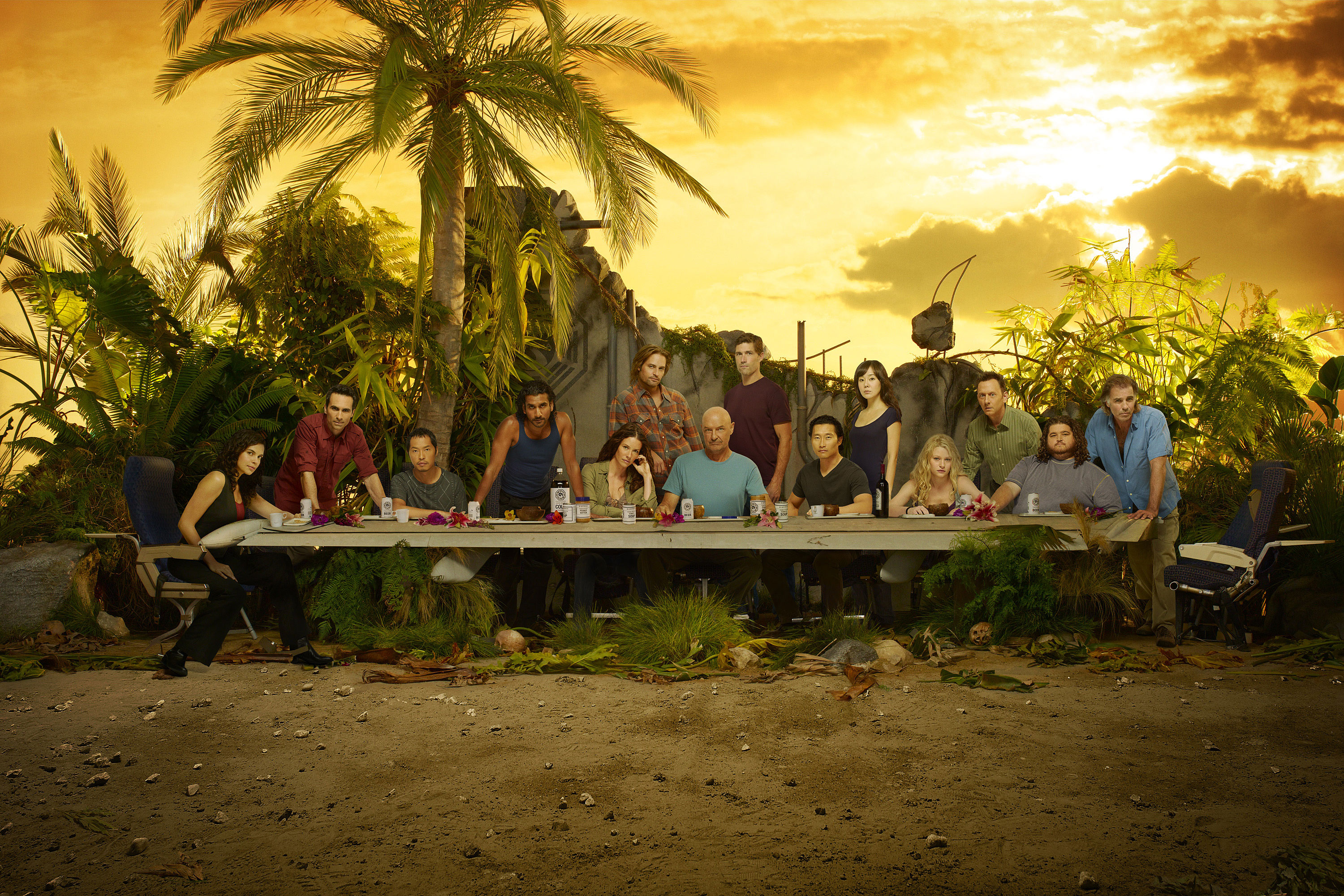
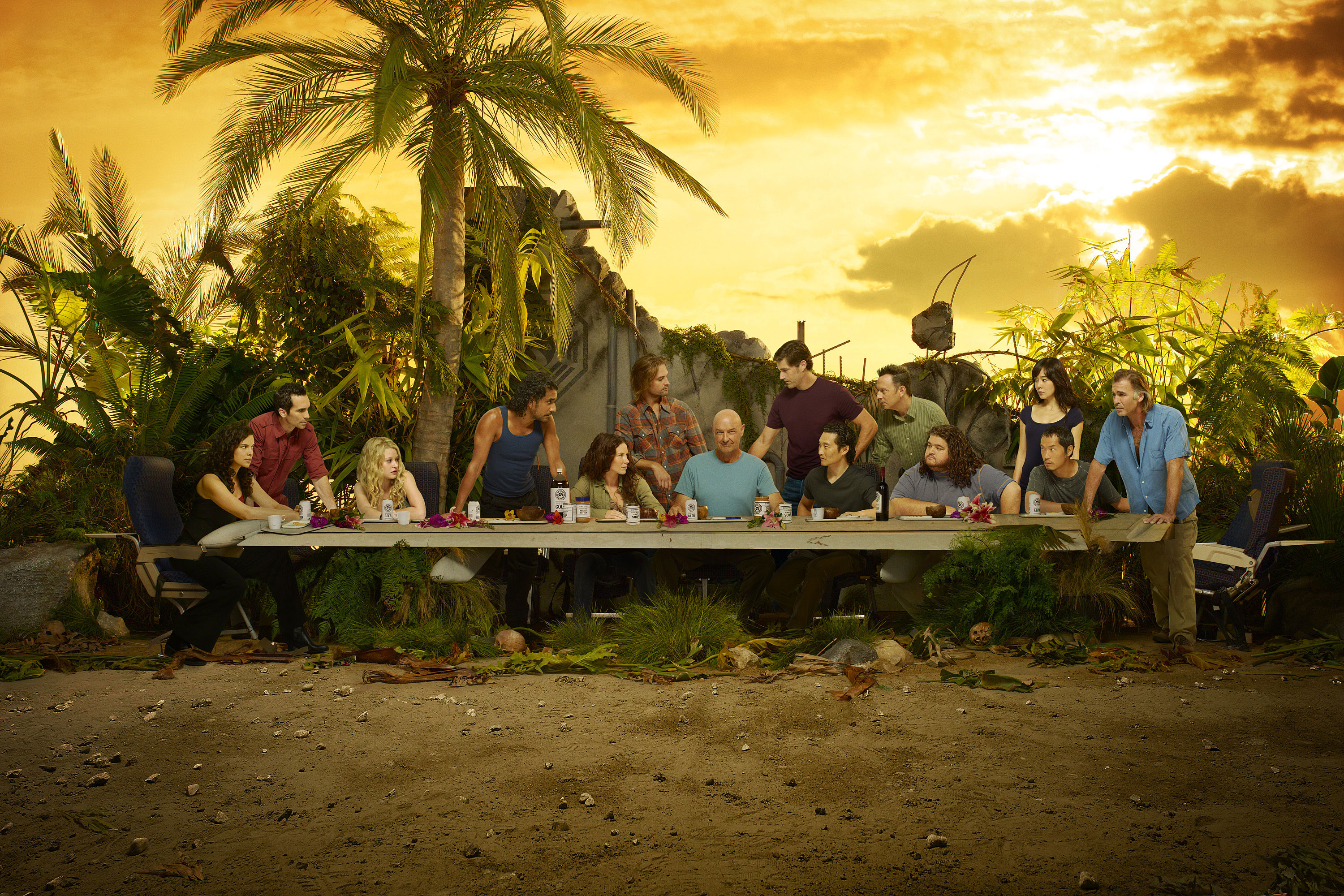
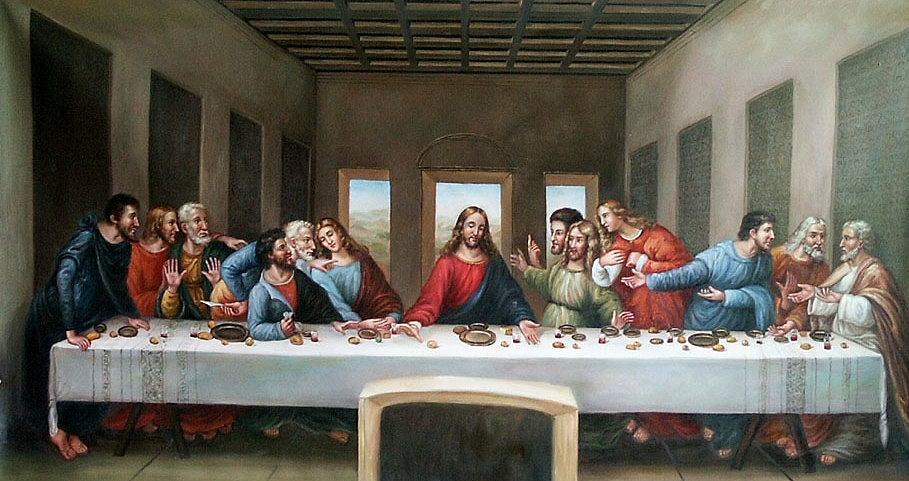
Since ABC’s recent release of a couple of promo shots for the final season of Lost (beginning next month), fans have been crafting all sorts of theories about what various clues in the photos might (or might not) mean. The first obvious clue is that the pictures are clearly akin to Da Vinci’s “The Last Supper” painting, with John Locke’s character sitting in the place of Christ. Locke has always deemed himself something of a “savior” when it comes to the mysterious island.
The images are posted below (as well as Da Vinci’s masterpiece), andherearevariousmusings on what the pictures might be saying. Meanwhile, the show’s producers give a few hints (but no spoilers) regarding the final season here.
 The World Health Organization reported last week that Diesel engine fumes may cause cancer—the latest educated guess at what kills over 7.5 million people each year. While I’ve always paid attention to findings such as this one, these days I have even more reason to.
Last fall, my husband, Jonathan, was a healthy 28-year-old man who seemingly had heartburn from the stress of a new baby. He ran half-marathons, played basketball twice weekly, and ate appropriate portions of locally grown produce, whole grains, lean meats, and fish.
To say we were shocked by Jonathan’s cancer diagnosis would be, to put it lightly, an understatement. Turns out, the heartburn was rather a mass in his lower neck and upper chest.
When something like cancer happens, onlookers want answers. “How could this happen to you? You’re so young and healthy,” they said. The question is one that at times we couldn’t help asking ourselves.
At Jonathan’s first doctor’s appointment his surgeon casually mentioned the high rate of lymphoma in our area and that agricultural pesticides could be a possible cause. I went home from the meeting and began Google searching like a crazy person. I wanted to find something—anything —that would help us understand why cancer had picked his body. I needed to know whether we could have prevented this mass, this cancer, from happening.
I came to no conclusions—about pesticides or any other causes for the cancer. And despite his treatment being complete and his body now free of cancer, it’s difficult to still think about the cause. Just a few days ago I found myself panicked as I went to heat the baby’s bottle. Plastic or glass? Tap water or purified water? Organic formula or Target brand? And, are we even wearing the right kind of sunscreen?! If cancer has visited our house once, what’s to say it won’t return? Surely I can prevent its appearance by making smart decisions.
Analyzing and worrying about what causes cancer is not what I’d like to be doing right now. But regardless of how much I try not to question what we could have done differently, it’s hard to escape the barrage of media attention around cancer’s potential causes.
In the past month alone, three separate studies reported different conclusions about why cancer exists. Are viruses, parasites, or infections the culprit? Or is it allergies and asbestos? Perhaps sleep apnea, or spray tans are to blame? And if cancer is caused by any, or all, of these nearly unavoidable factors (save spray tans), why do some people fall victim while others who have just as much exposure don’t? It’s enough to drive even the sanest person to become a hypochondriac, which doesn’t help the situation at all.
Because when you and I begin to believe that cancer (or any other disease for that matter) can be completely avoided by making all the right day-to-day choices, two things happen:
We begin to unconsciously live in a perpetual state of fear, and we start to think we have power over our final outcome: life or death. The first result is overwhelming; the second is inconsistent with our beliefs about God’s sovereignty.
Joan Didion, in her book The Year of Magical Thinking, said it best: “I realize how open we are to the persistent message that we can avert death. And to its punitive correlative, the message that if death catches us we have only ourselves to blame.” But when we believe that death is something that happens to people who don’t take enough care to avoid it, we forget that God is the maker of life and the only authority over death.
Despite hundreds of studies hypothesizing cancer’s causes and ways to avoid it, I believe as Christians we can only rest on one true fact: we are all going to die, and to do so is gain.
And while I am not advocating picking up a cigarette habit or stopping monthly self-breast exams, I am suggesting we live a life pursuing Christ rather than running from cancer.
What does this look like on a daily basis? To start, it means clinging to scripture’s promise that “the righteous shall not be shaken…they will not fear bad news, but instead trust in the Lord” (Psalm 112:6,7).
We may reside in a broken, polluted world where cancer seems to grow steadily, however, this disease is not winning. Christ, the Risen Lord, has already won. We get to partake in a life that does not end when our bodies fail.
“In a world where opinions rise to a place where only truth should be, and every voice seems to get an equal hearing, in the constant cacophony of ten thousand contradictory voices, it is a wonderful and amazing thing to be able to say with rest and confidence, The Lord is my Light!”—Paul Tripp
Although it can be tempting to allow our peace and anxiety to ebb and flow based on the latest research findings, I am in a place of new resolve not to. Lord, assist me in making the best choices for my family, I will say. And, Lord, help me remember that the final chapter of my story has already been written.
Lesley Sebek Miller, a Westmont College graduate, lives in Sacramento, California. Her work has appeared in Relevant Magazine. She blogs at http://barefooton45th.com.
 When you live near Niagara Falls, as I did for 20 years of my life, its magnitude and mystique begin to stream through your lifeblood. My parents honeymooned there; in later years, we schlepped all of our out-of-town guests there upon request; and one woman’s threat to jump with her child into the rushing waters led to that child’s adoption into my extended family. In fact, plunges over the Falls (whether accidental or suicidal) are so common that only the very rare survivors make big news.
Needless to say, then, it was more than curiosity that compelled me to watch Nik Wallenda‘s historic high-wire walk over the Falls last weekend: it was my own history and heritage beckoning.
Yet, the sheer spectacle had a pull of its own, too, as it apparently did for the estimated 112,000 people who gathered to watch on the American and Canadian sides of the Falls and the 13.1 million who viewed the feat on television along with them.
Yes, we are a rubbernecking species, drawn irresistibly and inexplicably to the drama posed by danger and death. Whether our own or whether experienced vicariously in our role as voyeurs, our fascination with risky behavior is attributed to various possible causes: Freud’s death wish, genetic predisposition, risk-taking personalities, the adrenalinerush, and simply the pleasure of relief that comes when we witness someone other than ourselves suffer.
But more than the psychological, sociological, and scientific explanations, I am intrigued by the aesthetic accounts of our infatuation with danger. In The Philosophical Enquiry into the Origin of our Ideas of the Sublime and Beautiful, 18th-century British statesman Edmund Burke famously distinguishes between the beautiful and the sublime, linking each to a primal passion: the beautiful to love, and the sublime to fear. Burke defines beautiful objects as those characterized by small, smooth, and delicate features and defines the sublime as characterized by vastness, infinity, obscurity, and magnitude. In so doing, Burke expands on the classical Greek text, On the Sublime, attributed to Longinus, which states that the sublime “transports us with wonder.” Burke further connects the sublime to “whatever is fitted in any sort to excite the ideas of pain and danger … Whatever is in any sort terrible, or is conversant about terrible objects, or operates in a manner analogous to terror.”
The sublime elicits a kind of controlled fear, which Burke says is accompanied by an inherent pleasure, a notion that the existence of every roller coaster, ski slope, NASCAR race, and horror flick would seem to confirm—along with the tourist industry built around Niagara Falls (once considered one of the Seven Wonders of the World), and the millions of eyes rapt upon Wallenda’s treacherous walk over its vast abyss.
There’s a fine line between sublime and morbid, however, and I was hesitant to watch Wallenda’s high wire walk until I learned of ABC’s insistence that he wear a safety harness during the stunt. Wallenda’s reluctance to do so given his inexperience in wearing one is understandable, but ABC was right to insist on the measure, stating beforehand, “We’re going to have millions of families watching this event … we don’t want to give people a reason to have to tell their children to leave the room.” A few vultures complained that with no danger of death there would be no point in watching, but they were, happily, proven wrong. The three-hour show was an entertainment success for ABC, resulting in the top-rated viewership of the night and the highest Friday night rankings on ABC in five years; the fulfillment of a lifelong dream for Wallenda; and an evening of good old-fashioned entertainment (high technology and million-dollar price tag, notwithstanding) for countless viewers.
Approached by customs officials when he reached the end of his walk on the Canadian side of the Falls, and asked by the officials in a seemingly scripted but lighthearted moment what his purpose was, Wallenda declared, “To inspire people around the world” and to “pay tribute to his ancestors.” While the definition of hero has changed dramatically over human history, a feat such as this harkens back to the oldest conceptions of the heroic, which center on noble lineage, daring feats, and extraordinary courage. Wallenda certainly didn’t inspire me to attempt anything remotely like that sort of daredevil act, but I can say that witnessing his daring feat demonstrated powerfully what both steel-mindedness and generations of training can accomplish in a mortal human being.
Thus perhaps the greatest feats of The Great Wallendas center on family and their longheld traditions. The current generation’s patriarch, Karl Wallenda, has been married to his wife, Helen, for over 40 years. Nik Wallenda is a seventh-generation tightrope walker, father of three, and married to an eighth-generation acrobat. I can think of little today outside a monarchy that has continued for so many generations. Furthermore, Wallenda’s unabashed Christian faith—evident, but not obnoxiously so, in the prayers he shared with his family before the walk and in the unceasing prayers and praise to Christ picked up by his microphone throughout the terrifying 25 minutes—made for a truly sublime event.
Of course, it is God himself who is most sublime—and beautiful—containing within his person and his nature all of those qualities we seek in taking risks, seeking thrills, and gazing on wondrous sights. Yet, we cannot see him, not in all his glory. Ultimately, our fascination with the sublime is but an expression of our longing for him.
 Maybe it was the tragic trifecta of bangs, glasses, and braces that marked me a prime target on bus rides to Northmont Middle School in the fall of 1997. It could have been a certain demeanor, a silliness that peaked after eight class periods and liked making girlfriends laugh, usually through outbursts of song. Maybe it was something less obvious, a sensitive spirit that peers, angry and hardened by who knows what, could sniff out. For whatever reason, Tara sniffed out me.
Tara lived on Rankin, a newly developed street three past Herr Street, down which I walked every morning at 7:10 to catch the bus. The mornings were okay, mostly; I’d slide into a military-green seat near the front and look intently out the window, avoiding eyes with Tara and her posse of highschoolers as they boarded. Tara had long brown hair and wore Nike Jordans; she displayed the brashness of the women I had seen on The Real World, which I had sneakily watched in my grandmother’s basement the summer prior. A mere 13 to my 12, Tara boasted about boys and mocked dumb teachers and threatened to “beat up the bitches” who crossed her. Even then I dimly perceived a certain chaos in her home; she had an older brother in and out of jail, and her father was gone.
The afternoons were when it began. I learned early in the year that my loud singing had drawn Tara’s attention—the last thing you want from a bully—so on the rides home I kept my head low and spoke rarely. But as we were about 10 minutes from my house, Tara and her cousin Jo would start hissing at me, for everyone to hear, “Look at that dumb bitch!” “What are you wearing?” “What are you going to do, cry all the way home?” Janine and Lauren, two friends, said nothing, fearing trial by association. The driver never intervened. On it went for the majority of seventh grade, once escalating into hitting—but I never said a word back.
Karen Klein didn’t say much back either. The 68-year-old grandmother of eight from upstate New York endured verbal torture from four middle-school boys, one of whom recorded the encounter on his cell phone and posted it on YouTube last week. In “Making the Bus Monitor Cry,” the teens hurl taunts like, “You don’t have a family because they all killed themselves because they didn’t want to be near you.” (Klein’s son committed suicide 10 years ago.) One boy pokes Klein’s arm with a book, saying if he were to stab her, his knife would go through her “like butter.”
Just as disturbing as these cruel taunts, which only worsen throughout the 10-minute film, is that Klein never responds. An adult with the clear authority in the situation (ironically, bus monitors are hired precisely to stop bullies), Klein stays seated, eventually crying. The scene is both heart-wrenching, drawing outraged calls for the boys to be punished as well as thousands of threatening text messages, and a bit unsettling.
Others, apparently, have found it so as well. Since the video went viral, media commentators have given plenty of explanations for why an adult wouldn’t kick the children off the bus immediately—everything from the isolated nature of school buses to our country’s rancorous political scene to the “mob mentality” of young teens. I wonder, however, if Klein sat passively because she had come to believe, somewhere along the way, that good people “rise above” extreme personal offense and brush off insults. Or, in Christian parlance, that they “turn the other cheek.”
Jesus’ Matthew 5 teaching was countercultural at the time, and it remains so, proving pivotal in the philosophy that undergirded the U.S. civil rights movement and India’s emancipation from British rule. But I’m afraid that applying it to cases of bullying—whether involving children or adults—misses the point of Christ’s original teaching, and misses God’s best for us.
Biblical scholars understand Jesus’ command as a warning against letting anger and the urge to retaliate consume a victim of mistreatment. Explicitly countering the “eye for an eye” teaching his original listeners know well, Jesus is outlawing revenge. In his essay “Why I Am Not a Pacifist,” C. S. Lewis summed up Jesus’ teaching this way: “Insofar as you are simply an angry man who has been hurt, mortify your anger and do not hit back.”
But self-defense and revenge are not the same. Unlike revenge, which lowers the victim’s dignity to the level of the abuser, self-defense preserves the victim’s dignity, showing the abuser that the victim won’t stoop to their level or passively forebear such evil. Instead, the victim becomes a person with agency—the kind of person God created him or her to be—who loves herself enough to refuse such hatred.
Under Tara’s fiery insults, I wilted like a flower, then cried on the walk home before telling my parents that it had happened, again. I had no agency. My parents, who had recently become evangelical Christians, told me I needed to forgive Tara and to “give the situation to God.” No doubt both principles were gesturing in the right direction, and I tried desperately to do both. But they weren’t enough, and I suffered through the rest of the school year.
As for herself, Klein has received an outpouring of support and over 0,000 to take the “vacation of a lifetime.” “You’ve taught an invaluable lesson,” says one commenter on the donation site. “You did the right thing. You kept your composure,” says another.
Klein very well may have done a good thing, but she didn’t do the best thing. I would have liked to have seen Klein’s composure paired with a loud “no!” to the 13-year-old perpetrators sending her to verbal hell—as I wish I would have gotten angry on my own behalf in junior high. As Klein told reporters this week, “I can’t believe it happened … It was just plain mean. Nobody should have to put up with that.”
That includes you, Karen. And only you can stop it.







