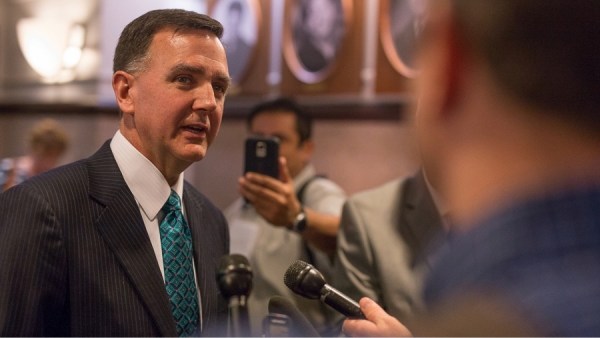
Lee Strobel has written many books—The Case for Faith, The Case for Christ, and The Case for the Real Jesus among them—that provide intellectual reasons, wrapped in stories, for the Christian faith. Stan Guthrie, Christianity Today managing editor for special projects, interviewed Strobel, a former pastor at Willow Creek Community Church, at the Christian Book Expo in Dallas about his latest title, written with Mark Mittelberg: The Unexpected Adventure: Taking Everyday Risks to Talk with People about Jesus (Zondervan).
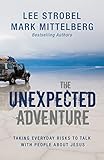
The Unexpected Adventure is basically a manual of personal stories encouraging people to do evangelism. Why did you write it?
The evangelism value leaks away from us faster than any other value in the Christian life. Churches are faced with the problem of having to elevate many different values: Bible study, prayer, community, and so on. Evangelism is [just] one of them. But I haven’t run into anybody who says, “Man, my spiritual life is so dry right now. I feel like I’m in the middle of the desert and, oh, by the way, I have a friend next door who’s not a Christian, and I’m really praying for opportunities to reach out to him. I’ve invited him to lunch next week, and I’m hoping God opens up a chance to talk about spiritual stuff.”
How have evangelism and apologetics changed?
They have become more relational, more story-driven. Josh McDowell would go on college campuses and describe why to trust the Bible. And people would come to faith in droves. Then they stopped coming to faith in so many numbers, and he didn’t know why. And now he takes a story approach. “You know,” he says, “I was the son of the town drunk. This is how it affected my life and my relationship with [my dad]. This is what prompted me to seek spiritually. This is the evidence I found. This is how my life was changed. This is how I reconciled with my father.” So it becomes a story.
That’s what my ministry is about. I tell my story: I was an atheist. I scoffed. My wife became a Christian. It prompted me to investigate. Here’s the evidence I found, how I received Christ, the difference it’s made. It’s a story. And I found that in postmodern America, people often are willing to engage on the level of story.
I’m excited about the huge trend of believers starting small groups and inviting nonbelievers to join them. The Alpha Course is taking this approach. A ministry on the East Coast, Neighborhood Bible Studies, was just kind of floundering. They have a new leader, Mary Schaller. Her vision is 25,000 groups, which have a new name, Q Place, in the next six years. We started these kinds of groups at Willow Creek. At one point, we had 1,100 nonbelievers in these groups. We found that if nonbelievers join one of these groups and stay with it, 80 percent come to faith.
The point of The Unexpected Adventure is that you don’t have to do everything all at once. There are smaller steps. You can be a link in the chain that eventually leads someone to Christ. Maybe a beginning link, more often a middle link, and sometimes, even that final link.
Some Christian apologists, such as William Lane Craig, dispute that we are living in a postmodern society. Are we?
Relativism and pluralism have taken root, and a lot of unbelievers on college campuses especially are coming from that worldview. So we have to respond to that. That doesn’t mean, though, that we throw out the tools that God has given us to reach people. I think we have to adapt.
When I was interviewing a famous scholar for The Case for Christ , about halfway through he said, “By the way, nobody’s going to read your book. Lee, we live in a postmodern world. People don’t care about the historical evidence for Jesus anymore. They don’t care. Nobody’s going to read your book.” And I was so bummed out.
But the ironic thing is, The Case for Christ came out, and the biggest group of people who contacted me saying, “God used that book to bring me to faith in Christ,” were 16- to 24-year-olds—the very people who supposedly don’t care about this stuff.
Of course, you wrote it as a story.
Exactly. It’s not just an encyclopedia of information. We ought not to lose that resource of apologetics, but we need to adapt it. Through story, through relationships, we can deliver it not as a soliloquy but in dialogue and a conversation where we engage people in a small-group setting.
Copyright © 2009 Christianity Today. Click for reprint information.
Related Elsewhere:
You can also listen to Stan Guthrie’s interview with Lee Strobel.
The Unexpected Adventure is available at ChristianBook.com and other book retailers.
More Christianity Today articles on evangelism and apologetics include:
A New Day for Apologetics | People young and old are flocking to hear — and be changed by — winsome arguments for the Christian faith. (June 2, 2008)
From Four Laws to Four Circles | James Choung has found a way to tell the old, old story to a new generation. (June 27, 2008)
Tim Keller Reasons with America | The New York pastor explains why he’s taking his ministry model on the road. (June 20, 2008)
Unapologetic Apologist | Jay Smith confronts Muslim fundamentalists with fundamentalist fervor. (June 13, 2008)
Unexpected Dialogue | Why is a former Chinese official talking to Luis Palau? (May 22, 2008)
Shoot-First Apologetics | What a dead bluebird taught Walter Martin about defending the faith. (November 10, 2006)