
Decide to back Reagan for the long race.
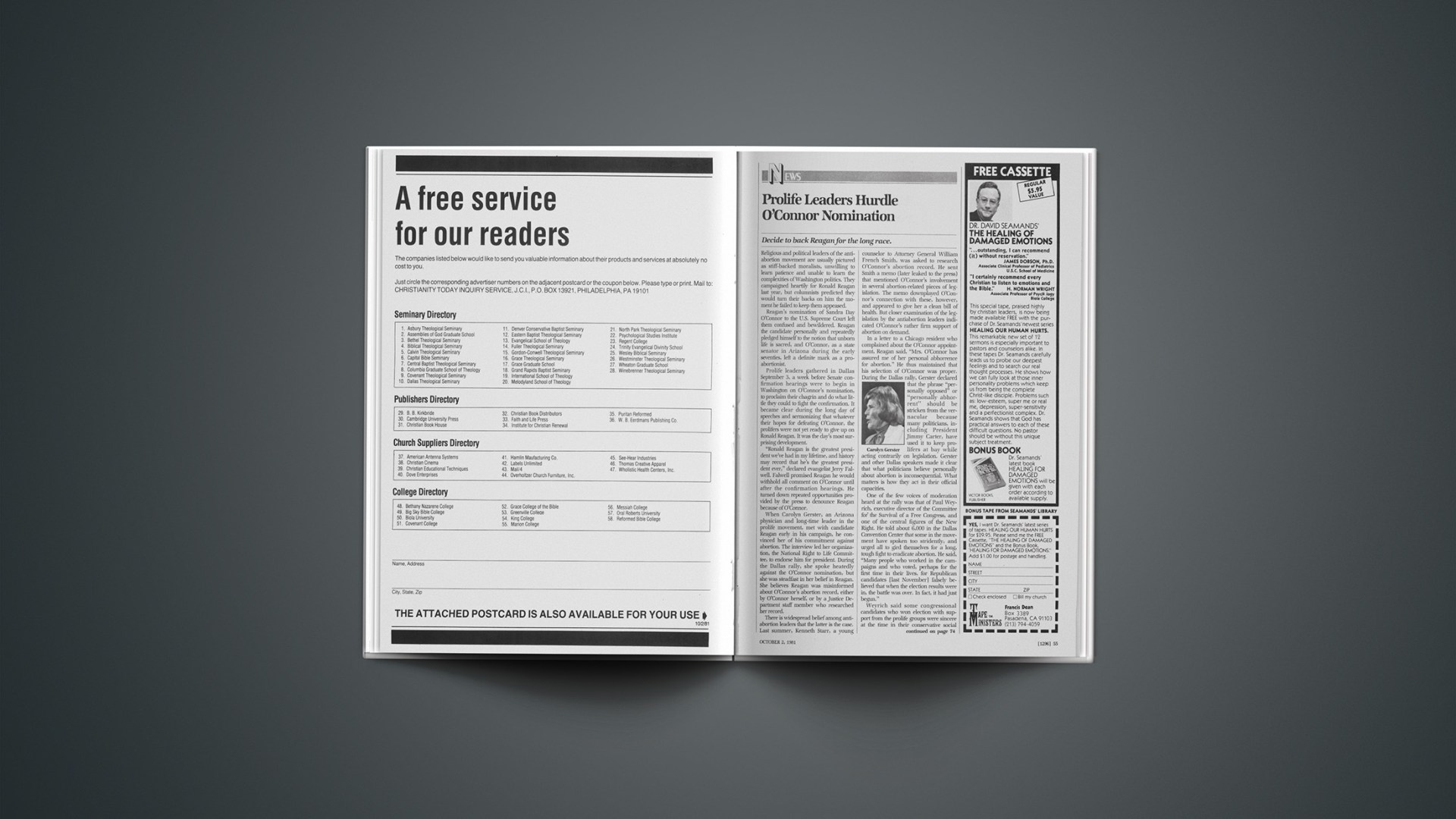
Religious and political leaders of the antiabortion movement are usually pictured as stiff-backed moralists, unwilling to learn patience and unable to learn the complexities of Washington politics. They campaigned heartily for Ronald Reagan last year, but columnists predicted they would turn their backs on him the moment he failed to keep them appeased.
Reagan’s nomination of Sandra Day O’Connor to the U.S. Supreme Court left them confused and bewildered. Reagan the candidate personally and repeatedly pledged himself to the notion that unborn life is sacred, and O’Connor, as a state senator in Arizona during the early seventies, left a definite mark as a pro-abortionist.
Prolife leaders gathered in Dallas September 3, a week before Senate confirmation hearings were to begin in Washington on O’Connor’s nomination, to proclaim their chagrin and do what little they could to fight the confirmation. It became clear during the long day of speeches and sermonizing that whatever their hopes for defeating O’Connor, the prolifers were not yet ready to give up on Ronald Reagan. It was the day’s most surprising development.
“Ronald Reagan is the greatest president we’ve had in my lifetime, and history may record that he’s the greatest president ever,” declared evangelist Jerry Falwell. Falwell promised Reagan he would withhold all comment on O’Connor until after the confirmation hearings. He turned down repeated opportunities provided by the press to denounce Reagan because of O’Connor.
When Carolyn Gerster, an Arizona physician and long-time leader in the prolife movement, met with candidate Reagan early in his campaign, he convinced her of his commitment against abortion. The interview led her organization, the National Right to Life Committee, to endorse him for president. During the Dallas rally, she spoke heatedly against the O’Connor nomination, but she was steadfast in her belief in Reagan. She believes Reagan was misinformed about O’Connor’s abortion record, either by O’Connor herself, or by a Justice Department staff member who researched her record.
There is widespread belief among anti-abortion leaders that the latter is the case. Last summer, Kenneth Starr, a young counselor to Attorney General William French Smith, was asked to research O’Connor’s abortion record. He sent Smith a memo (later leaked to the press) that mentioned O’Connor’s involvement in several abortion-related pieces of legislation. The memo downplayed O’Connor’s connection with these, however, and appeared to give her a clean bill of health. But closer examination of the legislation by the antiabortion leaders indicated O’Connor’s rather firm support of abortion on demand.
In a letter to a Chicago resident who complained about the O’Connor appointment, Reagan said, “Mrs. O’Connor has assured me of her personal abhorrence for abortion.” He thus maintained that his selection of O’Connor was proper. During the Dallas rally, Gerster declared that the phrase “personally opposed” or “personally abhorrent” should be stricken from the vernacular because many politicians, including President Jimmy Carter, have used it to keep prolifers at bay while acting contrarily on legislation. Gerster and other Dallas speakers made it clear that what politicians believe personally about abortion is inconsequential. What matters is how they act in their official capacities.
One of the few voices of moderation heard at the rally was that of Paul Weyrich, executive director of the Committee for the Survival of a Free Congress, and one of the central figures of the New Right. He told about 6,000 in the Dallas Convention Center that some in the movement have spoken too stridently, and urged all to gird themselves for a long, tough fight to eradicate abortion. He said, “Many people who worked in the campaigns and who voted, perhaps for the first time in their lives, for Republican candidates [last November] falsely believed that when the election results were in, the battle was over. In fact, it had just begun.”
Weyrich said some congressional candidates who won election with support from the prolife groups were sincere at the time in their conservative social positions. They find, however, now that they are in Washington, that “it just isn’t socially acceptable to be identified with these sorts of issues.” He said others who were elected by riding the New Right bandwagon never intended to follow through in the first place.
The Dallas rally was organized by the Roundtable, a consortium of conservative religious leaders headed by former Colgate-Palmolive executive Ed McAteer. On the surface, the voices in Dallas were united; but underneath, grumbling was heard. Falwell, for one, had promised to come to Dallas only under the agreement that the rally would not become the anti-O’Connor harangue it was. Falwell had taken seriously his promise to the president to hold fire until the Senate hearings were over, because the secular press erroneously tends to lump all participants in the New Right under Falwell’s Moral Majority label. Falwell’s assistants were busy collecting tapes of everything Falwell said throughout the day just in case they need to prove that Falwell kept his commitment.
The Dallas rally showed that although the prospect of Sandra O’Connor on the high court was personally abhorrent to just about everybody who marches under the prolife banner, the movement’s leaders were determined to believe the best about Ronald Reagan. They were not ready to cut themselves off from his administration, which, until this baffling nomination, has seemed so genuinely at one with them. The real value of the rally was to keep Reagan’s feet to the fire so that he will pay more attention to the heat when the next Supreme Court vacancy occurs.