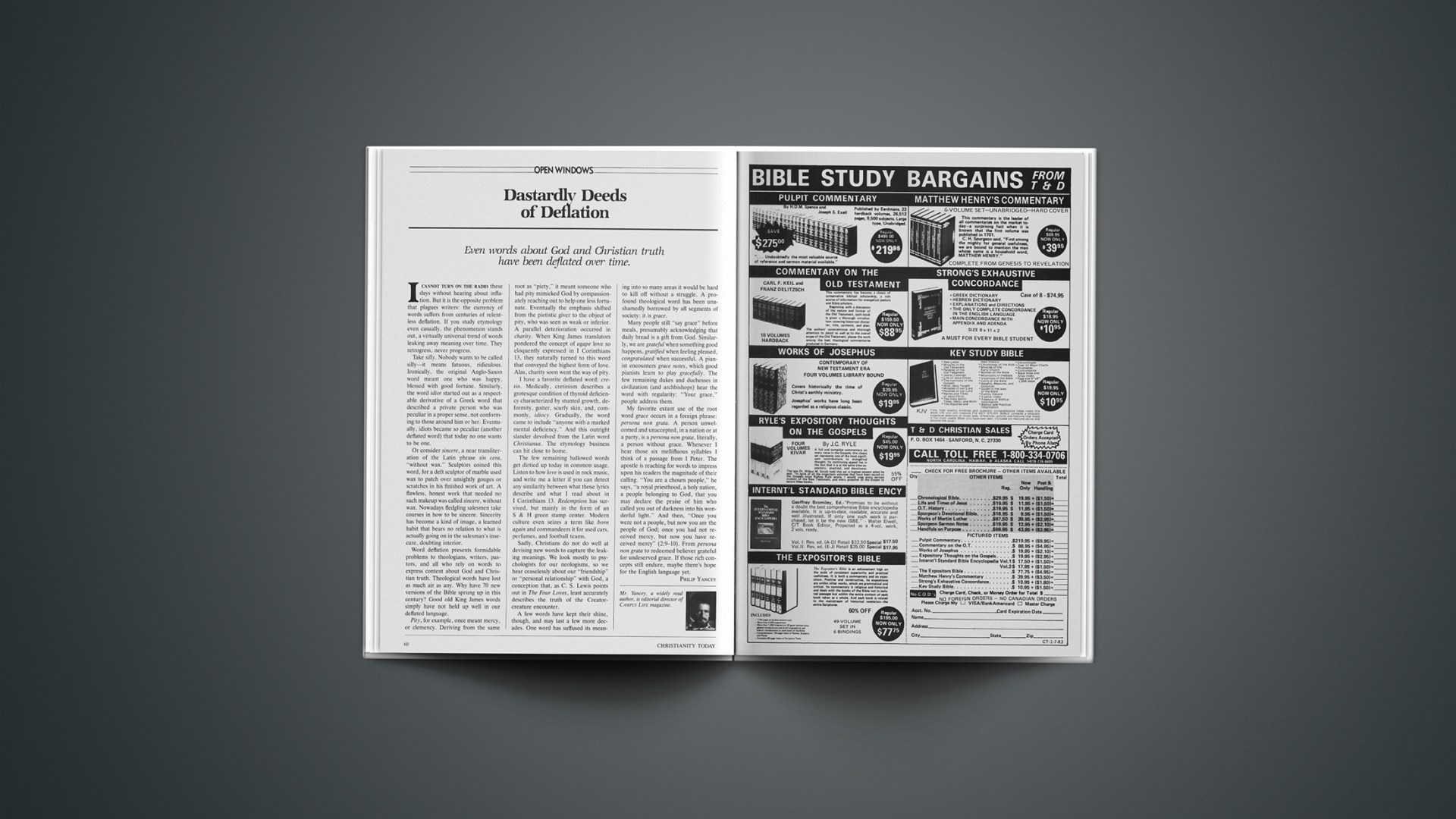

Even words about God and Christian truth have been deflated over time.
Icannot turn on the radio these days without hearing about inflation. But it is the opposite problem that plagues writers: the currency of words suffers from centuries of relentless deflation. If you study etymology even casually, the phenomenon stands out, a virtually universal trend of words leaking away meaning over time. They retrogress, never progress.
Take silly. Nobody wants to be called silly—it means fatuous, ridiculous. Ironically, the original Anglo-Saxon word meant one who was happy, blessed with good fortune. Similarly, the word idiot started out as a respectable derivative of a Greek word that described a private person who was peculiar in a proper sense, not conforming to those around him or her. Eventually, idiots became so peculiar (another deflated word) that today no one wants to be one.
Or consider sincere, a near transliteration of the Latin phrase sin cera, “without wax.” Sculptors coined this word, for a deft sculptor of marble used wax to patch over unsightly gouges or scratches in his finished work of art. A flawless, honest work that needed no such makeup was called sincere, without wax. Nowadays fledgling salesmen take courses in how to be sincere. Sincerity has become a kind of image, a learned habit that bears no relation to what is actually going on in the salesman’s insecure, doubting interior.
Word deflation presents formidable problems to theologians, writers, pastors, and all who rely on words to express content about God and Christian truth. Theological words have lost as much air as any. Why have 70 new versions of the Bible sprung up in this century? Good old King James words simply have not held up well in our deflated language.
Pity, for example, once meant mercy, or clemency. Deriving from the same root as “piety,” it meant someone who had pity mimicked God by compassionately reaching out to help one less fortunate. Eventually the emphasis shifted from the pietistic giver to the object of pity, who was seen as weak or inferior. A parallel deterioration occurred in charity. When King James translators pondered the concept of agape love so eloquently expressed in 1 Corinthians 13, they naturally turned to this word that conveyed the highest form of love. Alas, charity soon went the way of pity.
I have a favorite deflated word: cretin. Medically, cretinism describes a grotesque condition of thyroid deficiency characterized by stunted growth, deformity, goiter, scurfy skin, and, commonly, idiocy. Gradually, the word came to include “anyone with a marked mental deficiency.” And this outright slander devolved from the Latin word Christianus. The etymology business can hit close to home.
The few remaining hallowed words get dirtied up today in common usage. Listen to how love is used in rock music, and write me a letter if you can detect any similarity between what those lyrics describe and what I read about in 1 Corinthians 13. Redemption has survived, but mainly in the form of an S & H green stamp center. Modern culture even seizes a term like born again and commandeers it for used cars, perfumes, and football teams.
Sadly, Christians do not do well at devising new words to capture the leaking meanings. We look mostly to psychologists for our neologisms, so we hear ceaselessly about our “friendship” or “personal relationship” with God, a conception that, as C. S. Lewis points out in The Four Loves, least accurately describes the truth of the Creator-creature encounter.
A few words have kept their shine, though, and may last a few more decades. One word has suffused its meaning into so many areas it would be hard to kill off without a struggle. A profound theological word has been unashamedly borrowed by all segments of society: it is grace.
Many people still “say grace” before meals, presumably acknowledging that daily bread is a gift from God. Similarly, we are grateful when something good happens, gratified when feeling pleased, congratulated when successful. A pianist encounters grace notes, which good pianists learn to play gracefully. The few remaining dukes and duchesses in civilization (and archbishops) hear the word with regularity: “Your grace,” people address them.
My favorite extant use of the root word grace occurs in a foreign phrase: persona non grata. A person unwelcomed and unaccepted, in a nation or at a party, is a persona non grata, literally, a person without grace. Whenever I hear those six mellifluous syllables I think of a passage from I Peter. The apostle is reaching for words to impress upon his readers the magnitude of their calling. “You are a chosen people,” he says, “a royal priesthood, a holy nation, a people belonging to God, that you may declare the praise of him who called you out of darkness into his wonderful light.” And then, “Once you were not a people, but now you are the people of God; once you had not received mercy, but now you have received mercy” (2:9–10). From persona non grata to redeemed believer grateful for undeserved grace. If those rich concepts still endure, maybe there’s hope for the English language yet.
PHILIP YANCEY1Mr. Yancey, a widely read author, is editorial director of Campus Life magazine.