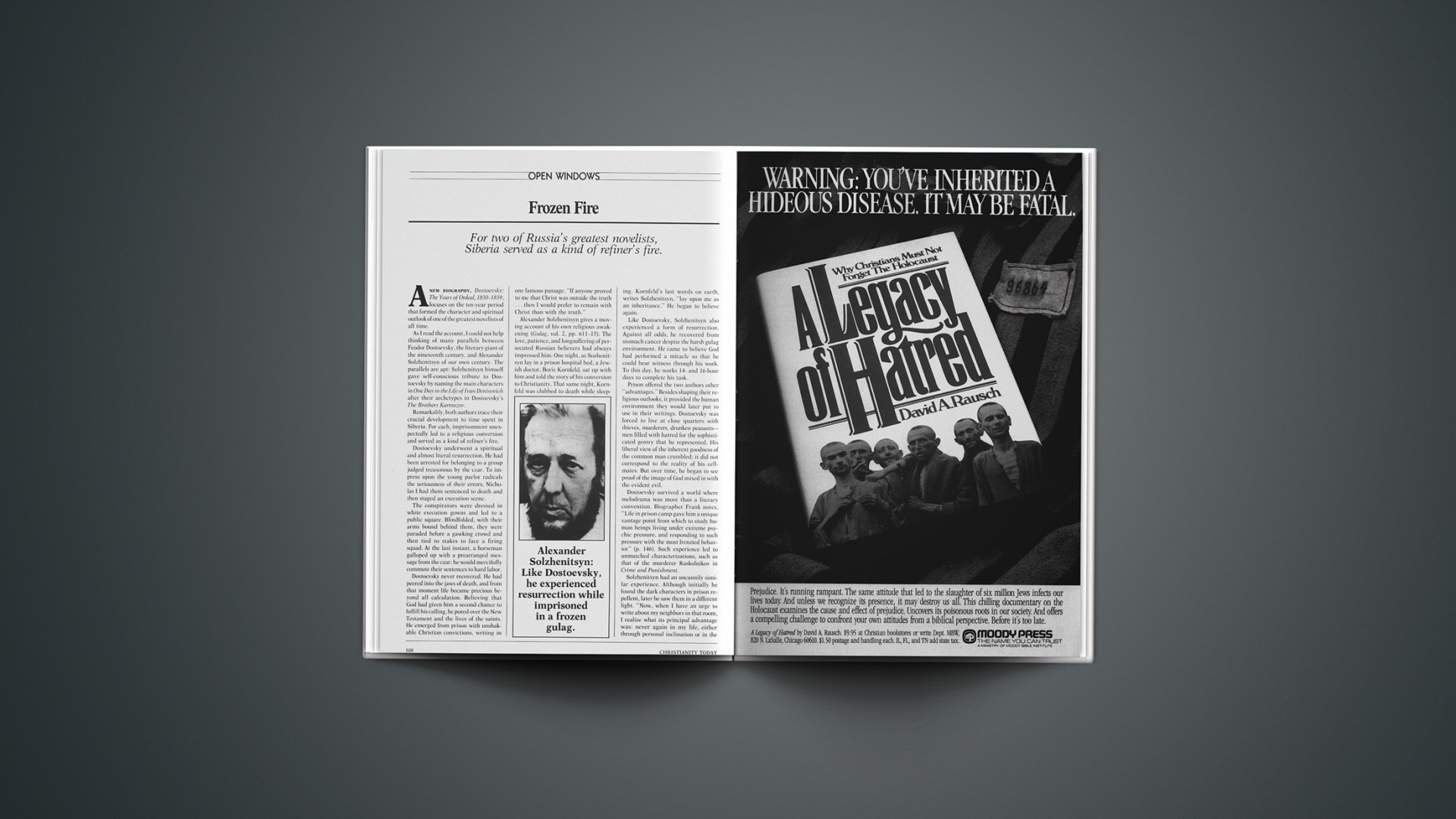

For two of Russia’s greatest novelists, Siberia served as a kind of refiner’s fire.
A new biography, Dostoevsky: The Years of Ordeal, 1850–1859, focuses on the ten-year period that formed the character and spiritual outlook of one of the greatest novelists of all time.
As I read the account, I could not help thinking of many parallels between Feodor Dostoevsky, the literary giant of the nineteenth century, and Alexander Solzhenitsyn of our own century. The parallels are apt: Solzhenitsyn himself gave self-conscious tribute to Dostoevsky by naming the main characters in One Day in the Life of Ivan Denisovich after their archetypes in Dostoevsky’s The Brothers Karmazov.
Remarkably, both authors trace their crucial development to time spent in Siberia. For each, imprisonment unexpectedly led to a religious conversion and served as a kind of refiner’s fire.
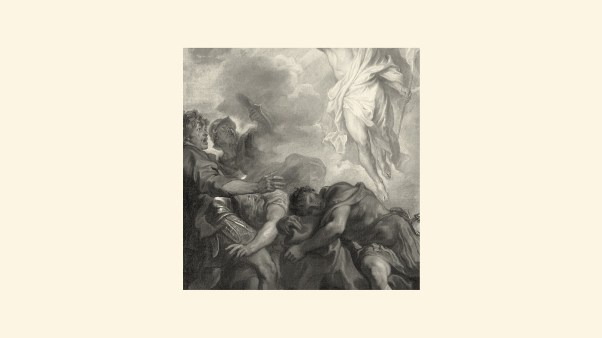
Dostoevsky underwent a spiritual and almost literal resurrection. Fie had been arrested for belonging to a group judged treasonous by the czar. To impress upon the young parlor radicals the seriousness of their errors, Nicholas I had them sentenced to death and then staged an execution scene.
The conspirators were dressed in white execution gowns and led to a public square. Blindfolded, with their arms bound behind them, they were paraded before a gawking crowd and then tied to stakes to face a firing squad. At the last instant, a horseman galloped up with a prearranged message from the czar: he would mercifully commute their sentences to hard labor.
Dostoevsky never recovered. He had peered into the jaws of death, and from that moment life became precious beyond all calculation. Believing that God had given him a second chance to fulfill his calling, he pored over the New Testament and the lives of the saints. He emerged from prison with unshakable Christian convictions, writing in one famous passage, “If anyone proved to me that Christ was outside the truth … then I would prefer to remain with Christ than with the truth.”
Alexander Solzhenitsyn gives a moving account of his own religious awakening (Gulag, vol. 2, pp. 611–15). The love, patience, and longsuffering of persecuted Russian believers had always impressed him. One night, as Sozhenitsyn lay in a prison hospital bed, a Jewish doctor, Boris Kornfeld, sat up with him and told the story of his conversion to Christianity. That same night, Kornfeld was clubbed to death while sleeping. Kornfeld’s last words on earth, writes Solzhenitsyn, “lay upon me as an inheritance.” He began to believe again.
Like Dostoevsky, Solzhenitsyn also experienced a form of resurrection. Against all odds, he recovered from stomach cancer despite the harsh gulag environment. He came to believe God had performed a miracle so that he could bear witness through his work. To this day, he works 14- and 16-hour days to complete his task.
Prison offered the two authors other “advantages.” Besides shaping their religious outlooks, it provided the human environment they would later put to use in their writings. Dostoevsky was forced to live at close quarters with thieves, murderers, drunken peasants—men filled with hatred for the sophisticated gentry that he represented. His liberal view of the inherent goodness of the common man crumbled; it did not correspond to the reality of his cellmates. But over time, he began to see proof of the image of God mixed in with the evident evil.
Dostoevsky survived a world where melodrama was more than a literary convention. Biographer Frank notes, “Life in prison camp gave him a unique vantage point from which to study human beings living under extreme psychic pressure, and responding to such pressure with the most frenzied behavior” (p. 146). Such experience led to unmatched characterizations, such as that of the murderer Raskolnikov in Crime and Punishment.
Solzhenitsyn had an uncannily similar experience. Although initially he found the dark characters in prison repellent, later he saw them in a different light. “Now, when I have an urge to write about my neighbors in that room, I realize what its principal advantage was: never again in my life, either through personal inclination or in the social labyrinth, would I get close to such people.… However tardily, I nonetheless caught myself and realized I had always devoted my time and attention to people who fascinated me and were pleasant, who engaged my sympathy, and that as a result I was seeing society like the Moon, always from one side.”
He too emerged with a view of humanity that would inform all his writing. He concludes, “It was only when I lay there on rotting prison straw that I sensed within myself the first stirrings of good. Gradually, it was disclosed to me that the line separating good and evil passes, not through states, nor between classes, nor between political parties either, but right through every human heart—and through all human hearts.… Bless you, prison, for having been in my life.”
Finally, in different ways both authors came to oppose, by personal example and in their work, an accepted dogma of their day: that human beings are not autonomous, free, and individually responsible for their behavior.
Dostoevsky was imprisoned by an autocratic regime for the purpose of punishment, not rehabilitation. Yet paradoxically he emerged as an incurable Russophile, obeisant to his government and wise to the excesses of his earlier idealism.
Solzhenitsyn, on the other hand, supposedly suffered for rehabilitation. Scientific socialism had begun the gulag as a massive reprogramming effort, designed to purge society of nonsocialist elements. Instead, this graduate became the single most forceful, eloquent voice against the regime that tried to rehabilitate him. By irrefutably documenting a holocaust with no equal (he estimates that 70 million died in the Soviet camps—ten times Hitler’s total), he changed the course of intellectual history in the latter half of this century.
Solzhenitsyn entitled his literary biography The Oak and the Calf, alluding to a Russian fable about a calf that, with seeming futility, kept butting its head against a large oak tree. But the calf persisted for so long that it eventually toppled the tree. Materialism, utopianism, and behaviorism in their extreme forms, whether from the West or the East, offer formidable challenges to a Christian doctrine of the nature of mankind. Fortunately, a few stubborn calves have not given up the struggle.