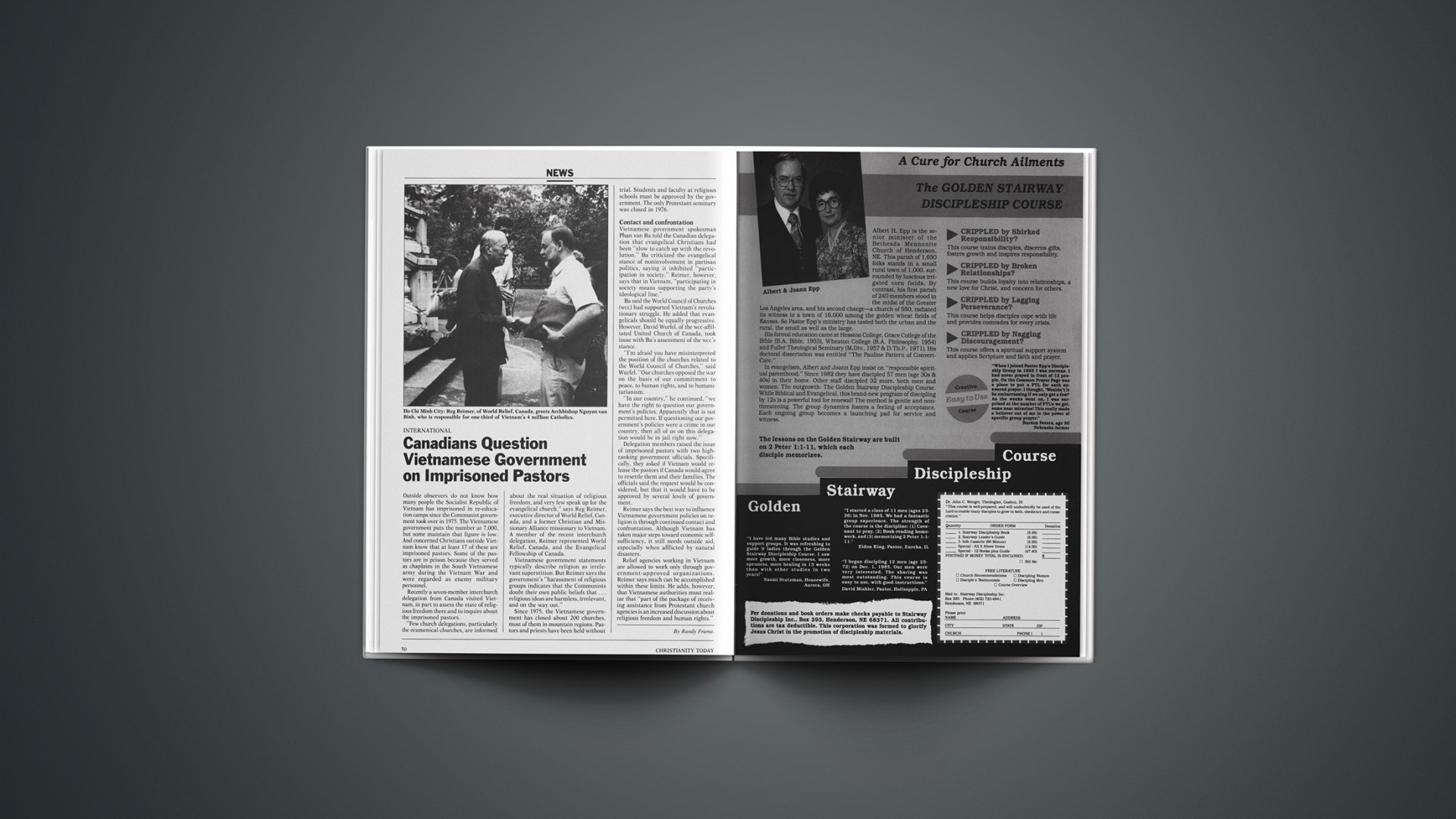

Outside observers do not know how many people the Socialist Republic of Vietnam has imprisoned in re-education camps since the Communist government took over in 1975. The Vietnamese government puts the number at 7,000, but some maintain that figure is low. And concerned Christians outside Vietnam know that at least 17 of these are imprisoned pastors. Some of the pastors are in prison because they served as chaplains in the South Vietnamese army during the Vietnam War and were regarded as enemy military personnel.
Recently a seven-member interchurch delegation from Canada visited Vietnam, in part to assess the state of religious freedom there and to inquire about the imprisoned pastors.
“Few church delegations, particularly the ecumenical churches, are informed about the real situation of religious freedom, and very few speak up for the evangelical church,” says Reg Reimer, executive director of World Relief, Canada, and a former Christian and Missionary Alliance missionary to Vietnam. A member of the recent interchurch delegation, Reimer represented World Relief, Canada, and the Evangelical Fellowship of Canada.
Vietnamese government statements typically describe religion as irrelevant superstition. But Reimer says the government’s “harassment of religious groups indicates that the Communists doubt their own public beliefs that … religious ideas are harmless, irrelevant, and on the way out.”
Since 1975, the Vietnamese government has closed about 200 churches, most of them in mountain regions. Pastors and priests have been held without trial. Students and faculty at religious schools must be approved by the government. The only Protestant seminary was closed in 1976.
Contact And Confrontation
Vietnamese government spokesman Phan van Ba told the Canadian delegation that evangelical Christians had been “slow to catch up with the revolution.” Ba criticized the evangelical stance of noninvolvement in partisan politics, saying it inhibited “participation in society.” Reimer, however, says that in Vietnam, “participating in society means supporting the party’s ideological line.”
Ba said the World Council of Churches (WCC) had supported Vietnam’s revolutionary struggle. He added that evangelicals should be equally progressive. However, David Wurfel, of the WCC-affiliated United Church of Canada, took issue with Ba’s assessment of the WCC’s stance.
“I’m afraid you have misinterpreted the position of the churches related to the World Council of Churches,” said Wurfel. “Our churches opposed the war on the basis of our commitment to peace, to human rights, and to humanitarianism.
“In our country,” he continued, “we have the right to question our government’s policies. Apparently that is not permitted here. If questioning our government’s policies were a crime in our country, then all of us on this delegation would be in jail right now.”
Delegation members raised the issue of imprisoned pastors with two high-ranking government officials. Specifically, they asked if Vietnam would release the pastors if Canada would agree to resettle them and their families. The officials said the request would be considered, but that it would have to be approved by several levels of government.
Reimer says the best way to influence Vietnamese government policies on religion is through continued contact and confrontation. Although Vietnam has taken major steps toward economic self-sufficiency, it still needs outside aid, especially when afflicted by natural disasters.
Relief agencies working in Vietnam are allowed to work only through government-approved organizations. Reimer says much can be accomplished within these limits. He adds, however, that Vietnamese authorities must realize that “part of the package of receiving assistance from Protestant church agencies is an increased discussion about religious freedom and human rights.”
By Randy Frame.