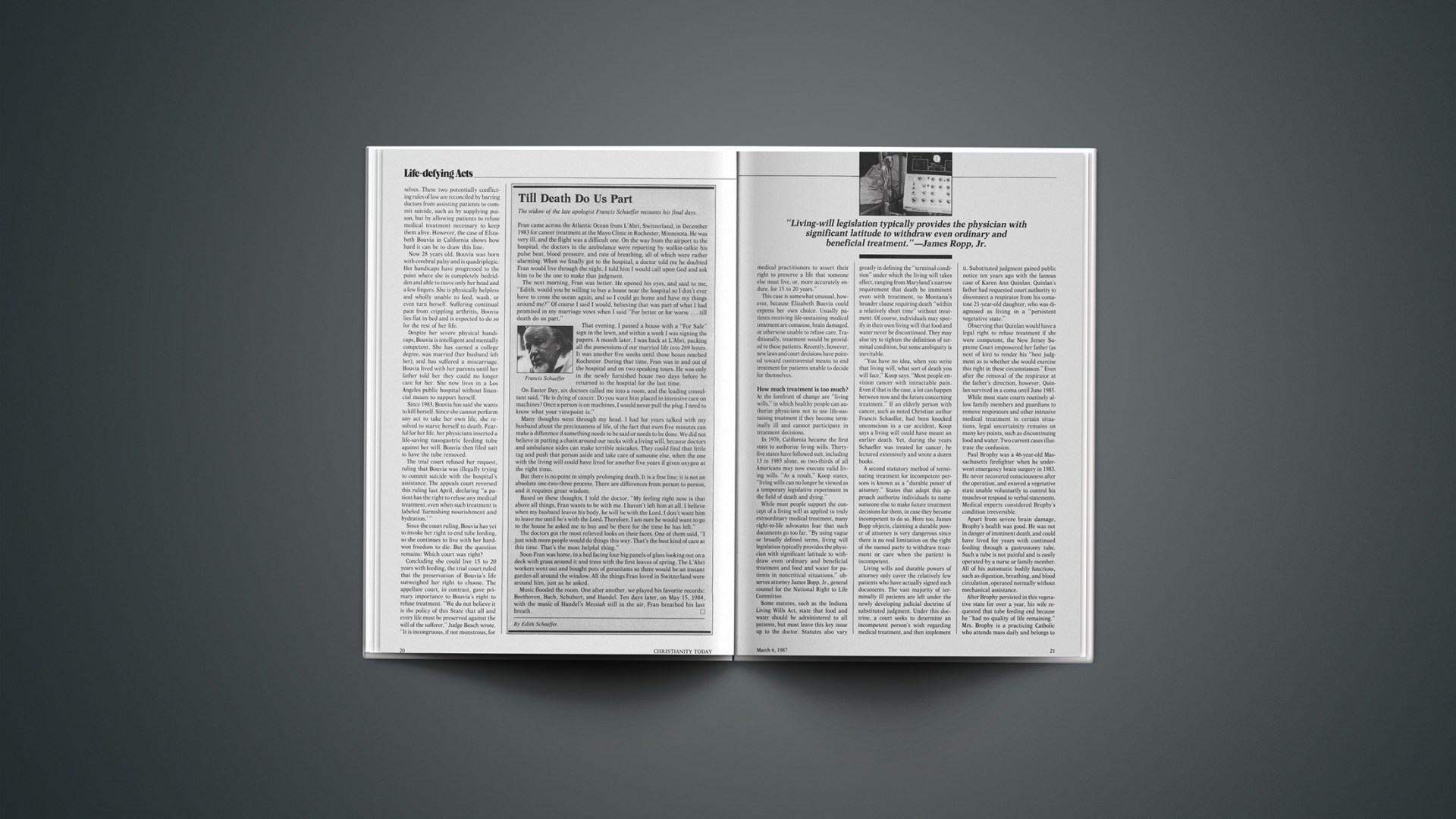

Fran came across the Atlantic Ocean from L’Abri, Switzerland, in December 1983 for cancer treatment at the Mayo Clinic in Rochester, Minnesota. He was very ill, and the flight was a difficult one. On the way from the airport to the hospital, the doctors in the ambulance were reporting by walkie-talkie his pulse beat, blood pressure, and rate of breathing, all of which were rather alarming. When we finally got to the hospital, a doctor told me he doubted Fran would live through the night. I told him I would call upon God and ask him to be the one to make that judgment.
The next morning, Fran was better. He opened his eyes, and said to me, “Edith, would you be willing to buy a house near the hospital so I don’t ever have to cross the ocean again, and so I could go home and have my things around me?” Of course I said I would, believing that was part of what I had promised in my marriage vows when I said “For better or for worse … till death do us part.”
That evening, I passed a house with a “For Sale” sign in the lawn, and within a week I was signing the papers. A month later, I was back at L’Abri, packing all the possessions of our married life into 269 boxes. It was another five weeks until those boxes reached Rochester. During that time, Fran was in and out of the hospital and on two speaking tours. He was only in the newly furnished house two days before he returned to the hospital for the last time.
On Easter Day, six doctors called me into a room, and the leading consultant said, “He is dying of cancer. Do you want him placed in intensive care on machines? Once a person is on machines, I would never pull the plug. I need to know what your viewpoint is.”
Many thoughts went through my head. I had for years talked with my husband about the preciousness of life, of the fact that even five minutes can make a difference if something needs to be said or needs to be done. We did not believe in putting a chain around our necks with a living will, because doctors and ambulance aides can make terrible mistakes. They could find that little tag and push that person aside and take care of someone else, when the one with the living will could have lived for another five years if given oxygen at the right time.
But there is no point in simply prolonging death. It is a fine line; it is not an absolute one-two-three process. There are differences from person to person, and it requires great wisdom.
Based on these thoughts, I told the doctor, “My feeling right now is that above all things, Fran wants to be with me. I haven’t left him at all. I believe when my husband leaves his body, he will be with the Lord. I don’t want him to leave me until he’s with the Lord. Therefore, I am sure he would want to go to the house he asked me to buy and be there for the time he has left.”
The doctors got the most relieved looks on their faces. One of them said, “I just wish more people would do things this way. That’s the best kind of care at this time. That’s the most helpful thing.”
Soon Fran was home, in a bed facing four big panels of glass looking out on a deck with grass around it and trees with the first leaves of spring. The L’Abri workers went out and bought pots of geraniums so there would be an instant garden all around the window. All the things Fran loved in Switzerland were around him, just as he asked.
Music flooded the room. One after another, we played his favorite records: Beethoven, Bach, Schubert, and Handel. Ten days later, on May 15, 1984, with the music of Handel’s Messiah still in the air, Fran breathed his last breath.
By Edith Schaeffer.