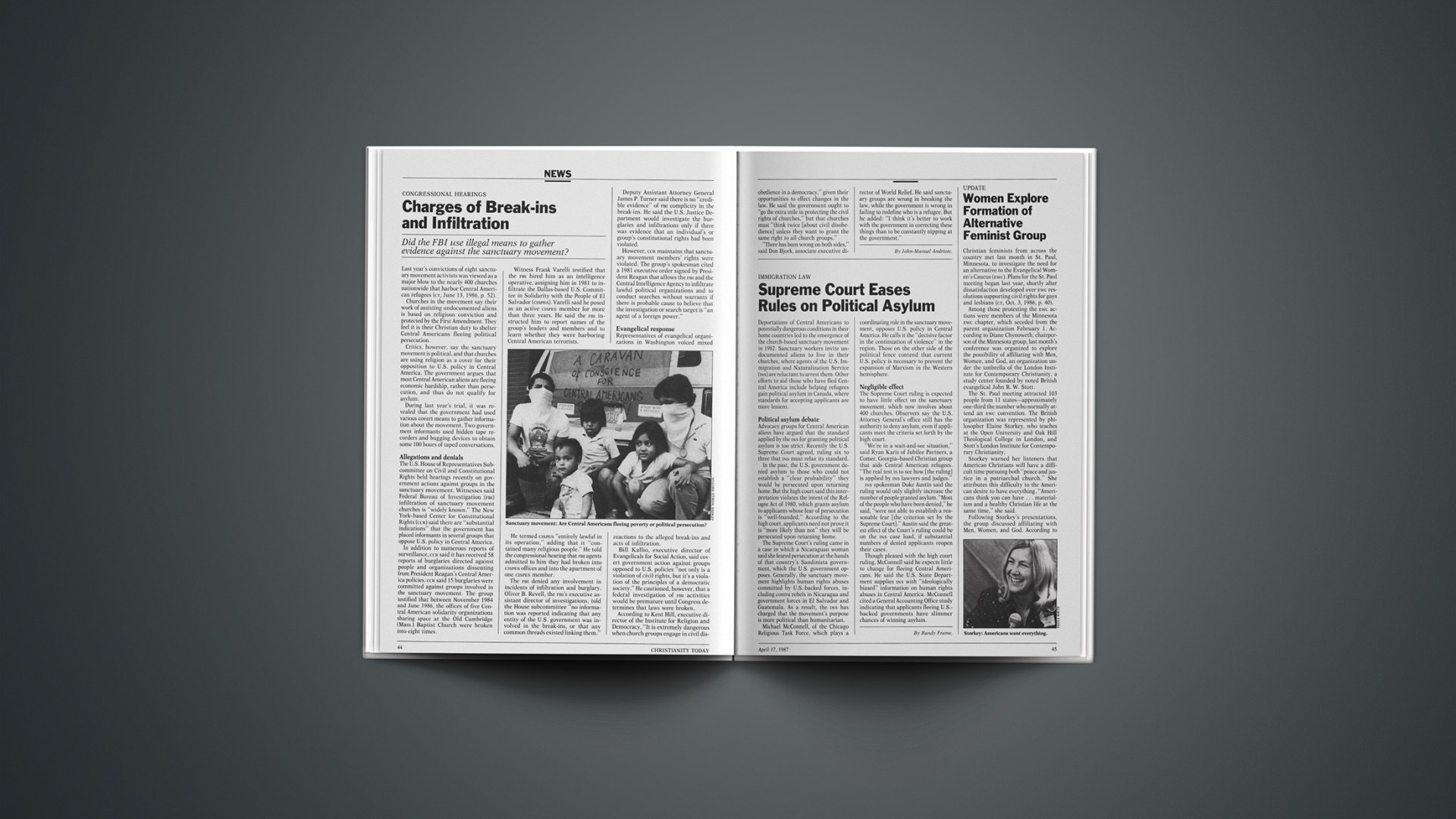

Deportations of Central Americans to potentially dangerous conditions in their home countries led to the emergence of the church-based sanctuary movement in 1982. Sanctuary workers invite undocumented aliens to live in their churches, where agents of the U.S. Immigration and Naturalization Service (INS) are reluctant to arrest them. Other efforts to aid those who have fled Central America include helping refugees gain political asylum in Canada, where standards for accepting applicants are more lenient.
Political Asylum Debate
Advocacy groups for Central American aliens have argued that the standard applied by the INS for granting political asylum is too strict. Recently the U.S. Supreme Court agreed, ruling six to three that INS must relax its standard.
In the past, the U.S. government denied asylum to those who could not establish a “clear probability” they would be persecuted upon returning home. But the high court said this interpretation violates the intent of the Refugee Act of 1980, which grants asylum to applicants whose fear of persecution is “well-founded.” According to the high court, applicants need not prove it is “more likely than not” they will be persecuted upon returning home.
The Supreme Court’s ruling came in a case in which a Nicaraguan woman said she feared persecution at the hands of that country’s Sandinista government, which the U.S. government opposes. Generally, the sanctuary movement highlights human rights abuses committed by U.S. backed forces, including contra rebels in Nicaragua and government forces in El Salvador and Guatemala. As a result, the INS has charged that the movement’s purpose is more political than humanitarian.
Michael McConnell, of the Chicago Religious Task Force, which plays a coordinating role in the sanctuary movement, opposes U.S. policy in Central America. He calls it the “decisive factor in the continuation of violence” in the region. Those on the other side of the political fence contend that current U.S. policy is necessary to prevent the expansion of Marxism in the Western hemisphere.
Negligible Effect
The Supreme Court ruling is expected to have little effect on the sanctuary movement, which now involves about 400 churches. Observers say the U.S. Attorney General’s office still has the authority to deny asylum, even if applicants meet the criteria set forth by the high court.
“We’re in a wait-and-see situation,” said Ryan Karis of Jubilee Partners, a Corner, Georgia-based Christian group that aids Central American refugees. “The real test is to see how [the ruling] is applied by INS lawyers and judges.”
INS spokesman Duke Austin said the ruling would only slightly increase the number of people granted asylum. “Most of the people who have been denied,” he said, “were not able to establish a reasonable fear [the criterion set by the Supreme Court].” Austin said the greatest effect of the Court’s ruling could be on the INS case load, if substantial numbers of denied applicants reopen their cases.
Though pleased with the high court ruling, McConnell said he expects little to change for fleeing Central Americans. He said the U.S. State Department supplies INS with “ideologically biased” information on human rights abuses in Central America. McConnell cited a General Accounting Office study indicating that applicants fleeing U.S. backed governments have slimmer chances of winning asylum.
By Randy Frame.