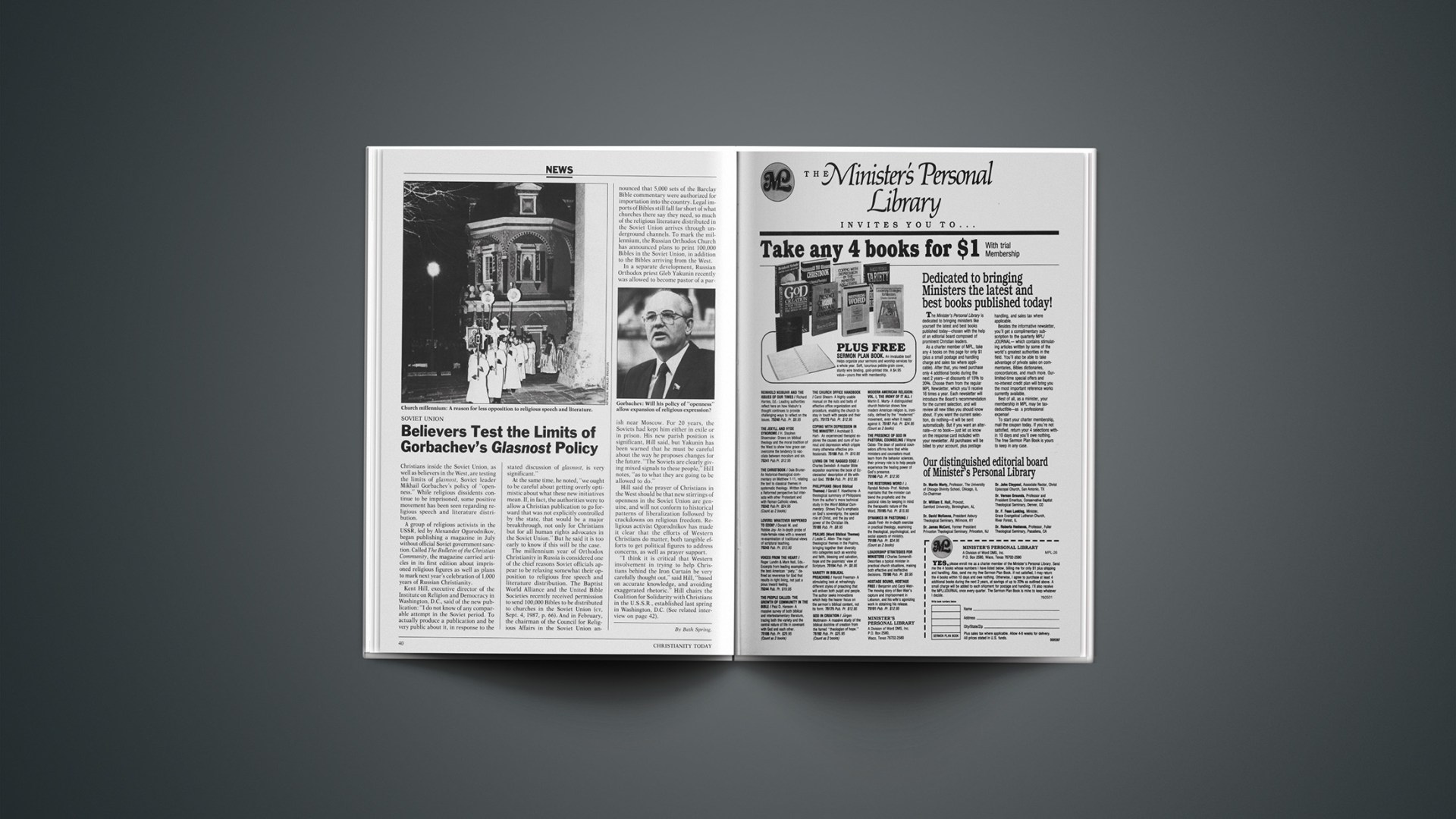

Christians inside the Soviet Union, as well as believers in the West, are testing the limits of glasnost, Soviet leader Mikhail Gorbachev’s policy of “openness.” While religious dissidents continue to be imprisoned, some positive movement has been seen regarding religious speech and literature distribution.
A group of religious activists in the USSR, led by Alexander Ogorodnikov, began publishing a magazine in July without official Soviet government sanction. Called The Bulletin of the Christian Community, the magazine carried articles in its first edition about imprisoned religious figures as well as plans to mark next year’s celebration of 1,000 years of Russian Christianity.
Kent Hill, executive director of the Institute on Religion and Democracy in Washington, D.C., said of the new publication: “I do not know of any comparable attempt in the Soviet period. To actually produce a publication and be very public about it, in response to the stated discussion of glasnost, is very significant.”
At the same time, he noted, “we ought to be careful about getting overly optimistic about what these new initiatives mean. If, in fact, the authorities were to allow a Christian publication to go forward that was not explicitly controlled by the state, that would be a major breakthrough, not only for Christians but for all human rights advocates in the Soviet Union.” But he said it is too early to know if this will be the case.
The millennium year of Orthodox Christianity in Russia is considered one of the chief reasons Soviet officials appear to be relaxing somewhat their opposition to religious free speech and literature distribution. The Baptist World Alliance and the United Bible Societies recently received permission to send 100,000 Bibles to be distributed to churches in the Soviet Union (CT, Sept. 4, 1987, p. 66). And in February, the chairman of the Council for Religious Affairs in the Soviet Union announced that 5,000 sets of the Barclay Bible commentary were authorized for importation into the country. Legal imports of Bibles still fall far short of what churches there say they need, so much of the religious literature distributed in the Soviet Union arrives through underground channels. To mark the millennium, the Russian Orthodox Church has announced plans to print 100,000 Bibles in the Soviet Union, in addition to the Bibles arriving from the West.
In a separate development, Russian Orthodox priest Gleb Yakunin recently was allowed to become pastor of a parish near Moscow. For 20 years, the Soviets had kept him either in exile or in prison. His new parish position is significant, Hill said, but Yakunin has been warned that he must be careful about the way he proposes changes for the future. “The Soviets are clearly giving mixed signals to these people,” Hill notes, “as to what they are going to be allowed to do.”
Hill said the prayer of Christians in the West should be that new stirrings of openness in the Soviet Union are genuine, and will not conform to historical patterns of liberalization followed by crackdowns on religious freedom. Religious activist Ogorodnikov has made it clear that the efforts of Western Christians do matter, both tangible efforts to get political figures to address concerns, as well as prayer support.
“I think it is critical that Western involvement in trying to help Christians behind the Iron Curtain be very carefully thought out,” said Hill, “based on accurate knowledge, and avoiding exaggerated rhetoric.” Hill chairs the Coalition for Solidarity with Christians in the U.S.S.R., established last spring in Washington, D.C. (See related interview on page 42).
By Beth Spring.