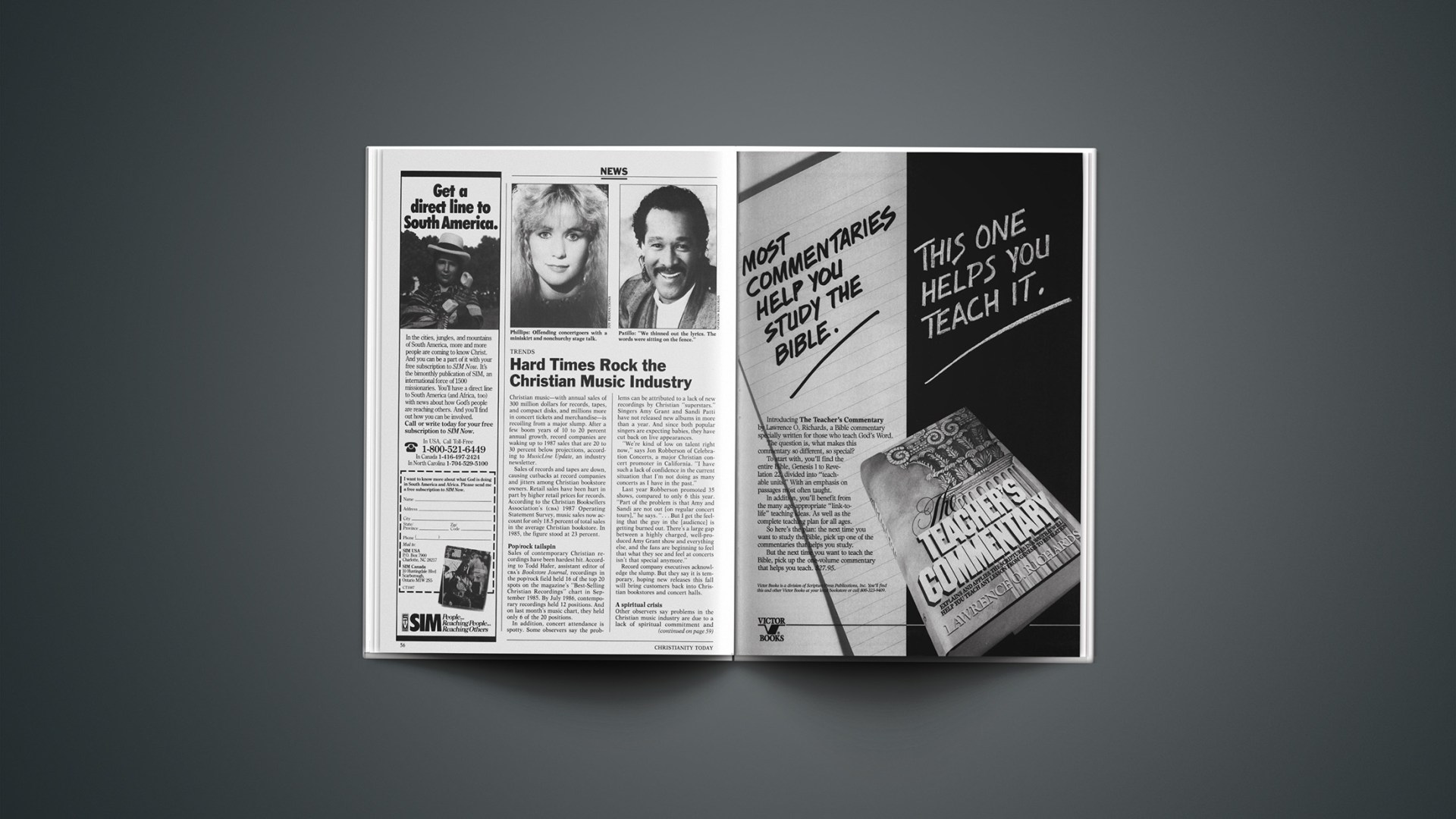

Christian music—with annual sales of 300 million dollars for records, tapes, and compact disks, and millions more in concert tickets and merchandise—is recoiling from a major slump. After a few boom years of 10 to 20 percent annual growth, record companies are waking up to 1987 sales that are 20 to 30 percent below projections, according to MusicLine Update, an industry newsletter.
Sales of records and tapes are down, causing cutbacks at record companies and jitters among Christian bookstore owners. Retail sales have been hurt in part by higher retail prices for records. According to the Christian Booksellers Association’s (CBA) 1987 Operating Statement Survey, music sales now account for only 18.5 percent of total sales in the average Christian bookstore. In 1985, the figure stood at 23 percent.
Pop/Rock Tailspin
Sales of contemporary Christian recordings have been hardest hit. According to Todd Hafer, assistant editor of CBA’SBookstore Journal, recordings in the pop/rock field held 16 of the top 20 spots on the magazine’s “Best-Selling Christian Recordings” chart in September 1985. By July 1986, contemporary recordings held 12 positions. And on last month’s music chart, they held only 6 of the 20 positions.
In addition, concert attendance is spotty. Some observers say the problems can be attributed to a lack of new recordings by Christian “superstars.” Singers Amy Grant and Sandi Patti have not released new albums in more than a year. And since both popular singers are expecting babies, they have cut back on live appearances.
“We’re kind of low on talent right now,” says Jon Robberson of Celebration Concerts, a major Christian concert promoter in California. “I have such a lack of confidence in the current situation that I’m not doing as many concerts as I have in the past.”
Last year Robberson promoted 35 shows, compared to only 6 this year. “Part of the problem is that Amy and Sandi are not out [on regular concert tours],” he says. “… But I get the feeling that the guy in the [audience] is getting burned out. There’s a large gap between a highly charged, well-produced Amy Grant show and everything else, and the fans are beginning to feel that what they see and feel at concerts isn’t that special anymore.”
Record company executives acknowledge the slump. But they say it is temporary, hoping new releases this fall will bring customers back into Christian bookstores and concert halls.
A Spiritual Crisis
Other observers say problems in the Christian music industry are due to a lack of spiritual commitment and meaningful lyrics. John Styll, editor of Contemporary Christian Music magazine, attacked wishy-washy Christian music in an editorial titled “Wanted: Explicit Lyrics.”
“Too often form has been allowed to take precedence over content,” he wrote. “Some ‘Christian’ songs today are so veiled in terms of spiritual content that their meaning is lost to all but the most imaginative.
“… I don’t like somebody saying they have a ministry if they really don’t,” Styll wrote. “I think some of the consumers have picked up on this dichotomy between the artists’ words and actions.”
Billy Ray Hearn, president of Sparrow Records, agrees somewhat with Styll’s assessment. “We’ve been guilty of not really giving people the meat they want,” he says. “We are now reexamining ourselves and trying to correct this. But we have a problem of credibility among youth pastors and Christian leaders who have brought their kids to our concerts.
“When Christians go to a concert they don’t want boogie for boogie’s sake,” Hearn said. “They want to see a definite ministry with a clear opportunity to make a life-changing decision.”
Failing To Cross Over
Many singers have softened their Christian message in an effort to “cross over” into the secular marketplace. But many now say this practice has damaged their credibility with Christian audiences while blunting their impact on secular consumers.
Many fans of contemporary Christian music were shocked when singer Leslie Phillips announced she was leaving the gospel music world to sign a recording contract with a secular record label. At a California concert in May, Phillips’s new material, black miniskirt, and nonchurchy stage talk were more than many fans could handle. An estimated 1,500 people walked out during the performance.
“I’ve never seen an audience react that way in my eight years of promoting,” says Robberson, who promoted the concert and formerly managed Phillips. “Fans were disappointed and surprised, and I was in shock myself.”
Other Christian artists, like Leon Patillo, have flirted with crossing over but are now returning to a more explicit Christian message. “We thinned out the lyrics,” says Patillo, who in 1985 aborted a controversial tour in which he was backed by an all-female band of non-Christian musicians. “The words were sitting on the fence. We didn’t commit to the gospel side or the secular side. As a result, people didn’t get any real meat from my music. And when you’re hurting, that’s what you need.”
Skeptics wonder whether a new lyrical explicitness among some gospel artists is motivated by God or mammon, noting that economics has forced many in the industry to do some soul searching. But Sparrow’s Hearn insists the return to biblical basics is more than a marketing decision.
“Sales are merely an indicator of whether we’re meeting people’s needs,” he says. “The drop in sales may have shocked some of us into realizing we were not on the right track. But our desire to meet people’s spiritual needs is deeper than that.”
By Steve Rabey.