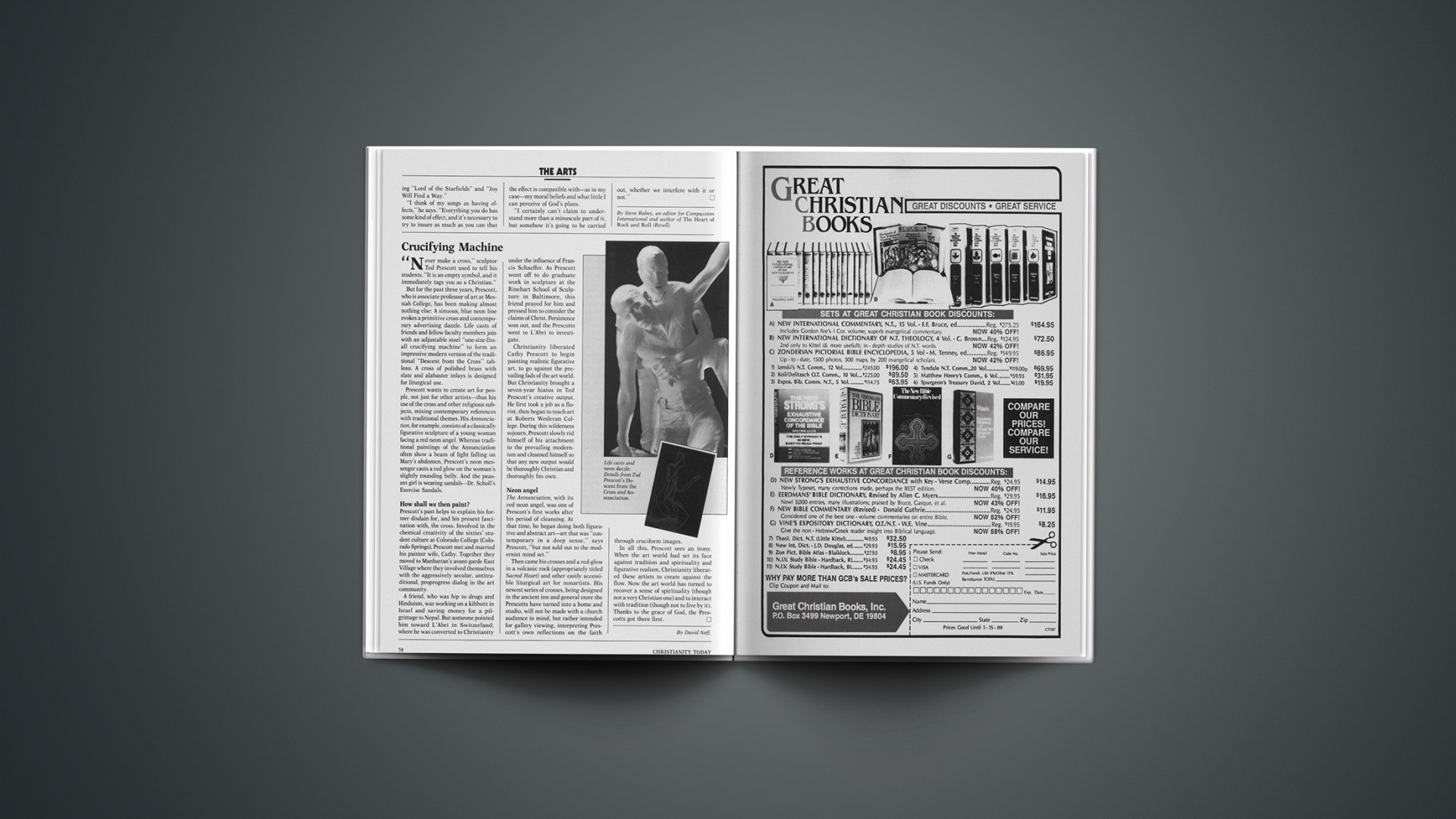

“Never make a cross,” sculptor Ted Prescott used to tell his students. “It is an empty symbol, and it immediately tags you as a Christian.”
But for the past three years, Prescott, who is associate professor of art at Messiah College, has been making almost nothing else: A sinuous, blue neon line evokes a primitive cross and contemporary advertising dazzle. Life casts of friends and fellow faculty members join with an adjustable steel “one-size-fits-all crucifying machine” to form an impressive modern version of the traditional “Descent from the Cross” tableau. A cross of polished brass with slate and alabaster inlays is designed for liturgical use.
Prescott wants to create art for people, not just for other artists—thus his use of the cross and other religious subjects, mixing contemporary references with traditional themes. His Annunciation, for example, consists of a classically figurative sculpture of a young woman facing a red neon angel. Whereas traditional paintings of the Annunciation often show a beam of light falling on Mary’s abdomen, Prescott’s neon messenger casts a red glow on the woman’s slightly rounding belly. And the peasant girl is wearing sandals—Dr. Scholl’s Exercise Sandals.
How Shall We Then Paint?
Prescott’s past helps to explain his former disdain for, and his present fascination with, the cross. Involved in the chemical creativity of the sixties’ student culture at Colorado College (Colorado Springs), Prescott met and married his painter wife, Cathy. Together they moved to Manhattan’s avant-garde East Village where they involved themselves with the aggressively secular, antitraditional, proprogress dialog in the art community.
A friend, who was hip to drugs and Hinduism, was working on a kibbutz in Israel and saving money for a pilgrimage to Nepal. But someone pointed him toward L’Abri in Switzerland, where he was converted to Christianity under the influence of Francis Schaeffer. As Prescott went off to do graduate work in sculpture at the Rinehart School of Sculpture in Baltimore, this friend prayed for him and pressed him to consider the claims of Christ. Persistence won out, and the Prescotts went to L’Abri to investigate.
Christianity liberated Cathy Prescott to begin painting realistic figurative art, to go against the prevailing fads of the art world. But Christianity brought a seven-year hiatus in Ted Prescott’s creative output. He first took a job as a florist, then began to teach art at Roberts Wesleyan College. During this wilderness sojourn, Prescott slowly rid himself of his attachment to the prevailing modernism and cleansed himself so that any new output would be thoroughly Christian and thoroughly his own.
Neon Angel
The Annunciation, with its red neon angel, was one of Prescott’s first works after his period of cleansing. At that time, he began doing both figurative and abstract art—art that was “contemporary in a deep sense,” says Prescott, “but not sold out to the modernist mind set.”
Then came his crosses and a red-glow in a volcanic rock (appropriately titled Sacred Heart) and other easily accessible liturgical art for nonartists. His newest series of crosses, being designed in the ancient inn and general store the Prescotts have turned into a home and studio, will not be made with a church audience in mind, but rather intended for gallery viewing, interpreting Prescott’s own reflections on the faith through cruciform images.
In all this, Prescott sees an irony. When the art world had set its face against tradition and spirituality and figurative realism, Christianity liberated these artists to create against the flow. Now the art world has turned to recover a sense of spirituality (though not a very Christian one) and to interact with tradition (though not to live by it). Thanks to the grace of God, the Prescotts got there first.
By David Neff.