
Illuminating The Old Testament
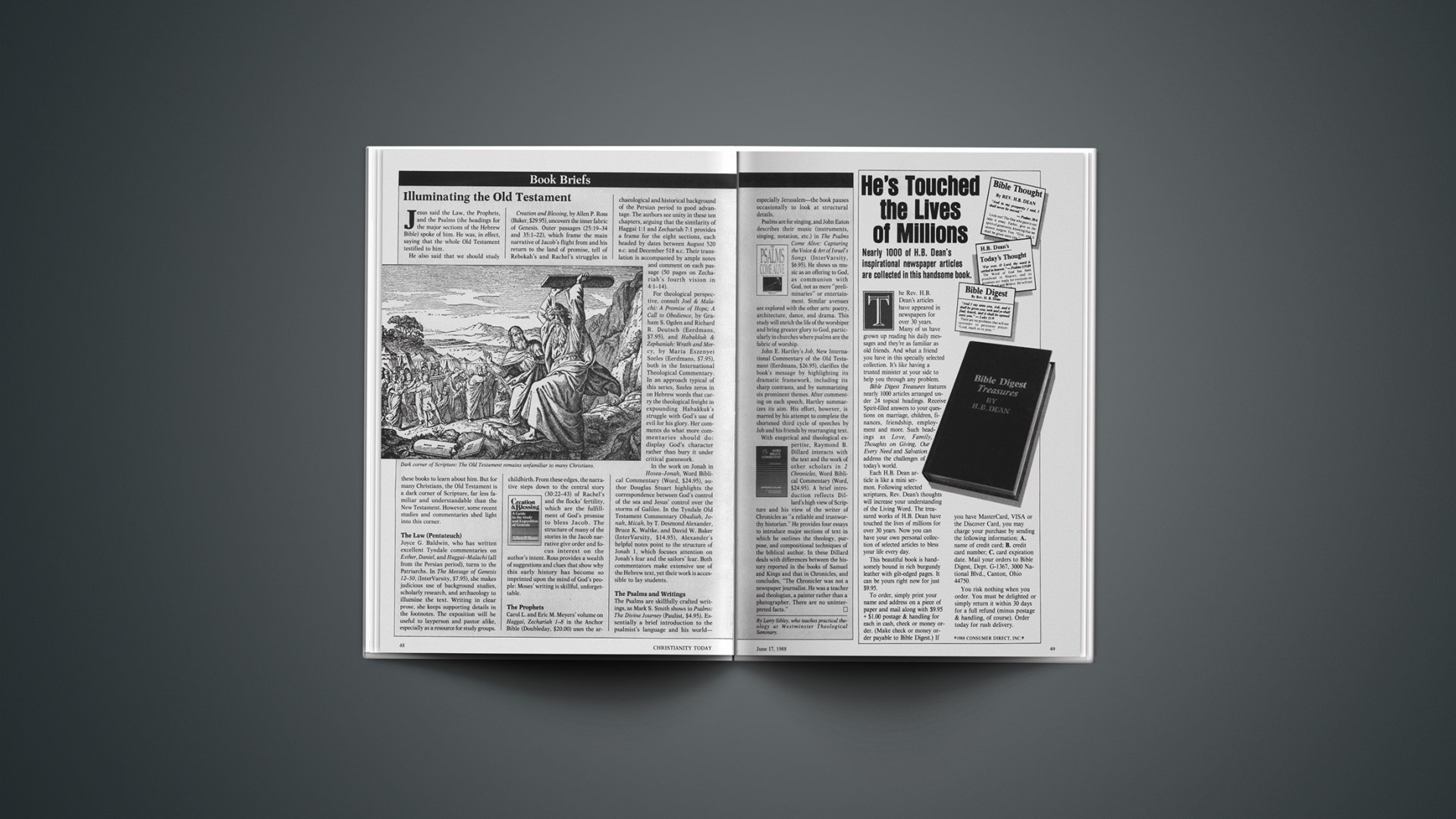
Jesus said the Law, the Prophets, and the Psalms (the headings for the major sections of the Hebrew Bible) spoke of him. He was, in effect, saying that the whole Old Testament testified to him.
He also said that we should study these books to learn about him. But for many Christians, the Old Testament is a dark corner of Scripture, far less familiar and understandable than the New Testament. However, some recent studies and commentaries shed light into this corner.
The Law (Pentateuch)
Joyce G. Baldwin, who has written excellent Tyndale commentaries on Esther, Daniel, and Haggai-Malachi (all from the Persian period), turns to the Patriarchs. In The Message of Genesis 12–50, (InterVarsity, $7.95), she makes judicious use of background studies, scholarly research, and archaeology to illumine the text. Writing in clear prose, she keeps supporting details in the footnotes. The exposition will be useful to layperson and pastor alike, especially as a resource for study groups.
Creation and Blessing, by Allen P. Ross (Baker, $29.95), uncovers the inner fabric of Genesis. Outer passages (25:19–34 and 35:1–22), which frame the main narrative of Jacob’s flight from and his return to the land of promise, tell of Rebekah’s and Rachel’s struggles in childbirth. From these edges, the narrative steps down to the central story (30:22–43) of Rachel’s and the flocks’ fertility, which are the fulfillment of God’s promise to bless Jacob. The structure of many of the stories in the Jacob narrative give order and focus interest on the author’s intent. Ross provides a wealth of suggestions and clues that show why this early history has become so imprinted upon the mind of God’s people: Moses’ writing is skillful, unforgettable.
The Prophets
Carol L. and Eric M. Meyers’ volume on Haggai, Zechariah 1–8 in the Anchor Bible (Doubleday, $20.00) uses the archaeological and historical background of the Persian period to good advantage. The authors see unity in these ten chapters, arguing that the similarity of Haggai 1:1 and Zechariah 7:1 provides a frame for the eight sections, each headed by dates between August 520 B.C. and December 518 B.C. Their translation is accompanied by ample notes and comment on each passage (50 pages on Zechariah’s fourth vision in 4:1–14).
For theological perspective, consult Joel & Malachi: A Promise of Hope; A Call to Obedience, by Graham S. Ogden and Richard R. Deutsch (Eerdmans, $7.95), and Habakkuk & Zephaniah: Wrath and Mercy, by Maria Eszenyei Szeles (Eerdmans, $7.95), both in the International Theological Commentary. In an approach typical of this series, Szeles zeros in on Hebrew words that carry the theological freight in expounding Habakkuk’s struggle with God’s use of evil for his glory. Her comments do what more commentaries should do: display God’s character rather than bury it under critical guesswork.
In the work on Jonah in Hosea-Jonah, Word Biblical Commentary (Word, $24.95), author Douglas Stuart highlights the correspondence between God’s control of the sea and Jesus’ control over the storms of Galilee. In the Tyndale Old Testament Commentary Obadiah, Jonah, Micah, by T. Desmond Alexander, Bruce K. Waltke, and David W. Baker (InterVarsity, $14.95), Alexander’s helpful notes point to the structure of Jonah 1, which focuses attention on Jonah’s fear and the sailors’ fear. Both commentators make extensive use of the Hebrew text, yet their work is accessible to lay students.
The Psalms And Writings
The Psalms are skillfully crafted writings, as Mark S. Smith shows in Psalms: The Divine Journey (Paulist, $4.95). Essentially a brief introduction to the psalmist’s language and his world—especially Jerusalem—the book pauses occasionally to look at structural details.
Psalms are for singing, and John Eaton describes their music (instruments, singing, notation, etc.) in The Psalms Come Alive: Capturing the Voice & Art of Israel’s Songs (InterVarsity, $6.95). He shows us music as an offering to God, as communion with God, not as mere “preliminaries” or entertainment. Similar avenues are explored with the other arts: poetry, architecture, dance, and drama. This study will enrich the life of the worshiper and bring greater glory to God, particularly in churches where psalms are the fabric of worship.
John E. Hartley’s Job, New International Commentary of the Old Testament (Eerdmans, $26.95), clarifies the book’s message by highlighting its dramatic framework, including its sharp contrasts, and by summarizing six prominent themes. After commenting on each speech, Hartley summarizes its aim. His effort, however, is marred by his attempt to complete the shortened third cycle of speeches by Job and his friends by rearranging text.
With exegetical and theological expertise, Raymond B. Dillard interacts with the text and the work of other scholars in 2 Chronicles, Word Biblical Commentary (Word, $24.95). A brief introduction reflects Dillard’s high view of Scripture and his view of the writer of Chronicles as “a reliable and trustworthy historian.” He provides four essays to introduce major sections of text in which he outlines the theology, purpose, and compositional techniques of the biblical author. In these Dillard deals with differences between the history reported in the books of Samuel and Kings and that in Chronicles, and concludes, “The Chronicler was not a newspaper journalist. He was a teacher and theologian, a painter rather than a photographer. There are no uninterpreted facts.”
By Larry Sibley, who teaches practical theology at Westminster Theological Seminary.