
WOMEN
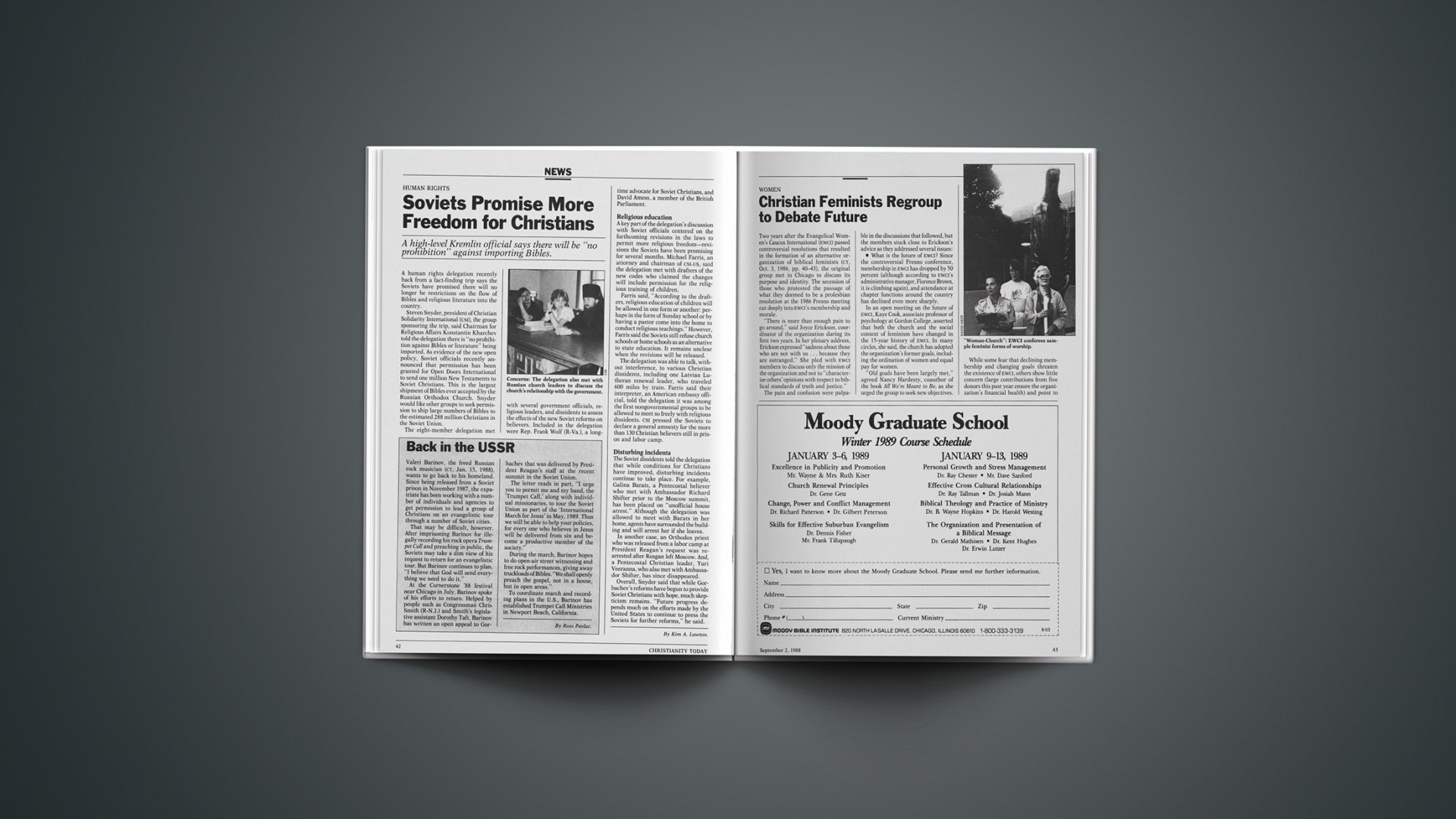
Two years after the Evangelical Women’s Caucus International (EWCI) passed controversial resolutions that resulted in the formation of an alternative organization of biblical feminists (CT, Oct. 3, 1986, pp. 40–43), the original group met in Chicago to discuss its purpose and identity. The secession of those who protested the passage of what they deemed to be a prolesbian resolution at the 1986 Fresno meeting cut deeply into EWCI’s membership and morale.
“There is more than enough pain to go around,” said Joyce Erickson, coordinator of the organization during its first two years. In her plenary address, Erickson expressed “sadness about those who are not with us … because they are estranged.” She pled with EWCI members to discuss only the mission of the organization and not to “characterize others’ opinions with respect to biblical standards of truth and justice.”
The pain and confusion were palpable in the discussions that followed, but the members stuck close to Erickson’s advice as they addressed several issues:
• What is the future of EWCI? Since the controversial Fresno conference, membership in EWCI has dropped by 50 percent (although according to EWCI’S administrative manager, Florence Brown, it is climbing again), and attendance at chapter functions around the country has declined even more sharply.
In an open meeting on the future of EWCI, Kaye Cook, associate professor of psychology at Gordon College, asserted that both the church and the social context of feminism have changed in the 15-year history of EWCI. In many circles, she said, the church has adopted the organization’s former goals, including the ordination of women and equal pay for women.
“Old goals have been largely met,” agreed Nancy Hardesty, coauthor of the book All We’re Meant to Be, as she urged the group to seek new objectives.
While some fear that declining membership and changing goals threaten the existence of EWCI, others show little concern (large contributions from five donors this past year ensure the organization’s financial health) and point to responsiveness to current issues as the key to the organization’s relevance.
• What is the mission of EWCI? At the organization’s 1984 Wellesley conference, disagreement arose over whether EWCI should restrict itself to encouraging sexual equality in evangelical and fundamentalist churches or should take stands on issues with political overtones, such as civil rights for lesbians and reproductive freedom for women.
Now that an alternative organization for biblical feminists, Christians for Biblical Equality (CBE), has been active in evangelical and fundamentalist churches, some EWCI members suggested it is time to focus more on “minority and justice issues, as well as bringing Woman-Church [feminist-oriented worship] to Protestants.” Others argued that EWCI needs to continue its ministry to those who believe conservative Christianity and feminism are incompatible.
• How will EWCI relate to lesbianism? The 1986 resolution on civil rights for lesbians contained language that recognized “the presence of the Lesbian minority” in EWCI, thus sparking continued discussion of sexuality at the 1988 conference. A plenary forum on “Issues of Sexuality” was addressed by a bisexual female who has a monogamous, lesbian relationship in which she has experienced “eight years of faithfulness” and which she believes “has been blessed by God.” Also addressing the forum was Roberta Kenney, one of the founders of Exodus International, a coalition of ministries committed to helping Christian homosexuals toward healing.
Emotionally charged discussion followed in which lesbianism appeared to be affirmed. “People who did not support” the idea that there is no biblical ground on which to critique lesbianism “felt intimidated,” says Kaye Cook, the newly appointed co-coordinator of EWCI. Nevertheless, says Cook, the heterosexual women in the group are concerned.
Following the biennial conference, the executive committee met and made recommendations yet to be approved by the membership: That informal ways of addressing issues be introduced to the organization in order to avoid the potential divisiveness of formal resolutions; and that the organization’s name be changed from the Evangelical Women’s Caucus International to Ecumenical Women’s Coalition.
“There’s a strong sentiment that many people in the organization don’t participate in evangelical churches anymore,” says Kaye Cook, “and that ecumenical more accurately reflects our composition. EWCI formerly focused on service in the evangelical tradition, but is now moving out to address other issues. Nevertheless, we want to retain our biblical feminism.”
By David Neff.