
RELIGIOUS EDUCATION
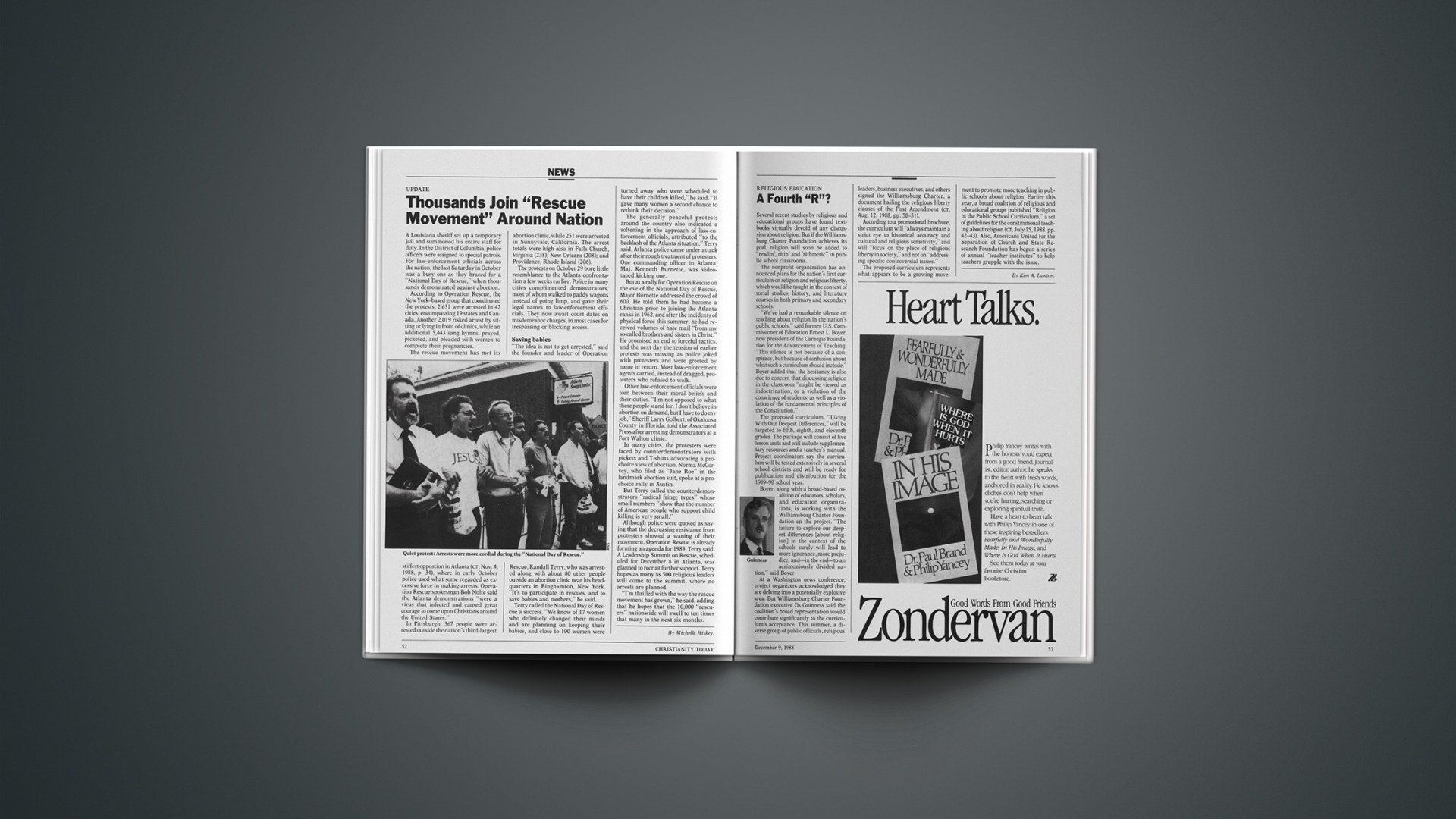
Several recent studies by religious and educational groups have found textbooks virtually devoid of any discussion about religion. But if the Williamsburg Charter Foundation achieves its goal, religion will soon be added to “readin’, ritin’ and ‘rithmetic” in public school classrooms.
The nonprofit organization has announced plans for the nation’s first curriculum on religion and religious liberty, which would be taught in the context of social studies, history, and literature courses in both primary and secondary schools.
“We’ve had a remarkable silence on teaching about religion in the nation’s public schools,” said former U.S. Commissioner of Education Ernest L. Boyer, now president of the Carnegie Foundation for the Advancement of Teaching. “This silence is not because of a conspiracy, but because of confusion about what such a curriculum should include.” Boyer added that the hesitancy is also due to concern that discussing religion in the classroom “might be viewed as indoctrination, or a violation of the conscience of students, as well as a violation of the fundamental principles of the Constitution.”
The proposed curriculum, “Living With Our Deepest Differences,” will be targeted to fifth, eighth, and eleventh grades. The package will consist of five lesson units and will include supplementary resources and a teacher’s manual. Project coordinators say the curriculum will be tested extensively in several school districts and will be ready for publication and distribution for the 1989–90 school year.
Boyer, along with a broad-based coalition of educators, scholars, and education organizations, is working with the Williamsburg Charter Foundation on the project. “The failure to explore our deepest differences [about religion] in the context of the schools surely will lead to more ignorance, more prejudice, and—in the end—to an acrimoniously divided nation,” said Boyer.
At a Washington news conference, project organizers acknowledged they are delving into a potentially explosive area. But Williamsburg Charter Foundation executive Os Guinness said the coalition’s broad representation would contribute significantly to the curriculum’s acceptance. This summer, a diverse group of public officials, religious leaders, business executives, and others signed the Williamsburg Charter, a document hailing the religious liberty clauses of the First Amendment (CT, Aug. 12, 1988, pp. 50–51).
According to a promotional brochure, the curriculum will “always maintain a strict eye to historical accuracy and cultural and religious sensitivity,” and will “focus on the place of religious liberty in society,” and not on “addressing specific controversial issues.”
The proposed curriculum represents what appears to be a growing movement to promote more teaching in public schools about religion. Earlier this year, a broad coalition of religious and educational groups published “Religion in the Public School Curriculum,” a set of guidelines for the constitutional teaching about religion (CT, July 15, 1988, pp. 42–43). Also, Americans United for the Separation of Church and State Research Foundation has begun a series of annual “teacher institutes” to help teachers grapple with the issue.
By Kim A. Lawton.