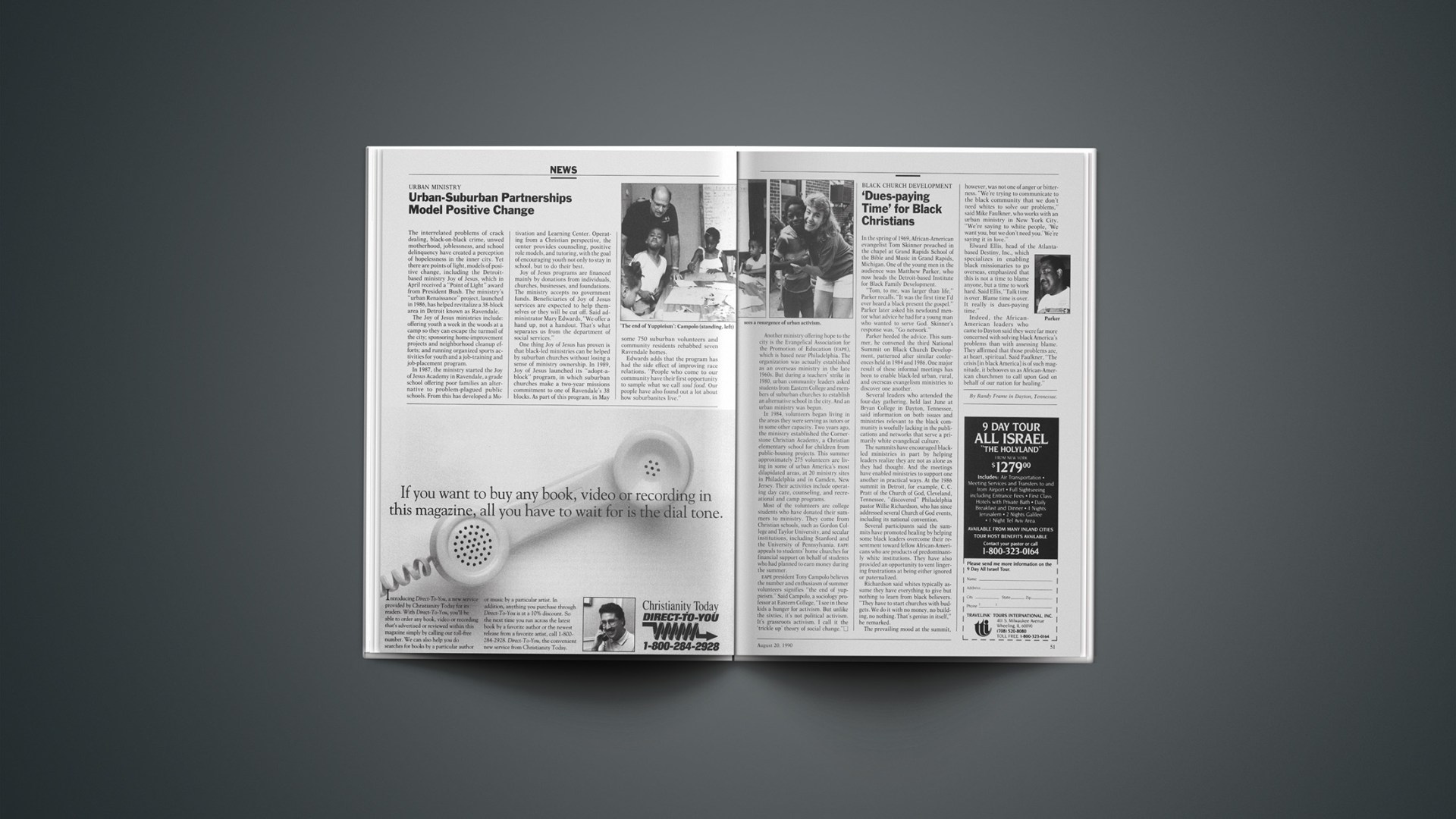

In the spring of 1969, African-American evangelist Tom Skinner preached in the chapel at Grand Rapids School of the Bible and Music in Grand Rapids, Michigan. One of the young men in the audience was Matthew Parker, who now heads the Detroit-based Institute for Black Family Development.
“Tom, to me, was larger than life,” Parker recalls. “It was the first time I’d ever heard a black present the gospel.” Parker later asked his newfound mentor what advice he had for a young man who wanted to serve God. Skinner’s response was, “Go network.”
Parker heeded the advice. This summer, he convened the third National Summit on Black Church Development, patterned after similar conferences held in 1984 and 1986. One major result of these informal meetings has been to enable black-led urban, rural, and overseas evangelism ministries to discover one another.
Several leaders who attended the four-day gathering, held last June at Bryan College in Dayton, Tennessee, said information on both issues and ministries relevant to the black community is woefully lacking in the publications and networks that serve a primarily white evangelical culture.
The summits have encouraged black-led ministries in part by helping leaders realize they are not as alone as they had thought. And the meetings have enabled ministries to support one another in practical ways. At the 1986 summit in Detroit, for example, C. C. Pratt of the Church of God, Cleveland, Tennessee, “discovered” Philadelphia pastor Willie Richardson, who has since addressed several Church of God events, including its national convention.
Several participants said the summits have promoted healing by helping some black leaders overcome their resentment toward fellow African-Americans who are products of predominantly white institutions. They have also provided an opportunity to vent lingering frustrations at being either ignored or paternalized.
Richardson said whites typically assume they have everything to give but nothing to learn from black believers. “They have to start churches with budgets. We do it with no money, no building, no nothing. That’s genius in itself,” he remarked.
The prevailing mood at the summit, however, was not one of anger or bitterness. “We’re trying to communicate to the black community that we don’t need whites to solve our problems,” said Mike Faulkner, who works with an urban ministry in New York City. “We’re saying to white people, ‘We want you, but we don’t need you.’ We’re saying it in love.”
Elward Ellis, head of the Atlanta-based Destiny, Inc., which specializes in enabling black missionaries to go overseas, emphasized that this is not a time to blame anyone, but a time to work hard. Said Ellis, “Talk time is over. Blame time is over. It really is dues-paying time.”
Indeed, the African-American leaders who came to Dayton said they were far more concerned with solving black America’s problems than with assessing blame. They affirmed that those problems are, at heart, spiritual. Said Faulkner, “The crisis [in black America] is of such magnitude, it behooves us as African-American churchmen to call upon God on behalf of our nation for healing.”
By Randy Frame in Dayton, Tennessee.