 Three Her.meneutics writers reflect on the difficulty of poverty and some misguided beliefs about the poor.
The Problem with Lists
Caryn Rivadeneira
For the longest time I wondered why God allowed me—and my family—to go broke. After so many cries for rescue, after so many laments, after so many opportunities where God could've "fixed" our financial crisis easily, but didn't, I wondered what he was up to. Wondered why he wasn't "blessing" us with financial abundance the way he had in the past.
At long last, I figured maybe God was actually blessing us with a time in relative poverty. That maybe, God allowed us to linger in financial desperation so that we might learn something life-changing through a time of total and utter dependence on him. That maybe learning what it is to lean on God and God's people, to fully understand the beauty of asking for and receiving daily bread would be a bigger blessing than some zeroes on a savings account.
But I was wrong. At least, according to a post on Christian financial guru Dave Ramsey's site. Based on that advice, we went broke—from rich to poor—because I wasn't forcing my children to read at least two non-fiction books a month… or following those 19 other things Rich People Do Every Day that Poor People Don't.
If this is true, it makes total sense why I'm no longer rich: I may have spent two hours last night in bed with Jane Eyre, but since I did not spend 30 minutes reading something career-related, I have no hope. It doesn't help that I choose NPR over audio books or that I usually speak what's on my mind. You know, like we broke people do.
But of course, I jest. This list's truthiness isn't its biggest problem. The problem is the prevalence with which so many Christians seem to think lists like this are helpful. After all, why should Christians be so concerned with what the rich do—how they become so or how they act? According to Jesus, they are not the blessed ones. They have the harder time finding the Kingdom.
While some of the items on the list make common sense (reading more of anything is always a good thing), if in my most desperate financial need someone handed me this list and told me to hop to it, I'd never seen Jesus poking through these words. Not like I saw him peek out when friends handed us stacks of grocery store gift cards or family members sent checks—with no repayment expectation. There, I saw love. There, I saw grace, There, I saw Jesus. In the gifts, not the lists.
Our Gifts, God's Grace
Rachel Marie Stone
From Proverbs, we might conclude that God rewards the hardworking with wealth, while poverty is the result of laziness. The book is full of aphorisms like, "A slack hand causes poverty, but the hand of the diligent makes rich" (10:4) and "Do not love sleep, or else you will come to poverty; open your eyes, and you will have plenty of bread" (19:13).
This idea—that people who are poor are poor simply because they haven't cultivated the right habits—gets labeled as biblical, but tends to foster a contempt for the poor that's anything but.
Scripture reminds us many times poverty itself is by no means a cursed state (Prov. 15:16) and condemns contempt for the poor: "Those who oppress the poor insult their Maker, but those who are kind to the needy honor him" (Prov. 14:31). Deuteronomy 15:7-8 warns Israelites not to be "hard-hearted or tight-fisted toward your needy neighbor. You should rather open your hand, willingly lending enough to meet the need, whatever it may be."
The Bible doesn't indicate that people must be worthy of such generosity, no provision made for excluding the person from charity because of laziness. We see that kindness and generosity are to be given without reservation, without restriction. Perhaps this is because all good things—including the ability to work hard—come from divine grace. The prosperity that can follow hard work is not exclusively our natural and inevitable reward, but in fact a gift from God.
I understand this idea much more clearly since I came to live in Malawi, Africa, which is one of the ten poorest countries in the world. It's common to see even very small children with babies tied to their backs, carrying buckets of water on their head, and women and girls cultivating the ground with short hoes or stooped over, gathering firewood: literally backbreaking work. I have never worked as hard as many women and even children do here, day in, day out, year after year. Yet my annual income exceeds theirs many, many times over. Not because of my hard work, but because I was born someplace else.
Ecclesiastes 9:11 reminds us that "under the sun the race is not to the swift, nor the battle to the strong, nor bread to the wise, nor riches to the intelligent, nor favor to the skillful; but time and chance happen to them all." Sometimes riches do indeed come from hard work, but when hard work can result in riches, it may be an accident of birth, or God's unknowable providence—in Manhattan, say, rather than in Malawi—that makes it so.
Whatever we have is because of God's generous grace, which we acknowledge when we, in turn, are generous and gracious.
What Poverty Really Looks Like
Marlena Graves
I'm familiar with poverty. I grew up poor and have worked with and among the poor. As the director of an after-school program in one of the poorest counties in Ohio, I remember watching a father tear up as he told me, "Thank you so much for teaching my son to read. I never learned to read, I've only got a sixth grade education." I could see how desperately he wanted a different life for his son. This father walked nearly four miles each day to work at a Burger King. He was a cook. With his educational level and the nearly non-existent jobs in rural Appalachia, he was doing the best he could for his family. That was in 2001, way before the economic downturn of 2008.
His story is not unusual for poor families. So I read Tom Corley's 20 Habits of the Rich (that the poor don't do) on Dave Ramsey's website, I wondered if either grew up poor or had spent considerable time among the poor. If they had, it's hard to believe they would've uncritically posted such suggestions out of context.
Most I know work long hard hours for very little pay, if they have a job. By the time they get home (assuming they work first shift), they're exhausted. It's all they can do to get supper together, help the kids with homework, and put them to bed. So they may grab whatever pre-packaged food is available (Habit #1).
And it's not that they don't want to read to their kids (Habit #10). They're tired and just trying to survive while providing the most basic needs of food, clothing, and shelter. With little time for leisure, watching television is one of the only luxuries they have (Habit #s 13, 14). The next day, they wake up and do it all over again without breaks. Many will not wake up hours early; rest is a gift (Habit #15).
They don't have the support networks and safety nets we take for granted. If no friends or parents are available to watch the kids, a large portion of their income goes to childcare. And if the car breaks down and there's no public transportation, then their job is in jeopardy. God forbid someone gets sick and needs medical attention. Many don't have health insurance and live with chronic health problems.
With whom are many of the poor going to network (Habit #12)? In the world's eyes, they have nothing to offer. Networking is mostly about quid pro quo. If I didn't have the mind God gave me, I couldn't have gone to college. And if I didn't go to college, I wouldn't have met so many of the people who've made me the person I am now, so many people God used to open doors for me. I stand on the shoulders of others. Many have no shoulders on which to stand.
Growing up, I felt like an outsider looking into the normal, comparably chaos-less life many of my friends lived. Too many things were stacked against me to succeed. And so when I see lists like these, I remember list makers are taking too much privilege for granted and not telling the whole story.
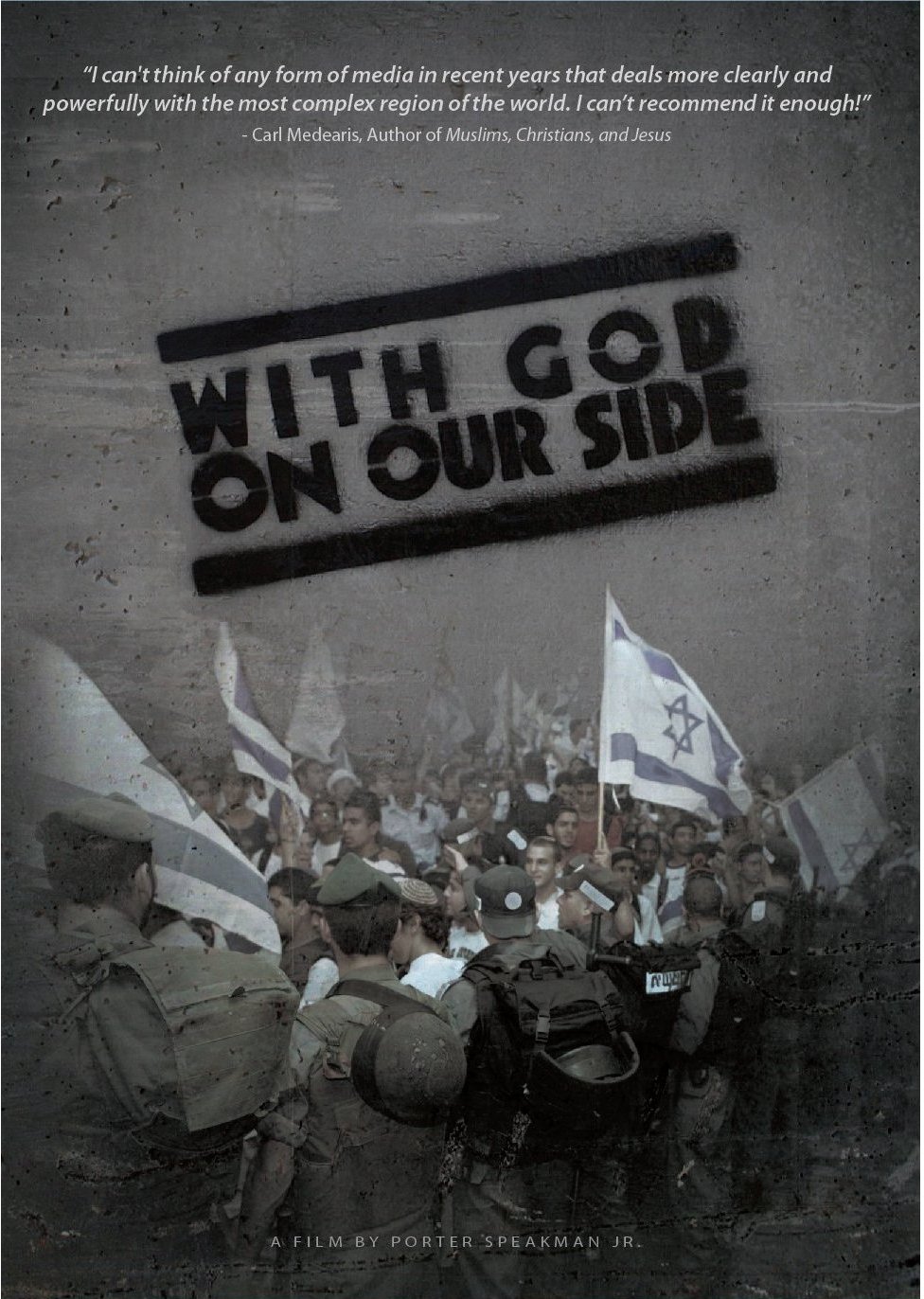
Editor’s note: Several months ago, we reviewed a pair of documentaries about Christian Zionism. Our reviewer found one of the films, With God on Our Side, to be a balanced look at the situation. Guest blogger Gerald McDermott, the Jordan-Trexler Professor of Religion at Virginia’s Roanoke College, offers a different viewpoint.
The documentary With God on Our Side is anything but balanced. It does not give “both sides their due” but instead interviews only Israelis on the far left and ignores Christian Zionists who defend the rights of Palestinians. The result is a one-sided attack on Israel that treats social and political realities with the same ideological insouciance which the documentary assigns to John Hagee and his band.
One interviewee in the film claims—without rebuttal—that Jews did not live in the land for two thousand years. The truth is that Jewish communities have lived in the land through all this time, flourishing in Jerusalem, Galilee and coastal cities in the 9th and 11th centuries, and then rebounding after being massacred by Crusaders in the 12th century. By the early 19th century, long before the rise of Zionism, more than ten thousand Jews lived in what is now Israel.
Viewers are told of Jews expelling Arabs from villages in the 1948 war for independence, but not that the war was started by Arabs, or that Arab armies from neighboring countries targeted Jewish civilians, or that the war was unnecessary because the UN had offered a two-state partition that the Jews accepted and Palestinians rejected.
The documentary states that Israel started the 1967 war “pre-emptively” but fails to provide the context: after months of threatening war against Israel, Egypt’s President Nasser announced (just days before Israel struck) that “the armies of Egypt, Jordan, Syria and Lebanon . . . are arranged for battle, the critical hour has arrived.”
The film then proceeds to charge Israel with “illegal occupation” of the West Bank after the 1967 War on the grounds that Israel failed to comply with UN Resolution 242.
According to this resolution, Israeli withdrawal was to take place in the context of mutual recognition of the right to exist and territorial adjustments to achieve secure boundaries. Withdrawal was ordered from “territories,” not “the territories.” Both Arthur Goldberg and Lord Carrington, the primary authors of this resolution, have said that the word “the” was purposely omitted because it was not intended for Israel to give back all of her territories, since they recognized that some were needed for secure boundaries.
Despite the fact that most Arab states have refused to recognize Israel’s right to exist (a condition of Resolution 242), Israel has implemented the principles of the Resolution three times. When Egypt terminated its claims of belligerency in 1979, Israel returned the Sinai. When Jordan signed a peace agreement, Israel returned land claimed by Jordan. Then in September 2005 Israel unilaterally withdrew from Gaza, only to be met with new attacks on her civilians launched from that territory.
Illegal occupation? Hardly. Israel has made repeated efforts to comply with UN stipulations for the territories, while its Arab neighbors have not.
When the Palestinians appeared to accept Israel’s right to exist during the Oslo negotiations, Israel turned over control of major West Bank cities to the Palestinian Authority (PA). But when the PA showed support for terrorist attacks on Israeli citizens in 2000, Israel resumed control of those cities. In that same year Israel offered to return 92 percent of the West Bank, which this documentary dismisses as ungenerous because, it charges, Israel never owned the land in the first place.
Yet Jews have lived in ancient Samaria (the West Bank) for over three thousand years. Jordan unilaterally renounced all claims to this area in 1988 and released legal ownership to Israel at that time. This video suggests Jews should remove all settlements from the West Bank, leaving it entirely for Palestinians. That would be as unreasonable as insisting that no Arabs can live in Judaea.
Besides, what other country has been required to give up land that it won in a defensive war? Do Germans displaced from Koenigsberg clamor and agitate for that German city to be returned to them by the victorious Russians?
The film concentrates attention on suffering caused Palestinians by the new wall. The wall is indeed tragic in many ways. But there is only a passing reference to the attacks on citizens which prompted its building, and the fact that this wall has prevented many such attacks.
Perhaps most disturbing, this video leaves unchallenged one man’s denunciation of Israel as “apartheid on steroids.” This accusation is not only inflammatory but egregiously unfair. South African apartheid was based on race. “Blacks” and “coloureds” could not vote and had no representation in the South African parliament. But Israeli citizens of all races—Arabs and Jews alike—can vote, be represented in the Knesset, and have recourse to the courts.
Apartheid was also a legal system that restricted participation to a minority that had control over a majority. In Israel the majority give equal legal rights and protection to Arab citizens, who make up 20% of the population of Israel.
Irshad Manji, a Muslim, has written, “At only 20 percent of the population, would Arabs even be eligible for election if they squirmed under the thumb of apartheid? Would an apartheid state extend voting rights to women and the poor in local elections, which Israel did for the first time in the history of Palestinian Arabs?”
There are also theological problems with this film. First, we are shown only Christian Zionists who use biblical prooftexts to support Israel’s rights to the land. There is no sign of the vast numbers of Israelis and evangelicals who believe that modern Israel is a miraculous work of God fulfilling biblical prophecy while at the same time supporting Palestinians’ rights to self-determination in the land. In other words, viewers never hear of another kind of Jewish and Christian theological Zionism that takes seriously both prophecies of Israel’s return and the biblical mandate of social justice for Jews and Arabs alike.
The second and more serious theological problem is that the end of the documentary suggests that God’s covenant with the Jews (Gen. 12.1-3 et al) was eclipsed by the new covenant for Christians. This is the familiar replacement theology that does not do justice to Rom 11.28-29, and that helped create an atmosphere that required Zionism in the first place. In other words, it was this sort of supersessionism (the belief that the Christian covenant replaced the Jewish covenant) that taught Christians for millennia that Judaism was no longer significant theologically, which then encouraged the belief that Jews were no longer important in a Christian world.