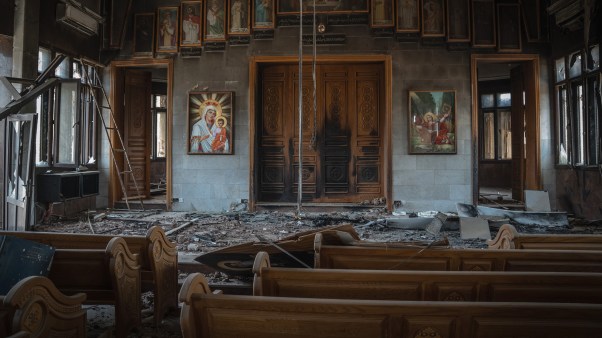

Hostilities between Christians and Muslims escalated last month in northern Nigeria, where some 300 people were reportedly killed during inter-religious fighting. According to international press reports, several Christian churches were also destroyed in what is being characterized as some of the worst rioting in nearly a decade of tensions.
In the midst of the conflicts, some Christian leaders are pushing reconciliation efforts. However, according to one prominent Nigerian pastor, the prospects for peace and nonviolence are growing more distant. Nigerian Anglican Bishop Josiah Idowu-Fearon reports that Christians in the Muslim-dominated areas of his country are “starting to fight back with violence.” “More Christians are seeing Muslims as their enemies,” the bishop said during a brief visit to Washington, D.C., in May.
Nigeria’s long-standing religious tensions stem in large part from the demographic factors that divide the West African nation of some 118 million. Idowu-Fearon says population patterns have created “three countries in one”: a Muslim-dominated north, a religiously mixed middle belt, and a predominantly Christian south.
Idowu-Fearon serves in the northern Sokoto diocese, a region believed to be 93 percent Muslim. Most of the violent clashes have occurred in the north, where Christians frequently are denied education privileges, public preaching is forbidden, and churches are often targeted for destruction by radical Muslims.
Fighting Back
Idowu-Fearon believes a turning point in the conflicts occurred late in October last year when German evangelist Reinhard Bonnke attempted to stage a crusade in the Muslim-controlled city of Kano. As a Muslim protest erupted into a violent rampage, the bishop says Christians for the first time began to fight back.
“The Muslim attacks stopped as soon as Christians started defending themselves,” he says. However, after the Muslims regrouped, the violence escalated and spread to outlying areas, leaving about 2,000 people dead, according to estimates by Christian observers. In March, 15 people were reported killed in religious rioting sparked by a dispute over the use of a water reservoir.
The military government of Africa’s most populous nation has been slow in addressing the tensions. Officials have never updated their early estimate of eight dead and 34 injured in the October incident. At the United Nations Human Rights Commission hearings in February, Nigeria denied that religious freedom was a factor in the conflict.
Religious Rights
In light of the heightened tensions, religious leaders are uniting to call for increased efforts toward reconciliation and social reform. Idowu-Fearon serves on a special committee of Christians and Muslims appointed to study the situation. That committee has released a detailed report accusing the government of a less-than-satisfactory response to the religious crises.
The report calls for religious property rights and freedom of worship for religious groups “anywhere in the country.” It also advocates that government policy be disseminated to all religious groups, a move that might help clear up confusion about the jurisdiction of Islamic courts.
The 1989 Nigerian Constitution includes some provisions for strict Islamic law, or shari‘a, and the bishop claims many Nigerian Christians are being held subject to the Islamic courts, even in the middle region, which is nearly 50 percent Christian. The report, however, does not delve into fundamental legal questions of religious discrimination.
Nigeria must find a consensus on religious pluralism, says Idowu-Fearon, in order to survive as a state. “Nigeria is not an Islamic country, and it is not a Christian country,” he asserts. Nor is it a secular state, “because religion plays a very vital role in the life of our country.” Peace, he says, can only come when the genuine religious convictions of all Nigerians are respected.
By Randy Tift, News Network International.