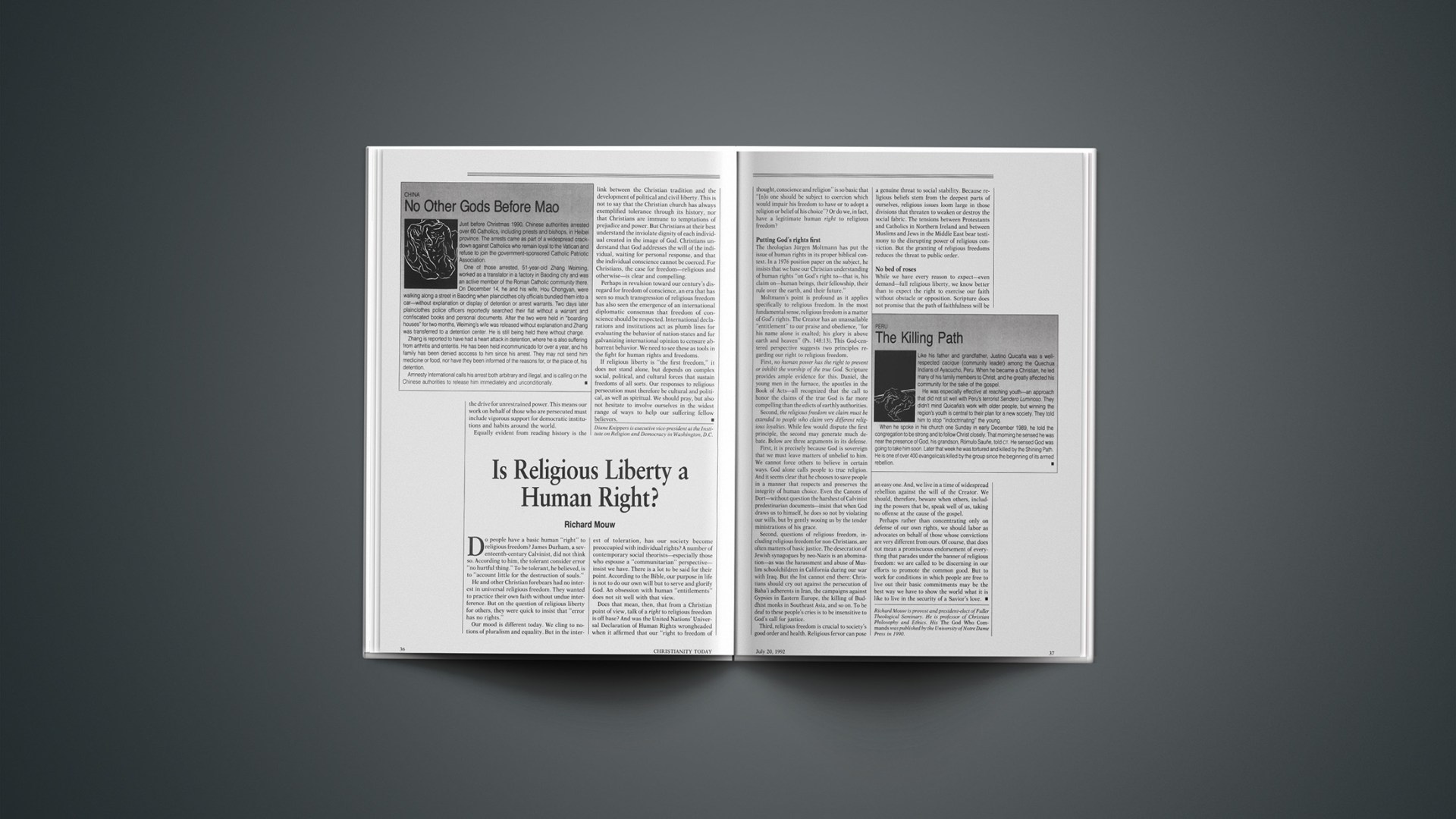

Just before Christmas 1990, Chinese authorities arrested over 60 Catholics, including priests and bishops, in Heibei province. The arrests came as part of a widespread crackdown against Catholics who remain loyal to the Vatican and refuse to join the government-sponsored Catholic Patriotic Association.
One of those arrested, 51-year-old Zhang Weiming, worked as a translator in a factory in Baoding city and was an active member of the Roman Catholic community there. On December 14, he and his wife, Hou Chongyan, were walking along a street in Baoding when plainclothes city officials bundled them into a car—without explanation or display of detention or arrest warrants. Two days later plainclothes police officers reportedly searched their flat without a warrant and confiscated books and personal documents. After the two were held in “boarding houses” for two months, Weiming’s wife was released without explanation and Zhang was transferred to a detention center. He is still being held there without charge.
Zhang is reported to have had a heart attack in detention, where he is also suffering from arthritis and enteritis. He has been held incommunicado for over a year, and his family has been denied acccess to him since his arrest. They may not send him medicine or food, nor have they been informed of the reasons for, or the place of, his detention.
Amnesty International calls his arrest both arbitrary and illegal, and is calling on the Chinese authorities to release him immediately and unconditionally.
Equally evident from reading history is the link between the Christian tradition and the development of political and civil liberty. This is not to say that the Christian church has always exemplified tolerance through its history, nor that Christians are immune to temptations of prejudice and power. But Christians at their best understand the inviolate dignity of each individual created in the image of God. Christians understand that God addresses the will of the individual, waiting for personal response, and that the individual conscience cannot be coerced. For Christians, the case for freedom—religious and otherwise—is clear and compelling.
Perhaps in revulsion toward our century’s disregard for freedom of conscience, an era that has seen so much transgression of religious freedom has also seen the emergence of an international diplomatic consensus that freedom of conscience should be respected. International declarations and institutions act as plumb lines for evaluating the behavior of nation-states and for galvanizing international opinion to censure abhorrent behavior. We need to see these as tools in the fight for human rights and freedoms.
If religious liberty is “the first freedom,” it does not stand alone, but depends on complex social, political, and cultural forces that sustain freedoms of all sorts. Our responses to religious persecution must therefore be cultural and political, as well as spiritual. We should pray, but also not hesitate to involve ourselves in the widest range of ways to help our suffering fellow believers.