 This morning, I left the house early to work out. My husband Peter arose with the kids—Penny, age 8, William, 5, and Marilee, almost 3. I returned to find them in various forms of protest, insisting I make their breakfast even though their dad is equally capable of slicing banana bread and strawberries.
The morning progressed and Peter tried to help out—packing lunches, showers, getting dressed, making beds, brushing teeth—as our children continued to resist his assistance. They swarmed me for most of the time, with one break to pillow-fight with their father.
Liza Mundy's recent article in The Atlantic, Daddy Track: The Case for Paternity Leave, suggests that the parenting imbalance in our household has a specific root. I took maternity leave. And although my husband and I talked for years about sharing parenting responsibilities, he took only a few days off from work after each of our children was born.
Peter said he would stop working or work part-time so he could be with the kids and I could work more, but his job provided our housing and health insurance. What's more, as a writer, I brought in approximately an hour, leaving me to find a better-paying job I didn't really want or to keep plugging away at writing during the kids' naps.
With time, it didn't seem to make sense for us to switch roles. I knew the routines. He liked his job. We secured some childcare so I could keep writing. And finally, as much as I bemoaned my life as a part-time SAHM, I also cherished what I learned from being around these little ones every day. The small decisions about who sang the kids to sleep and who changed the dirty diapers and who planned the meals all became patterns of life together.
It has worked out for us, and yet I wonder how much our children have missed out as a result of our bifurcated roles. While separation of tasks makes many decisions easier, it also comes at a cost. Peter brings different qualities to the household than I do, so I've often wished we could more fully share both aspects of adult life—the responsibilities at home and the work hours. Moreover, in his role as father, Peter can offer an understanding of our heavenly Father that I cannot. It's not to say he is a perfect parent, nor that my mothering won't provide our children with some understanding of God's character. But Jesus teaches us to pray to our Daddy, and for kids to experience the care and leadership of a good and loving earthy father can pave the way for them to better understand God's grace and truth in their lives.
Mundy's article points out that the positive social gain of maternity leave, initially offered for medical reasons, has nevertheless led to a separation of home and work roles among male and female. This separation is evident even in "progressive" societies like Sweden, in which paid year-long maternity leave has led to an even harder glass ceiling for women in the workplace.
Thankfully, Mundy doesn't propose abolishing maternity leave and getting women back to work quickly in order to overcome this problem. Rather, she advocates for the positive personal and social value of paternity leave.
Paternity leave encourages men to bond with their children, to learn the routines and needs of the household from day one. It establishes patterns that enable men to continue their involvement in the household even once they resume working—including spending more hours with their kids on workdays and taking more time for family vacation. Furthermore, it changes the culture of the workplace so that both parents become concerned with the health and stability of the family and the possibilities for a meaningful work-life balance.
Progressive feminist thought has often thrown the proverbial baby out with the bathwater. Instead of advocating for greater social and personal supports for women with unplanned pregnancies, and instead of calling upon men to take equal responsibility for the children conceived, we've legalized abortion. Instead of advocating for self-control and mutual respect and care in sexual relationships, we've determined that girls can be just like boys in their hookups, infidelities, and exploits. Much of the feminist movement has not empowered and protected women or called men to greater responsibility for their actions and relationships. Rather, it has encouraged women to become just like men.
Paternity leave certainly counts as progressive social policy. But for once it supports families rather than undercutting them. This policy allows workplaces to support men in becoming active participants and leaders within their households from the moment their children are born. Generous paternity leave is an example of feminism gone right, in which families as a whole are strengthened.
As Mundy points out, right now, only the states of California, Rhode Island, and New Jersey mandate paternity leave. A few other states are due to follow soon. The church has an opportunity to get out on the front end of a cultural trend that strengthens families while enabling greater female involvement in church leadership by instituting generous paternity leave policies. Such policies would not only do good for the people involved but would also send a positive message to our culture about what (and who) we are for instead of what we are against.
Last month, a photo of an African-American dad with his two daughters went viral. It shows him with an infant strapped to his chest combing his two-year old daughter's hair. The father—who also happens to be a portrait of masculinity with muscular arms, dressed in camoflauge shorts—had taken paternity leave. The viral response to this photo demonstrates how unusual it is to see a dad (and an African-American dad too) involved in domestic childcare duties. And yet the image hints at the strength and stability a family gains when both mother and father can care for their children and work outside the home.
Your preteen daughter surely knows that Justin Bieber’s first feature film is opening this Friday, Feb. 11, in theaters everywhere. But does your pastor know? Or your church’s youth leaders?
There’s a subtle-but-fascinating marketing campaign going on for Justin Bieber: Never Say Never, accentuating the faith angle of the movie. Well, maybe not so much the movie as Bieber himself. Other than a quick pre-show prayer or two, the film is not overt about Bieber’s faith; one publicist clarified that “while Justin and his mother [also prominently featured] are Christians . . . this is a secular film about Justin and his music. However, it is clean, safe, wholesome entertainment that parents and grandparents can take their kids to.”
Still, due to the faith angle — however subtle — a relatively new division of a large marketing agency is pitching the movie to faith-based media and audiences. Allied Faith & Family, an arm of Allied Integrated Marketing, is working the faith angle for the movie, which is being distributed by Paramount. Allied IM (the parent company) is an established marketing agency that works a myriad of projects with well-known clients — including many of Hollywood’s major studios. (CT works regularly with the Chicago branch of Allied for movie screenings for our local film critics.)
In conjunction with the new Bieber film, Allied Faith & Family has put together a 12-page Bible study discussion guide titled, “Never Say Never: For Nothing Is Impossible With God,” based on the film and Bieber’s own faith journey. The guide bills itself as “an opportunity to teach our children about the power of hope, prayer, faith and family.” It includes sections on “Discerning God’s Plan for Your Life,” “The Power of Prayer,” and “The Importance of Godly Friendships.”
We already knew that Bieber was a Christian, but Allied Faith & Family’s efforts — which include a video interview with Bieber’s mother, Pattie Mallette — have helped members of the media learn even more about his faith journey. Cobbled from press releases, videos, and the interview with Mallette, we learn that:
> Bieber, in his own words, is “a Christian. I believe in God. I believe that, you know, Jesus died on the cross for my sins. I have a relationship with him. And he’s the reason I’m here.” (A few more “you knows” were edited out here.)
> Mallette wanted her son to be “a youth pastor or a worship leader,” and when Justin’s pop star began to rise so rapidly, she didn’t think it was God’s plan because so many entertainment celebs “are getting into trouble. It’s not the best environment to raise a child from.” But she says God “said” to her that he’d called her son “to be a light in the world, and how are you supposed to be a light in the world if you’re not in the world.”
Warning: This post contains spoilers from season 4, episode 2 of Downton Abbey.
I had to look away when the visiting valet attacked Anna Bates on Downton Abbey's recent episode. It's my knee-jerk reaction. Even people who haven't experienced sexual violation probably have the same instinct. Seeing a predator leer, then assault a victim should make us all recoil.
I keep recoiling, escaping into myself, and mourning my own crushing Anna moments, wondering how many people walk wounded on this earth, feeling afraid, alone, violated, never to be whole. I'm grateful they didn't show what happened, but Anna's screams and the noise of the valet's violent attack were enough to remind me of that terribly helpless feeling of not being able to escape a perpetrator.
After the rape, we see Anna's shame play out on-screen. Cornered, wild-eyed, and frightened, she begs the one person who knows to keep her secret. This same kind of shame has kept many of us silent, some for lifetimes.
Last year, as a part of a long process of healing and telling my story, I wrote two posts that went crazy on the web: The Sexy Wife I Can't Be and I'm Sick of Hearing About Your Smoking Hot Wife, published here at Her.meneutics. In each post, I talked about the difficulty for survivors of sexual abuse to develop healthy view of sex.
I've received many emails, including some from women as old as their 70s who were sharing their sexual abuse stories for the very first time. After such excruciatingly honest revelations and the myriad of responses of rape victims who thought they were the only ones who struggled, I decided it was time to write a book for those silenced by rape.
The real-life Annas of this world need to know they are not alone. They need to know that others want to help. They need to see a pathway through from silence to healing.
I kept my own story silent for a decade. When I was raped at five years old by neighborhood bullies, I kept their yearlong violation completely tucked away. Nightmares haunted me, and I spent my childhood feeling marked as I continued to have to run away from new predators.
I finally shared my story as a teenager, let it out into the world, only to be disbelieved or dismissed. A blessed few listened and offered counsel. The best thing I learned to do? Entrust my story to some safe people who dared to believe that prayer would help me heal. In college, a group of friends prayed me through many, many tears—the foundation of my healing today. I also sought out wise counsel, asking how I could heal, particularly enough to entertain the idea of marriage someday. (It sure seemed scary.)
But then I succumbed to the underlying message that once I became a Christian, all was well. The old memories, the nightmares, the gut-lurching fears had been taken away, and a new life awaited me. Denial of the past became my holy act (so I thought).
Although I told my husband of the rapes prior to marriage, neither of us really knew what that would mean for us as a couple. So I arbitrarily silenced myself, not wanting to face the shame and desperately wanting to believe that rape had no sway over my heart or my behavior. I put on my best game-face for sex, gritting my way through it, and dying a bit inside.
Once my first daughter turned five years old, I broke down again. I realized how very small I had been when those teenage boys brutalized me. I nearly collapsed under the weight of the memories and shame. I sought professional counseling. I prayed a lot. My husband Patrick and I had excruciatingly honest talks about sex. I hurt his feelings (so many times), and he hurt mine. We both got angry at the boys (now men) who sexually assaulted me.
The process of new wholeness took another decade of very deliberate work by me, along with the help and support of good friends and a humble, dedicated spouse. It was by no means formulaic. There were times I yelled at God, asking where he had been when those boys and their friends took their turns. I allowed myself to say it was unfair. I inventoried how sexual abuse had messed with my thinking, particularly that I had no worth other than to be used.
Once, when Patrick asked why I couldn't emotionally connect to sex (I often float above myself, detached, during the act), I just cried, then said, "Believe me, I want to be well. I want to connect. I just don't know how." I've felt the weight of despair that perhaps this is my lot in life.
In the trenches, I've worked my way toward health, learning that God loves me and is changing me, day by day. I've come to peace with myself, knowing I may always walk with a limp in this area, anticipating the day when I'll be blessedly free of the effects of the abuse in heaven.
Today I have hope. I'm less pessimistic, and I've started (finally) to grant myself grace as a wife who struggles. I'm in a better place now, openly sharing what happened, and telling the story in such a way that I almost feel as if it's someone else's story.
I'm curious to see how the next Downton Abbey episodes progress, dealing with the aftermath of Anna's rape. If the writers stay true to the time period, the silence and shame will continue. The valet will not face consequences. And Anna will slowly (or maybe quickly) fall apart. Her undoing is something I wish I didn't know.
Not Marked marks the end of my silence and quiet suffering. It's my declaration that shame need not recoil us from life. That it wasn't our fault. That we don't need to be hesitant any longer about our stories. And that healing, blessedly, comes in the light of sharing them rather than concealing.
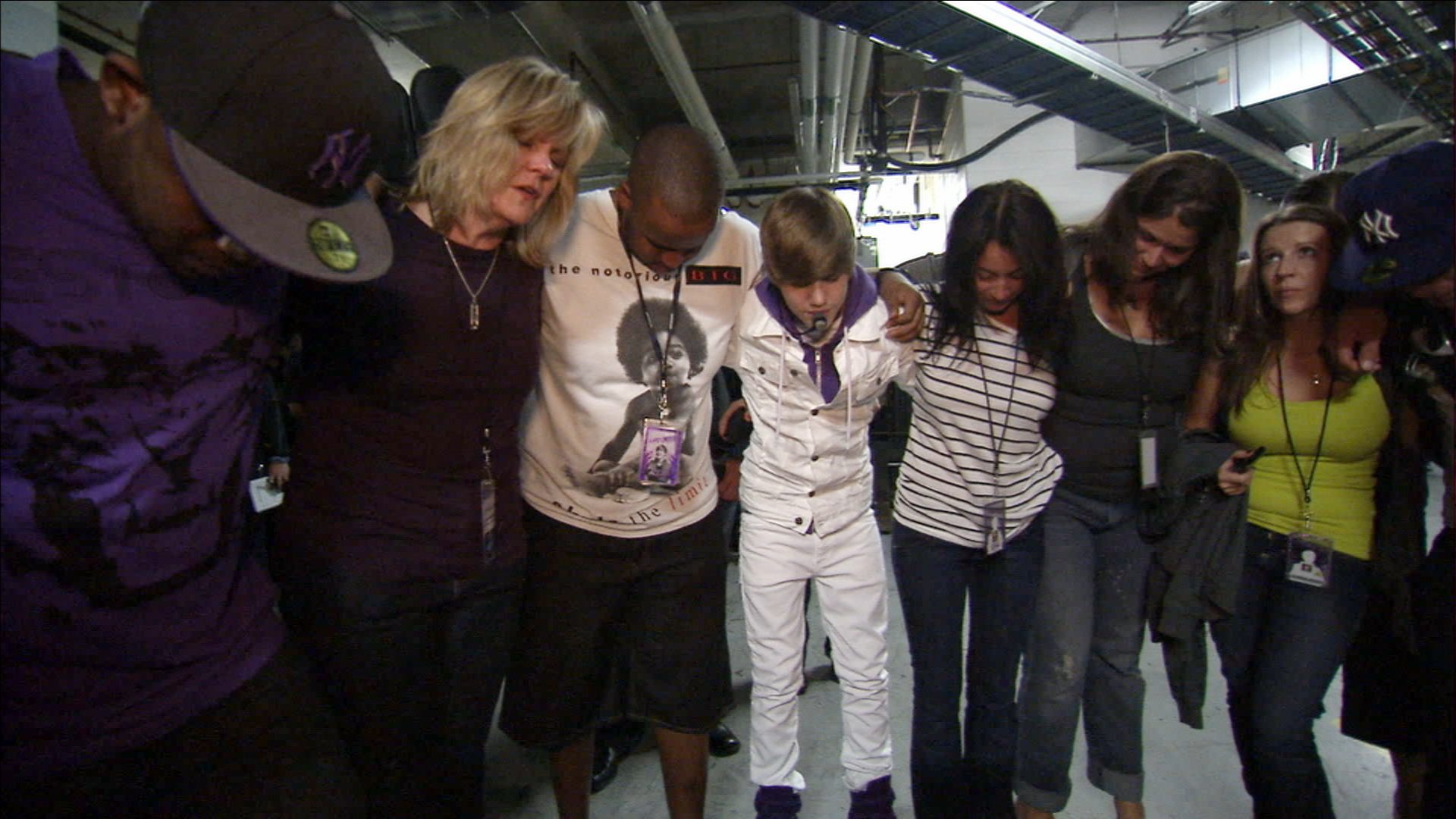
> The prayers of many surround Bieber, his family, and his traveling entourage. “You can never have enough prayer,” Mallette says. “I have a group of people that I ask to keep us covered in prayer.” She also notes that many fans she’s never met regularly pray for them. (At left, Bieber and tour members pray before a show.)
> “Justin is still discovering who he is and who God is,” according to Mallette. “He has faith in God, and God has hooks in his heart. . . . He definitely knows he is not here on his own merit. He can’t deny the unprecedented favor of God in such a short period of time. And he knows it’s for a purpose and a plan.”
> Justin’s “Pray” is his mom’s “all time favorite song. It’s so full of life and hope.” In the song, Bieber notes some of world’s woes (“children are crying, soldiers are dying, some people don’t have a home”) before praying “for the broken hearted, for the life not started, for all the ones not breathing, for all the souls in need.” It’s not great poetry, but it’s a catchy pop song with a good word from a nice kid who believes in Jesus, you know?
And here’s the movie trailer:
bieberpremiere on livestream.com. Broadcast Live Free