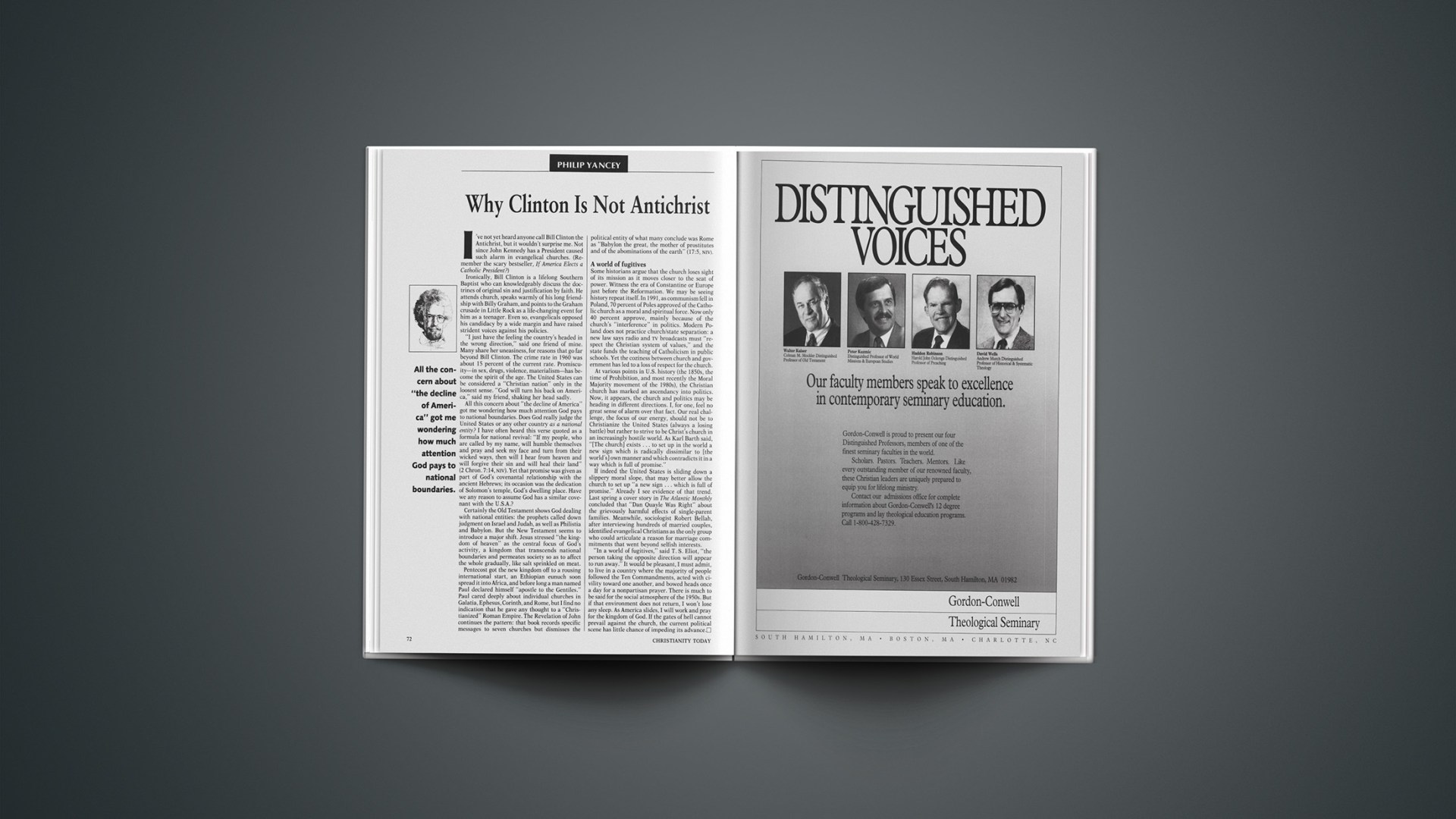

I’ve not yet heard anyone call Bill Clinton the Antichrist, but it wouldn’t surprise me. Not since John Kennedy has a President caused such alarm in evangelical churches. (Remember the scary bestseller, If America Elects a Catholic President?)
Ironically, Bill Clinton is a lifelong Southern Baptist who can knowledgeably discuss the doctrines of original sin and justification by faith. He attends church, speaks warmly of his long friendship with Billy Graham, and points to the Graham crusade in Little Rock as a life-changing event for him as a teenager. Even so, evangelicals opposed his candidacy by a wide margin and have raised strident voices against his policies.
“I just have the feeling the country’s headed in the wrong direction,” said one friend of mine. Many share her uneasiness, for reasons that go far beyond Bill Clinton. The crime rate in 1960 was about 15 percent of the current rate. Promiscuity—in sex, drugs, violence, materialism—has become the spirit of the age. The United States can be considered a “Christian nation” only in the loosest sense. “God will turn his back on America,” said my friend, shaking her head sadly.
All this concern about “the decline of America” got me wondering how much attention God pays to national boundaries. Does God really judge the United States or any other country as a national entity? I have often heard this verse quoted as a formula for national revival: “If my people, who are called by my name, will humble themselves and pray and seek my face and turn from their wicked ways, then will I hear from heaven and will forgive their sin and will heal their land” (2 Chron. 7:14, NIV). Yet that promise was given as part of God’s covenantal relationship with the ancient Hebrews; its occasion was the dedication of Solomon’s temple, God’s dwelling place. Have we any reason to assume God has a similar covenant with the U.S.A.?
Certainly the Old Testament shows God dealing with national entities: the prophets called down judgment on Israel and Judah, as well as Philistia and Babylon. But the New Testament seems to introduce a major shift. Jesus stressed “the kingdom of heaven” as the central focus of God’s activity, a kingdom that transcends national boundaries and permeates society so as to affect the whole gradually, like salt sprinkled on meat.
Pentecost got the new kingdom off to a rousing international start, an Ethiopian eunuch soon spread it into Africa, and before long a man named Paul declared himself “apostle to the Gentiles.” Paul cared deeply about individual churches in Galatia, Ephesus, Corinth, and Rome, but I find no indication that he gave any thought to a “Christianized” Roman Empire. The Revelation of John continues the pattern: that book records specific messages to seven churches but dismisses the political entity of what many conclude was Rome as “Babylon the great, the mother of prostitutes and of the abominations of the earth” (17:5, NIV).
A world of fugitives
Some historians argue that the church loses sight of its mission as it moves closer to the seat of power. Witness the era of Constantine or Europe just before the Reformation. We may be seeing history repeat itself. In 1991, as communism fell in Poland, 70 percent of Poles approved of the Catholic church as a moral and spiritual force. Now only 40 percent approve, mainly because of the church’s “interference” in politics. Modern Poland does not practice church/state separation: a new law says radio and TV broadcasts must “respect the Christian system of values,” and the state funds the teaching of Catholicism in public schools. Yet the coziness between church and government has led to a loss of respect for the church.
At various points in U.S. history (the 1850s, the time of Prohibition, and most recently the Moral Majority movement of the 1980s), the Christian church has marked an ascendancy into politics. Now, it appears, the church and politics may be heading in different directions. I, for one, feel no great sense of alarm over that fact. Our real challenge, the focus of our energy, should not be to Christianize the United States (always a losing battle) but rather to strive to be Christ’s church in an increasingly hostile world. As Karl Barth said, “[The church] exists … to set up in the world a new sign which is radically dissimilar to [the world’s] own manner and which contradicts it in a way which is full of promise.”
If indeed the United States is sliding down a slippery moral slope, that may better allow the church to set up “a new sign … which is full of promise.” Already I see evidence of that trend. Last spring a cover story in The Atlantic Monthly concluded that “Dan Quayle Was Right” about the grievously harmful effects of single-parent families. Meanwhile, sociologist Robert Bellah, after interviewing hundreds of married couples, identified evangelical Christians as the only group who could articulate a reason for marriage commitments that went beyond selfish interests.
“In a world of fugitives,” said T. S. Eliot, “the person taking the opposite direction will appear to run away.” It would be pleasant, I must admit, to live in a country where the majority of people followed the Ten Commandments, acted with civility toward one another, and bowed heads once a day for a nonpartisan prayer. There is much to be said for the social atmosphere of the 1950s. But if that environment does not return, I won’t lose any sleep. As America slides, I will work and pray for the kingdom of God. If the gates of hell cannot prevail against the church, the current political scene has little chance of impeding its advance.
Loren Wilkinson is the writer/editor of Earthkeeping in the ’90s (Eerdmans) and the coauthor, with his wife, Mary Ruth Wilkinson, of Caring for Creation in Your Own Backyard (Servant). He teaches at Regent College in Vancouver, British Columbia, Canada.