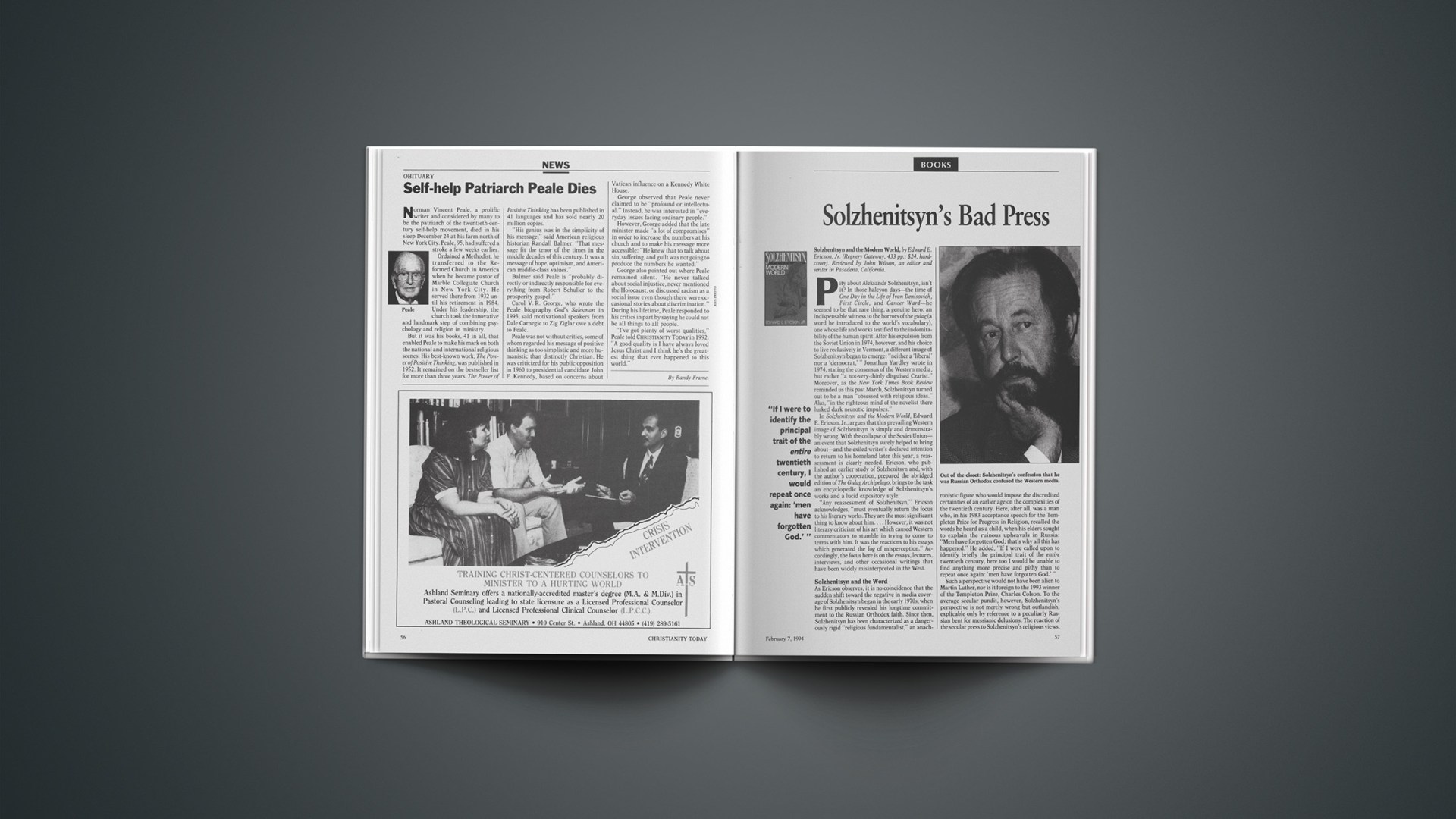
Norman Vincent Peale, a prolific writer and considered by many to be the patriarch of the twentieth-century self-help movement, died in his sleep December 24 at his farm north of New York City. Peale, 95, had suffered a stroke a few weeks earlier.
Ordained a Methodist, he transferred to the Reformed Church in America when he became pastor of Marble Collegiate Church in New York City. He served there from 1932 until his retirement in 1984. Under his leadership, the church took the innovative and landmark step of combining psychology and religion in ministry.
But it was his books, 41 in all, that enabled Peale to make his mark on both the national and international religious scenes. His best-known work, The Power of Positive Thinking, was published in 1952. It remained on the bestseller list for more than three years. The Power of Positive Thinking has been published in 41 languages and has sold nearly 20 million copies.
“His genius was in the simplicity of his message,” said American religious historian Randall Balmer. “That message fit the tenor of the times in the middle decades of this century. It was a message of hope, optimism, and American middle-class values.”
Balmer said Peale is “probably directly or indirectly responsible for everything from Robert Schuller to the prosperity gospel.”
Carol V. R. George, who wrote the Peale biography God’s Salesman in 1993, said motivational speakers from Dale Carnegie to Zig Ziglar owe a debt to Peale.
Peale was not without critics, some of whom regarded his message of positive thinking as too simplistic and more humanistic than distinctly Christian. He was criticized for his public opposition in 1960 to presidential candidate John F. Kennedy, based on concerns about Vatican influence on a Kennedy White House.
George observed that Peale never claimed to be “profound or intellectual.” Instead, he was interested in “everyday issues facing ordinary people.”
However, George added that the late minister made “a lot of compromises” in order to increase the numbers at his church and to make his message more accessible: “He knew that to talk about sin, suffering, and guilt was not going to produce the numbers he wanted.”
George also pointed out where Peale remained silent. “He never talked about social injustice, never mentioned the Holocaust, or discussed racism as a social issue even though there were occasional stories about discrimination.” During his lifetime, Peale responded to his critics in part by saying he could not be all things to all people.
“I’ve got plenty of worst qualities,” Peale told CHRISTIANITY TODAY in 1992. “A good quality is I have always loved Jesus Christ and I think he’s the greatest thing that ever happened to this world.”
By Randy Frame.